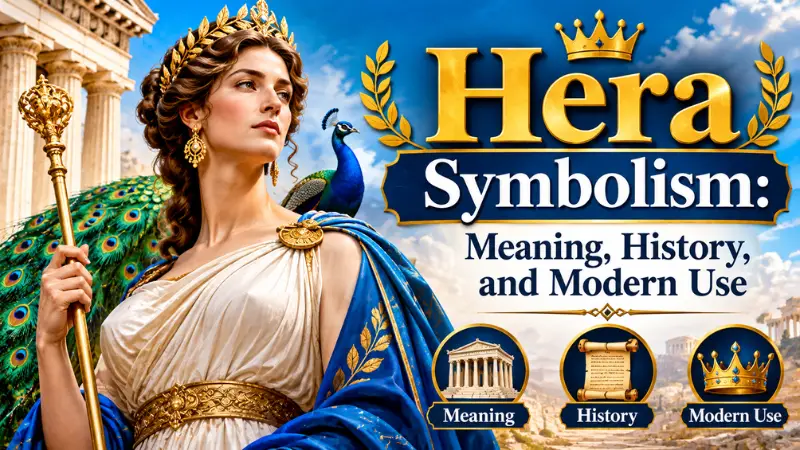
Hera symbolism is closely associated with marriage, feminine authority, loyalty, royalty, and the protection of family life. In ancient Greek mythology, Hera was the queen of the Olympian gods and the wife of Zeus, making her one of the most important female figures in the Greek religious tradition. Her image represented the dignity of marriage, the responsibilities of queenship, and the social importance of legitimate family relationships.
Today, Hera continues to appear in American literature, mythology-inspired artwork, jewelry, tattoos, fashion, and popular culture. Some people admire her as a symbol of feminine independence and authority, while others associate her with marital commitment, jealousy, or the complicated emotions that can develop within relationships.
Understanding Hera requires looking beyond her position as Zeus’s wife. Her mythology reflects ancient Greek ideas about marriage, power, family expectations, and the challenges faced by women living within patriarchal societies.
Quick Answer: What Does Hera Symbolize?
Hera symbolism commonly represents marriage, loyalty, feminine authority, queenship, and the protection of family relationships. Historically, she was worshipped as an important Greek goddess associated with marriage, women, legitimate heirs, and royal power, while her myths also explored jealousy, betrayal, dignity, and personal authority.
TL;DR: Key Meanings of Hera Symbolism
- Marriage: Represents commitment, partnership, and marital responsibilities.
- Queenship: Symbolizes authority, leadership, dignity, and social status.
- Feminine power: Reflects women’s influence, independence, and self-respect.
- Family: Connects with household relationships, legitimate heirs, and protection.
- Peacock: Represents beauty, pride, majesty, and royal identity.
- Mythology: Illustrates jealousy, betrayal, loyalty, and complicated relationships.
Who Was Hera in Greek Mythology?
Hera – Greek Goddess of Marriage and Queen of Olympus
„Die Unsterblichen“ in der Münchner Glyptothek: Diese Götter sind unsere Ebenbilder | FAZ
9
Hera was one of the twelve principal Olympian gods in ancient Greek mythology. She was the daughter of the Titans Cronus and Rhea and the sister and wife of Zeus, the ruler of Mount Olympus.
As queen of the gods, Hera occupied an important position in the divine hierarchy. She was particularly connected with marriage, married women, childbirth, and the legitimacy of children. Her responsibilities extended beyond her relationship with Zeus because she represented institutions that were central to ancient Greek society.
Hera also had a complicated personality in Greek stories. She could demonstrate intelligence, determination, dignity, and authority, but she was also portrayed as jealous and vengeful, particularly toward Zeus’s lovers and their children.
These conflicting characteristics make her an interesting mythological figure. She represents both the honored position of a queen and the emotional difficulties associated with betrayal, unequal relationships, and the struggle to maintain personal dignity.
Her Roman counterpart was Juno, who similarly became associated with marriage, women, and the protection of the Roman state.
The Main Symbolic Meanings of Hera
Hera represents several connected ideas. Although marriage is her most widely recognized association, her symbolism also includes political authority, feminine identity, family responsibilities, and emotional strength.
Here are her major symbolic meanings:
| Symbolic meaning | What it represents | Common association |
|---|---|---|
| Marriage | Commitment and partnership | Weddings and relationships |
| Queenship | Authority and leadership | Crowns and royal imagery |
| Feminine power | Dignity and self-respect | Women’s independence |
| Family protection | Legitimate family relationships | Household and children |
| Loyalty | Commitment and expectations | Trust and fidelity |
| Pride | Personal dignity and status | Peacock imagery |
These meanings are connected to Hera’s position in mythology and the religious practices of ancient Greek communities.
Importantly, not every interpretation comes directly from ancient worship. Modern readers sometimes reinterpret Hera as an emblem of independence or resistance to betrayal, reflecting contemporary values rather than a single traditional Greek belief.
Ancient Greek Origins of Hera Symbolism
Hera’s religious importance developed long before the classical period of ancient Greek civilization.
Her name appears in Mycenaean Linear B records, demonstrating that she was already known in the Bronze Age. Her worship became particularly prominent in regions such as Argos, Sparta, Mycenae, and Samos.
Some of her most important sanctuaries were major religious centers rather than small local shrines. The Heraion near Argos and the sanctuary on Samos demonstrate how significant her worship was to ancient Greek communities.
Her religious identity was connected with several important aspects of social life:
- Marriage ceremonies and marital relationships.
- The transition of women into married adulthood.
- The legitimacy of children and royal succession.
- The status and responsibilities of queens.
- The protection of women during important life stages.
Hera was not simply a mythological character created to explain Zeus’s marriage. She had an established religious identity, and different Greek communities developed their own traditions surrounding her.
This distinction matters because her symbolism was broader than the stories of her conflicts with Zeus.
Hera as a Symbol of Marriage and Commitment
Zeus and Hera Dome (detail) by Jeff Raum Studios in Los Angeles
Marriage is the most established symbolic association of Hera.
In Greek mythology, her marriage to Zeus represented the divine model of a recognized marital union. Their relationship was also connected with ancient ideas about family structure, inheritance, social legitimacy, and the responsibilities of spouses.
Greek communities honored Hera through religious ceremonies and festivals associated with marriage. One example was the Theogamia, a celebration connected with the divine marriage of Zeus and Hera.
However, her mythology presents an important contradiction. Although Hera represented marriage, her own relationship was marked by Zeus’s repeated infidelity.
This contradiction gives her symbolism additional meaning.
For modern readers, Hera can represent:
- The desire for a faithful relationship.
- The importance of mutual respect between partners.
- Commitment during difficult circumstances.
- The emotional consequences of betrayal.
- The difference between a public marriage and a healthy private relationship.
In contemporary American culture, someone might choose Hera-inspired jewelry or artwork to express appreciation for commitment and the importance of marriage.
Her story also reminds readers that commitment should not automatically be confused with tolerating disrespect.
The Peacock and Its Connection to Hera
Cesaretin simgesi: Hera – Med Gündem
The peacock is one of the most recognizable animals associated with Hera.
Its colorful feathers, elegant appearance, and distinctive display make it an appropriate visual representation of her royal status. In later Greek and Roman artistic traditions, the bird became especially closely associated with the goddess.
The peacock commonly represents:
Royalty and status: Its impressive appearance connects with Hera’s position as queen of the gods.
Beauty and elegance: Its colorful feathers suggest visual refinement and dignity.
Pride: The bird’s display can represent confidence, self-importance, and awareness of one’s position.
Watchfulness: The eye-like patterns on its feathers have encouraged later interpretations involving observation and awareness. These associations should be understood as later symbolic readings rather than a universal ancient Greek doctrine.
In American decorative culture, peacock imagery sometimes appears in mythology-inspired paintings, home accessories, fashion, and tattoos.
When paired with a crown or an image of Hera, the peacock generally reinforces ideas of feminine royalty, beauty, and authority.
The Crown and Scepter: Symbols of Queenship
The Goddess Hera’s Place in Ancient Greek Mythology – GreekReporter.com
Hera is frequently represented wearing a crown or diadem and holding a royal scepter.
These objects communicate her position within the Olympian hierarchy. They are not simply decorative accessories; they identify her as a goddess with recognized authority and royal dignity.
The crown represents sovereignty, status, and leadership. The scepter reinforces the idea of legitimate authority and the responsibility that comes with holding power.
Together, these objects make Hera a symbol of:
- Leadership and responsibility.
- Personal dignity.
- Social recognition.
- Feminine authority.
- Confidence and self-respect.
Modern artists sometimes use Hera’s crown and scepter to represent women who hold positions of influence or refuse to diminish their authority.
In this interpretation, Hera becomes an image of a woman who understands her worth and expects to be treated with respect.
Hera and Feminine Power
Hera’s mythology offers a complicated picture of feminine power.
She was a queen who possessed influence, intelligence, and the ability to challenge other gods. Although Zeus held greater authority in many myths, Hera was not simply a passive figure.
She questioned decisions, formed alliances, developed strategies, and sometimes attempted to challenge her husband’s control.
Her position makes her relevant to modern conversations about women’s identity and authority.
In the United States, Hera is sometimes interpreted through contemporary ideas about female empowerment. Her crown can represent leadership, while her determination can symbolize refusing to accept disrespect.
However, it is important not to present her as a straightforward modern feminist icon. Ancient Greek society was patriarchal, and Hera’s traditional religious role was closely connected with marriage and family institutions.
Her modern interpretation is therefore a reinterpretation of an ancient figure.
For some people, Hera represents a woman who wants recognition within an established relationship. For others, she symbolizes the need to establish boundaries and protect personal dignity.
Both readings reflect different aspects of her mythology.
Hera Symbolism in Ancient Greek Art and Worship
Samos Island, Greece – June 18, 2023, statue of Hera at Samos, Heraion Ancient City – Greece
The Heraion of Argos – Archaeology Wiki
7
Hera’s symbolism was expressed through temples, sculptures, religious ceremonies, and sacred objects.
Ancient Greek artists commonly portrayed her as a mature, dignified woman with a crown or veil. Her appearance communicated authority rather than the youthful romantic beauty usually associated with Aphrodite.
One of the most famous representations was the monumental statue of Hera created by the sculptor Polykleitos for her sanctuary near Argos. Ancient descriptions portray her as an impressive seated figure with royal attributes.
Her sanctuaries also played an important role in public religious life.
At Olympia, a temple dedicated to Hera was among the early monumental buildings of the sanctuary. At Samos, her sanctuary became an important religious center.
These places demonstrate that her significance was not limited to domestic relationships. She was honored publicly as a goddess whose authority extended into community identity and religious life.
Her worship also varied between locations. Different cities emphasized different aspects of her divine character.
Hera Symbolism in the United States
Hera does not have the same everyday cultural visibility in the United States as figures such as Athena, Aphrodite, or Zeus. Nevertheless, she remains recognizable through classical mythology, educational materials, literature, entertainment, and modern artistic interpretations.
American audiences generally encounter her symbolism in several contexts.
Education and classical mythology
Hera appears in American school curricula, mythology books, university courses, and educational resources. She is often introduced as the queen of the gods and the goddess of marriage.
Literature and entertainment
Greek mythology continues to influence American fantasy novels, television, films, and video games. Hera frequently appears as a royal or influential divine character.
Women’s identity and empowerment
Some contemporary interpretations emphasize her authority, confidence, and refusal to accept disrespect. These readings often connect her with modern discussions about self-worth and relationship boundaries.
Weddings and relationship symbolism
Hera’s historical association with marriage makes her relevant to mythology-inspired wedding artwork, decorative objects, and personal gifts.
Art and interior design
Her peacock, crown, and classical portrait imagery can be used in elegant or historically inspired decorative styles.
Unlike symbols such as the American flag or the bald eagle, Hera does not have a standardized national meaning in the United States. Her significance depends largely on the context in which she appears.
The Emotional and Psychological Meaning of Hera
Hera’s mythology explores emotions that remain familiar to modern readers.
Her stories involve loyalty, jealousy, disappointment, pride, anger, and the desire for recognition. These feelings make her more psychologically complicated than a goddess whose identity is limited to one positive quality.
Her emotional symbolism can be understood through several themes.
The need for recognition: Hera’s position as queen does not prevent her from experiencing disrespect. Her stories reflect the desire to have one’s contributions and status acknowledged.
The pain of betrayal: Zeus’s repeated affairs create a recurring source of conflict. Hera can therefore represent the emotional consequences of broken trust.
The protection of personal dignity: Her royal identity suggests that a person’s worth should not depend entirely on another person’s behavior.
The difficulty of controlling emotions: Her anger and revenge demonstrate how jealousy can lead to destructive decisions.
From a psychological perspective, Hera’s stories can encourage reflection on the difference between healthy boundaries and attempts to control another person.
Her mythology does not provide a modern psychological diagnosis or a universal relationship formula. Instead, it presents recognizable emotional conflicts through the language of ancient storytelling.
Hera Symbolism in Tattoos, Jewelry, and Modern Design
13
Hera-inspired designs appeal to people who appreciate Greek mythology, classical art, and symbols of feminine authority.
Her visual attributes offer several possibilities for personal expression.
Hera tattoos
A tattoo featuring Hera can represent marriage, feminine identity, confidence, royalty, or personal dignity. The intended meaning often depends on the accompanying imagery.
Peacock tattoos
A peacock associated with Hera may communicate beauty, pride, elegance, and self-confidence. It can also reflect an interest in classical mythology.
Crown jewelry
A crown-inspired pendant or ring can represent leadership, self-respect, and personal authority. When connected with Hera, it adds a mythological reference.
Classical home decor
Hera portraits, peacock artwork, and Greek-inspired sculptures can create a traditional or historically influenced decorative style.
Fashion and accessories
Gold details, feather patterns, and classical goddess imagery may evoke Hera’s royal appearance.
Not every peacock design or crown represents Hera specifically. The association becomes clearer when the design includes recognizable mythological references.
Hera’s Sacred Animals, Plants, and Objects
Several animals and objects appear in traditional descriptions of Hera. Each offers a different way of understanding her religious and artistic identity.
Hera Greek Gods’ Queen – Mythology Vault
The cow: The cow, particularly the heifer, was sacred to Hera. It was associated with her ancient religious identity and appears in Homeric descriptions of the goddess. The animal should not be reduced to a single modern meaning such as motherhood.
The peacock: This is her best-known later artistic association, representing royal beauty, pride, and majesty.
The cuckoo: The bird appears in traditions concerning Zeus’s courtship of Hera. In one well-known story, Zeus approached her in the form of a cuckoo.
The pomegranate: This fruit appears among Hera’s traditional attributes and is associated with marriage, fertility, and the continuation of family life.
The scepter: It represents divine authority, royal position, and leadership.
The crown or diadem: These objects communicate sovereignty, honor, and status.
The meanings of these objects developed through mythology, artistic conventions, and local religious traditions. Their interpretations are not identical across every period or community.
Hera’s Relationship With Zeus and the Symbolism of Betrayal
Hera’s marriage to Zeus is central to her mythology, but their relationship is far from an uncomplicated romantic ideal.
Zeus repeatedly pursued relationships with other women, including goddesses and mortals. These affairs produced children who frequently became targets of Hera’s anger.
Her conflicts with figures such as Heracles and Leto demonstrate the consequences of these relationships within Greek mythological storytelling.
Hera’s reactions were often severe, and some stories portray her as pursuing revenge against people who were not responsible for Zeus’s behavior.
This creates an important distinction between her traditional role as a protector of marriage and her actions within individual myths.
Modern readers may interpret her story as a representation of:
- Broken trust within a relationship.
- The emotional consequences of infidelity.
- Anger resulting from unequal treatment.
- The struggle to maintain personal dignity.
- The destructive effects of jealousy and revenge.
Her mythology is not simply a celebration of marital loyalty. It also shows what can happen when loyalty is demanded without reciprocal respect.
Hera in Other Cultures and Religious Traditions
Hera’s original identity belongs to ancient Greek religion, but related ideas developed in Roman religious traditions.
The Romans identified her with Juno, an important goddess associated with marriage, women, and the protection of the Roman community.
Juno held a particularly prominent position in Roman public religion. She was not merely a different name for a Greek character; Roman worship gave her a distinct place within Roman political and religious life.
Hera is also sometimes compared with other female divine figures, although these comparisons should be made carefully.
For example, the Egyptian goddess Isis was associated with motherhood, protection, and royal legitimacy. Certain aspects of their symbolism overlap, but their mythologies and religious identities are different.
Similarly, the Hindu goddess Parvati has associations with marriage and divine partnership, but she belongs to a separate religious tradition with its own theology and cultural history.
These comparisons can help readers recognize shared human concerns surrounding marriage, family, and feminine authority without suggesting that all goddesses represent the same beliefs.
Common Misunderstandings About Hera Symbolism
Hera’s mythology is frequently simplified in modern retellings. Some interpretations focus entirely on her jealousy, while others present her as an uncomplicated symbol of feminine empowerment.
Both approaches overlook important details.
Misunderstanding 1: Hera only represents jealousy.
Jealousy is part of her mythology, but her religious identity also includes marriage, queenship, women’s life stages, and family legitimacy.
Misunderstanding 2: Hera represents a perfect marriage.
Her marriage to Zeus was filled with conflict and infidelity. She represents the institution of marriage, but her own relationship was not an ideal example of mutual commitment.
Misunderstanding 3: Hera was powerless against Zeus.
Zeus held superior authority, but Hera exercised considerable influence and sometimes openly challenged him. Her position was complicated rather than entirely powerless.
Misunderstanding 4: The peacock was her only important symbol.
The peacock is especially recognizable in later artistic traditions, but ancient descriptions also connect her with the cow, cuckoo, pomegranate, crown, and scepter.
Misunderstanding 5: Hera is a modern feminist symbol by historical definition.
Contemporary audiences may interpret her through feminist ideas, but these are modern readings of a goddess whose original religious roles developed within ancient Greek society.
Separating ancient beliefs from modern interpretations makes Hera’s symbolism more meaningful and historically accurate.
How Hera’s Symbolism Has Changed Over Time
Hera’s symbolic identity has evolved through different historical periods.
In Bronze Age Greece, she was already a recognized goddess, although the details of her early worship remain limited.
During the Archaic and Classical periods, her religious importance became especially visible through major sanctuaries, public festivals, sculptures, and associations with marriage and royal authority.
Roman religion subsequently connected her with Juno, giving her related but distinct meanings within Roman society.
During the Renaissance and later European artistic periods, classical mythology returned as an important source of inspiration. Hera appeared in paintings, sculptures, and decorative art, often emphasizing her position as queen of the gods.
In modern American culture, her image has become more varied.
Some audiences recognize her through mythology education and entertainment. Others use her imagery to communicate confidence, feminine authority, or interest in classical traditions.
The most important change is that modern interpretations increasingly focus on her individual identity rather than only her relationship with Zeus.
Her mythology remains historically rooted in marriage and queenship, but contemporary audiences can also use her story to examine loyalty, boundaries, and personal dignity.
FAQs
1. What does Hera symbolize spiritually?
Hera is commonly interpreted as a symbol of marriage, loyalty, feminine authority, and family protection. In modern spiritual interpretations, she may also represent self-respect, relationship boundaries, and the importance of commitment. These personal interpretations should be distinguished from historical Greek religious beliefs.
2. What does Hera symbolize in a tattoo?
A Hera tattoo can represent feminine strength, marriage, confidence, royalty, or personal dignity. A peacock design emphasizes beauty and royal identity, while a crown or scepter highlights authority and leadership. The meaning depends on the design and the wearer’s personal connection to her mythology.
3. Why is the peacock associated with Hera?
The peacock became one of Hera’s best-known sacred animals in Greek and Roman artistic traditions. Its impressive feathers and regal appearance complemented her identity as queen of the gods. It is now commonly used in Hera-inspired artwork and decorative designs.
4. Is Hera a symbol of female empowerment?
Hera can represent feminine authority, confidence, and the refusal to accept disrespect. Modern audiences sometimes interpret her challenges to Zeus as expressions of female independence. However, this is a contemporary interpretation rather than the complete meaning of her ancient religious role.
5. What does Hera’s crown symbolize?
Hera’s crown represents her royal position, dignity, sovereignty, and authority among the Olympian gods. In modern designs, it can also communicate leadership, confidence, and self-respect.
6. Is Hera a positive or negative symbol?
Hera has both positive and negative symbolic associations. Marriage, loyalty, protection, and authority are positive interpretations, while jealousy, revenge, and marital conflict represent more difficult aspects of her mythology. Her overall meaning depends on which part of her story is being emphasized.
7. What is the difference between Hera and Juno?
Hera is the Greek goddess of marriage and queen of the Olympian gods, while Juno is her Roman counterpart. Although the Romans identified the two goddesses, Juno developed her own religious and political significance within Roman culture
Conclusion
Hera represents marriage, queenship, feminine authority, family responsibilities, and the complicated emotions that develop within relationships. Her mythology offers more than an image of a powerful goddess standing beside Zeus. It reveals the importance of social status, personal dignity, loyalty, and the challenges associated with maintaining relationships.
In modern American culture, Hera can symbolize confidence, commitment, independence, and self-respect. Her peacock, crown, and scepter continue to provide recognizable imagery for tattoos, jewelry, artwork, and mythology-inspired design.
Ultimately, Hera symbolism is most meaningful when its different dimensions are considered together. She represents the dignity associated with commitment, the responsibilities of authority, and the emotional complexity of being respected within a relationship.