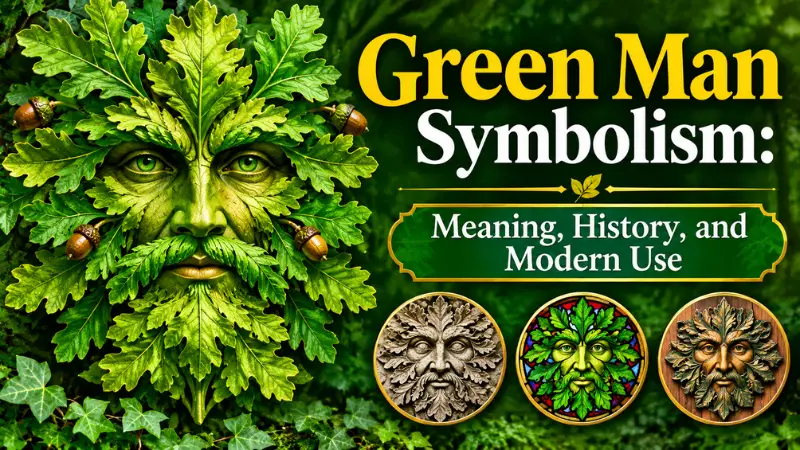
The Green Man is a distinctive figure in folklore and decorative art, usually represented as a human face surrounded by leaves, branches, vines, or other forms of vegetation. In some depictions, leaves grow directly from the mouth, eyes, or forehead, making the figure appear as though the human body and the natural world have become one.
Green Man symbolism is commonly associated with nature, renewal, fertility, seasonal change, and humanity’s relationship with the environment. Its imagery appears in medieval European churches, traditional folklore, contemporary spiritual practices, and modern environmental artwork.
Although the Green Man is often described as an ancient pagan nature god, his history is more complicated. Similar leafy faces existed in ancient art, while the recognizable Green Man tradition developed through several different cultural and artistic settings. Historians have not established one universal origin or meaning for every example.
In the United States, the figure is particularly recognizable in nature-inspired artwork, pagan and earth-centered spirituality, garden decoration, and contemporary discussions about environmental responsibility. Understanding its history helps distinguish documented traditions from modern interpretations.
Quick Answer
Green Man symbolism commonly represents nature, renewal, fertility, and humanity’s connection to the natural world in modern American culture. Historically, leafy human figures appeared in ancient and medieval art, where they acquired different associations with seasonal life, Christian themes, folklore, and the relationship between humanity and vegetation.
TL;DR
- Nature: Represents humanity’s connection with plants, forests, and the living environment.
- Renewal: Reflects seasonal change, regrowth, and the return of life.
- Historical roots: Combines ancient leafy imagery with medieval European artistic traditions.
- Spirituality: Appears in contemporary pagan and earth-centered practices.
- American culture: Features in environmental art, garden decoration, and nature-inspired design.
- Personal meaning: Can express ecological awareness, growth, and respect for the natural world.
What Does the Green Man Look Like?
The Green Man | CQ2 | Ed Murphy
Green Man Connections: The Foliate Head | Folklife Today
Medal, Contemporary Bronze Sculpture, 21st Century. | Vinterior
15
The Green Man is usually depicted as a human face or head connected to vegetation. Its appearance varies considerably depending on the artist, historical period, and cultural setting.
Common visual features include:
- Leaves growing from the mouth: Vegetation emerges from the lips, suggesting a connection between human expression and plant life.
- Leaf-covered faces: Branches and foliage surround or partially conceal the human features.
- Vine-like hair: Twisting stems, flowers, and leaves form the figure’s hair or beard.
- Tree-like facial features: The eyes, nose, and mouth appear integrated with natural forms.
- Seasonal vegetation: Some representations include flowers, berries, oak leaves, or other plants associated with particular seasons.
The figure is sometimes portrayed as youthful and peaceful, while other versions have an older, rugged, or intimidating appearance.
In historical European architecture, these images are commonly called foliate heads. They appear on stone capitals, corbels, doorways, wooden carvings, and decorative architectural elements.
The important visual characteristic is the combination of a recognizable human face with growing vegetation. This combination explains why contemporary viewers often interpret the figure as a representation of nature and human life existing together.
The Core Symbolic Meanings of the Green Man
The Green Man does not have one universally accepted meaning. Its interpretation depends on the historical setting and the person using the image. Nevertheless, several associations appear frequently in modern symbolism.
1. Connection With Nature
The most recognizable modern meaning is the relationship between humanity and the natural environment.
The Green Man combines a human face with leaves and branches, visually suggesting that people are part of nature rather than separate from it. His appearance challenges the distinction between human civilization and the wilderness.
For Americans, this interpretation can connect with national parks, forests, gardening, conservation, and outdoor traditions. Someone who displays a Green Man sculpture in a garden may be expressing appreciation for plants, wildlife, and ecological balance.
2. Renewal and Rebirth
Plants change throughout the year. Trees lose their leaves, remain dormant during colder months, and produce fresh growth when conditions become favorable.
The Green Man’s leafy appearance makes him a natural image for seasonal renewal.
In modern interpretations, he can represent:
- Recovering after a difficult period.
- Beginning a new chapter in life.
- Developing healthier habits.
- Rebuilding confidence.
- Finding opportunities after change.
This association is especially common in contemporary spiritual artwork and personal decorative objects.
3. Fertility and Growth
Fertility symbolism is another recurring interpretation. In this context, fertility does not refer exclusively to human reproduction.
It can describe the ability of the natural world to produce new life, sustain ecosystems, and support continuing growth.
The Green Man’s connection with vegetation makes him suitable for representing fertile soil, productive gardens, flourishing forests, and agricultural abundance.
Some modern pagan traditions also associate the figure with fertility deities and seasonal celebrations. However, these interpretations should not automatically be treated as proof that every medieval Green Man carving represented a fertility god.
4. The Changing Seasons
The Green Man is frequently connected with the seasonal cycle.
Spring represents emerging growth, summer suggests abundance, autumn brings maturity and falling leaves, and winter represents dormancy.
His changing natural surroundings can therefore symbolize the idea that life involves periods of activity, rest, decline, and renewal.
This interpretation also offers a practical perspective on human experiences. Not every period of life involves visible progress, just as plants do not grow continuously throughout the year.
Ancient Roots and Medieval Origins
Chapiteau corinthien à tête de feuillage – La villa de Chiragan
villachiragan.saintraymond.toulouse.fr
Leaf-covered faces and human figures surrounded by vegetation existed in artistic traditions long before the modern Green Man became a recognizable symbolic category.
Ancient Mediterranean artists used plant ornamentation in architecture, sculpture, and decorative objects. Roman artistic traditions, for example, frequently incorporated foliage, vines, and acanthus leaves into architectural designs.
However, the existence of ancient leafy imagery does not establish an uninterrupted tradition of worshipping a specific deity called the Green Man.
During the medieval period, foliate heads became familiar decorative features in European religious architecture. Examples can be found in churches and cathedrals, particularly in Britain and other parts of Europe.
These carvings sometimes show human faces surrounded by leaves or vegetation emerging from the mouth.
Their precise meanings remain uncertain. Some may have carried religious associations, while others may have served decorative purposes. Interpretations involving Christ, resurrection, nature, sin, and seasonal life have all been proposed.
The distinction matters because medieval artists did not leave a single explanation that applies to every example.
The modern understanding of the Green Man developed partly through later folklore studies, architectural interpretation, and the growing interest in nature-based spirituality.
Why the Green Man Appears in Medieval Churches
Green Man Connections: The Foliate Head | Folklife Today
Green Man Sculpture at Southwell Chapter House
17
One of the most interesting aspects of the Green Man is his appearance in Christian buildings.
Medieval churches sometimes included decorative faces with leaves emerging from their mouths or surrounding their heads. These images existed alongside religious figures, biblical scenes, animals, and ornamental plant designs.
Several interpretations have been suggested:
- Creation: Vegetation may have represented the natural world as part of God’s creation.
- Resurrection: The repeated appearance of new growth after winter could provide a visual comparison with Christian resurrection.
- Human weakness: Some interpretations connect unusual foliage-emitting faces with sin, disorder, or the consequences of human behavior.
- Decoration: Certain carvings may simply have been artistic expressions of the medieval interest in natural forms.
There is no reliable evidence that all these carvings had the same religious purpose. Some may have carried recognizable symbolic meanings to medieval viewers, while others may have been ornamental.
This history also challenges the popular claim that Green Man images were necessarily pagan objects secretly placed inside Christian churches. Their presence in religious architecture demonstrates that vegetation imagery could exist comfortably within different artistic and religious contexts.
The Green Man in European Folklore
A Wild Man Of The Woods by Science Photo Library
The Green Man’s history is not limited to church architecture. Related figures appeared in European pageants, seasonal customs, public celebrations, and folklore.
Historical records from England use the expression Green Man for leaf-covered or woodland-associated human figures involved in public festivities. These figures were sometimes known as wild men or woodwoses.
They could appear dressed in greenery, carrying branches, or wearing leafy costumes. Their appearance connected them with wilderness, seasonal celebrations, and the contrast between cultivated society and untamed nature.
Some interpretations also associate Green Man traditions with Robin Hood, the Green Knight of medieval literature, and other woodland figures. These connections are historically debated rather than established as one continuous tradition.
Another related figure is Jack-in-the-Green, a character associated with May Day celebrations in England. Traditionally, a person was concealed inside a large structure covered with leaves and greenery.
Although these figures share natural imagery, they should not automatically be considered identical characters. Their histories developed in different contexts.
The Library of Congress’s folklife research documents how the name and imagery evolved across pageantry, folklore, architecture, and modern environmental movements. Folklife Today+2
What the Green Man Symbolizes in the United States
STONE GARDEN ACORN LEAF GREEN MAN WALL PLAQUE ORNAMENT – Ferney Heyes Garden Products
In the United States, the Green Man is primarily understood through contemporary interpretations of nature, environmental awareness, folklore, and earth-centered spirituality.
Unlike symbols such as the bald eagle or the Statue of Liberty, the Green Man is not a traditional national emblem. His presence in American culture is more closely associated with individual interests, artistic communities, and spiritual practices.
Several interpretations are particularly relevant.
Environmental responsibility: The figure can represent the importance of protecting forests, maintaining healthy ecosystems, and recognizing humanity’s dependence on the natural environment.
Appreciation of wilderness: For people who enjoy hiking, gardening, camping, and outdoor recreation, the Green Man can represent a personal connection with the land.
Seasonal celebrations: Some Americans incorporate Green Man imagery into spring festivals, May Day gatherings, and other nature-oriented celebrations.
Spiritual identity: Contemporary pagan and earth-centered communities may use the figure to express reverence for natural cycles and the living world.
Artistic expression: Sculptures, wall decorations, illustrations, and garden ornaments use his distinctive face to introduce natural imagery into everyday spaces.
His American meaning is therefore not fixed. A gardener may see him as a symbol of flourishing plants, while an environmental artist may use him to question humanity’s treatment of the planet.
Green Man Symbolism Across Different Cultural and Religious Traditions
The Green Man is primarily associated with European artistic and folkloric traditions, but similar combinations of human faces and vegetation appear in other cultural settings.
It is important to distinguish visual similarities from direct historical relationships.
Ancient Greek and Roman Traditions
Ancient Greek and Roman art frequently connected vegetation with divine figures, seasonal cycles, and agricultural abundance.
The Roman god Silvanus was associated with forests, fields, and uncultivated land. Other classical figures, including Dionysus and his Roman counterpart Bacchus, were connected with vegetation, growth, and seasonal celebration.
Some ancient foliate faces also resemble medieval Green Man carvings.
These similarities help explain the broader history of vegetation imagery, but they do not establish that the medieval Green Man was simply a surviving image of one particular classical god.
Celtic and British Folklore
The Green Man’s Garden | Crow Moon
Modern interpretations often associate the Green Man with Celtic spirituality and ancient British woodland traditions.
The connection is understandable because forests, sacred landscapes, seasonal festivals, and vegetation held important places in many pre-Christian European traditions.
However, there is no established historical evidence identifying a single ancient Celtic deity known universally as the Green Man.
Contemporary Celtic-inspired spiritual practices may adopt the image as a representation of woodland life, natural cycles, and respect for the earth. These are modern interpretations rather than definitive descriptions of ancient Celtic religious beliefs.
Christian Interpretations
Christian interpretations connect the Green Man’s vegetation with creation, resurrection, and the relationship between humanity and God.
The medieval Christian concept of viriditas, associated particularly with the writings of Hildegard of Bingen, describes greenness or flourishing vitality in spiritual and natural life.
This concept offers a useful way of understanding why vegetation could carry positive spiritual associations within medieval Christianity.
It does not mean that every foliate head represented viriditas, but it demonstrates that greenery had meaningful religious associations beyond pagan worship.
Green Man Symbolism in Modern Spirituality
In contemporary spirituality, the Green Man often represents the living natural world and the relationship between human beings and the changing seasons.
Some modern pagan traditions interpret him as a masculine nature figure associated with fertility, vegetation, growth, and the annual cycle.
In certain seasonal spiritual systems, the figure may represent the changing stages of the natural year. Spring and summer emphasize growth and abundance, while autumn and winter suggest maturity, decline, and dormancy.
Other people use the Green Man without following a particular religion. For them, the image may simply express:
- Respect for the environment.
- Interest in woodland folklore.
- Appreciation of natural beauty.
- A desire to live more sustainably.
- Spiritual connection with seasonal change.
These interpretations are valid examples of modern symbolic use. They should not be confused with proof of a single ancient religious tradition.
Emotional and Psychological Meaning of the Green Man
The Green Man’s appearance combines two familiar ideas: the human face and the natural environment.
This combination can create a sense of belonging, reminding viewers that human life depends on the same natural systems that support forests, plants, animals, and agriculture.
His symbolism can also connect with several emotional experiences.
Feeling grounded: The figure may remind someone to slow down, spend time outdoors, and reconnect with everyday surroundings.
Personal recovery: New leaves emerging after winter provide an accessible image of recovery following loss, uncertainty, or difficult experiences.
Acceptance of change: Seasonal imagery suggests that different stages of life have different purposes. Rest and transition are not necessarily signs of failure.
Environmental concern: The human face surrounded by vegetation can encourage reflection on the consequences of pollution, deforestation, and habitat destruction.
Belonging: For people who feel emotionally connected to forests, gardens, or particular landscapes, the Green Man can represent a sense of place and identity.
These are symbolic and psychological interpretations, not scientifically established effects of displaying or encountering the image.
Green Man Symbolism in Tattoos, Jewelry, and Personal Style
Tattoo leszy | Green man tattoo, Tattoos for guys, Slavic tattoo
Green Man Pendant With Open Eyes in Sterling Silver or Antique Bronze – Le Dragon Argenté
13
The Green Man’s distinctive appearance makes him suitable for personal artwork and decorative objects.
People who choose this imagery often appreciate its combination of human features, natural patterns, and folklore.
Green Man Tattoos
A Green Man tattoo can communicate environmental appreciation, personal growth, renewal, or interest in mythology.
Some people choose a traditional leafy face, while others prefer an artistic interpretation featuring tree branches, flowers, roots, or vines.
The placement and artistic style can influence its presentation, but there is no universal tattoo meaning.
Jewelry and Pendants
Green Man pendants, rings, and necklaces often appeal to people interested in nature-inspired accessories.
A small leafy face can serve as a personal reminder of environmental responsibility, seasonal change, or an individual’s connection with the outdoors.
Materials such as wood, bronze, silver, and copper can reinforce the natural or historical appearance.
Clothing and Accessories
The figure also appears in printed shirts, scarves, bags, and handmade accessories.
Some designs emphasize medieval folklore, while others use a more contemporary botanical style.
For some wearers, the image is primarily decorative. For others, it communicates an interest in environmental protection or alternative spiritual traditions.
Green Man Symbolism in Gardens, Homes, and Interior Design
STONE GARDEN LEAFY TREE GREEN MAN LEAF FACE WALL PLAQUE PAGAN WICCAN – Ferney Heyes Garden Products
Green Man Garden Wall Water Fountain
13
Garden decoration is one of the most natural settings for the Green Man.
His leafy appearance works particularly well among trees, climbing plants, stone pathways, water features, and flower beds.
In American homes, he may appear as:
- A stone or ceramic garden statue.
- A carved wooden wall ornament.
- A bronze outdoor sculpture.
- A decorative fountain.
- A botanical wall hanging.
- A nature-inspired fireplace or architectural detail.
The figure can also contribute to different interior design styles.
In rustic spaces, wood and stone versions complement natural materials. In traditional interiors, carved foliage creates a connection with medieval architectural decoration. In contemporary spaces, simplified leafy faces can introduce organic shapes without making the room appear overly traditional.
For many homeowners, the Green Man is both an artistic decoration and a reminder of the importance of the natural world.
The Green Man in Environmental Movements and Modern Culture
Green Man: O Significado do Homem Verde e o Espírito da Floresta – Arte e Sintonia
One of the most important developments in the Green Man’s modern history is his adoption as an environmental symbol.
During the late twentieth century, particularly around the 1980s, the figure became associated with environmentalist movements and renewed interest in humanity’s relationship with nature.
His visual form offered an accessible way to communicate ecological ideas. Instead of presenting environmental responsibility through statistics or technical explanations, artists could use a human face made of leaves to suggest that nature and humanity belong together.
Today, this interpretation appears in several settings:
- Environmental artwork and public sculpture.
- Nature festivals and woodland events.
- Garden and conservation projects.
- Contemporary pagan gatherings.
- Illustrations about ecological responsibility.
- Fantasy literature and nature-inspired entertainment.
The image has also appeared in prominent public design. In 2023, a Green Man figure featured centrally in the invitation design for the coronation of King Charles III in the United Kingdom.
This public appearance renewed discussion about its historical, religious, and ecological interpretations.
The figure’s environmental meaning is distinctly modern. It should not be presented as an established medieval ecological movement. Rather, contemporary audiences have adapted older imagery to address present-day concerns about the natural world. Folklife Today+1
Positive and Negative Interpretations of the Green Man
The Green Man is generally viewed positively in contemporary nature-based symbolism, although his meaning can change depending on the context.
| Context | Positive Meaning | Possible Negative Association | Notes |
|---|---|---|---|
| Nature | Environmental awareness and harmony | Uncontrolled wilderness | Reflects humanity’s relationship with nature |
| Renewal | Recovery and fresh beginnings | Loss and decay | Connected with seasonal change |
| Fertility | Growth and abundance | Excess or uncontrolled growth | Appears in modern fertility symbolism |
| Spirituality | Reverence for the natural world | Misrepresentation of ancient beliefs | Interpretations vary between traditions |
| Folklore | Woodland identity and cultural heritage | Fear of the wilderness | Related to European wild-man imagery |
A positive interpretation usually emphasizes growth, environmental responsibility, and the continuity of life.
A darker interpretation may focus on the untamed wilderness, the unpredictability of nature, or the decline of human control over the environment.
Neither interpretation is universal. The Green Man’s expression, surrounding imagery, and cultural setting all influence how viewers understand him.
Common Misunderstandings About the Green Man
Several popular explanations simplify the Green Man’s history too much.
Misunderstanding 1: The Green Man was one ancient pagan god.
There is no convincing historical evidence establishing a single ancient deity universally known by this name. The imagery developed through multiple artistic and folkloric traditions.
Misunderstanding 2: Every medieval Green Man carving was pagan.
Foliate heads appeared in Christian buildings. Some may have carried Christian meanings, while others may have been decorative. Their presence alone does not establish pagan worship.
Misunderstanding 3: Lady Raglan invented the entire Green Man tradition.
Lady Raglan’s 1939 article helped popularize the name for medieval foliate heads. However, the expression Green Man had already existed for centuries in connection with leaf-covered figures and public festivities.
Misunderstanding 4: The Green Man and Jack-in-the-Green are exactly the same figure.
They share leafy imagery and seasonal associations, but their historical development and traditional appearances are not identical.
Misunderstanding 5: The Green Man always represents fertility.
Fertility is one possible interpretation, particularly in modern spiritual traditions. Nature, seasonal change, decoration, Christian symbolism, and folklore are also important parts of his history.
Understanding these distinctions makes it easier to appreciate the symbol without assigning unsupported historical claims to it. Folklife Today+3
How Green Man Symbolism Has Evolved Over Time
The Green Man’s meaning has developed through different historical periods rather than following one unchanging religious tradition.
| Historical Period | Development | Symbolic Interpretation |
|---|---|---|
| Ancient world | Human faces and foliage appeared in decorative art | Vegetation, abundance, and natural imagery |
| Medieval Europe | Foliate heads became features of church architecture | Possible Christian, natural, or decorative meanings |
| 15th–16th centuries | Leaf-covered figures appeared in public pageants | Woodland folklore and seasonal festivities |
| 17th–19th centuries | Green Man imagery appeared in signs and festive traditions | Wildness, entertainment, and public identity |
| 20th century | Foliate heads became widely associated with the Green Man name | Nature, folklore, and renewed historical interest |
| 1980s–2026 | Environmental and contemporary spiritual interpretations expanded | Ecology, renewal, and humanity’s connection with nature |
An important turning point came in 1939, when Lady Raglan published her article The Green Man in Church Architecture. She connected medieval foliate heads with the earlier Green Man figures of English folklore.
Her interpretation helped establish the modern name, although the relationship between all these historical figures remains debated.
By the late twentieth century, environmental movements had adopted the figure as an emblem of nature and ecological responsibility.
In contemporary culture, the Green Man can therefore represent several things simultaneously: an architectural motif, a folkloric character, a spiritual image, or a modern environmental symbol.
Its history demonstrates how traditional imagery can acquire new meanings as societies change. Folklife Today+2
FAQs
1. What does the Green Man symbolize spiritually?
Spiritually, the Green Man commonly represents nature, fertility, renewal, and the relationship between human beings and the natural world. Contemporary pagan and earth-centered traditions may also interpret him as a masculine representation of seasonal growth and vegetation.
2. Is the Green Man a pagan symbol?
The Green Man is frequently associated with modern pagan spirituality, but his historical identity is not exclusively pagan. Similar leafy imagery appeared in ancient art and medieval Christian buildings, and historians have not established one universal religious origin.
3. What does a Green Man tattoo mean?
A Green Man tattoo can represent environmental appreciation, personal transformation, natural growth, or an interest in folklore and mythology. Its meaning depends on the wearer’s personal beliefs and the design they choose.
4. Is the Green Man associated with Christianity?
Yes. Foliate heads appear in medieval Christian architecture, and some interpretations connect their vegetation with creation, spiritual vitality, and resurrection. However, not every carving has an established Christian meaning.
5. Why is the Green Man associated with spring?
Spring represents the return of vegetation after winter, making it a natural seasonal association for a leafy human figure. His imagery is also connected with fertility, fresh growth, and seasonal celebrations such as May Day.
6. Is the Green Man a symbol of environmental protection?
In modern culture, yes. Environmental movements have adopted the Green Man as a representation of humanity’s connection with nature and the importance of protecting the natural environment. This ecological interpretation developed primarily in modern times rather than being a documented medieval environmental belief.
7. What is the difference between the Green Man and Jack-in-the-Green?
The Green Man is a broad term associated with leafy human figures, including architectural carvings and folkloric characters. Jack-in-the-Green is a specific English May Day tradition involving a person concealed inside a leafy structure, historically associated with chimney sweeps’ celebrations.
Conclusion
The Green Man represents the relationship between humanity and the natural world, with modern interpretations emphasizing nature, renewal, fertility, seasonal change, and environmental responsibility. His distinctive combination of a human face and growing vegetation makes him an easily recognizable figure in folklore, art, and contemporary spirituality.
His history is more complicated than the popular idea of an ancient pagan woodland god. Medieval church carvings, European pageants, classical artistic influences, and twentieth-century environmental movements have all contributed to the meanings associated with him today.
Ultimately, Green Man symbolism reminds us that human life remains connected to the natural cycles that sustain it. Whether encountered in an old stone carving, a garden sculpture, a tattoo, or an environmental artwork, the figure offers a recognizable image of growth, change, and the continuing relationship between people and the living world.