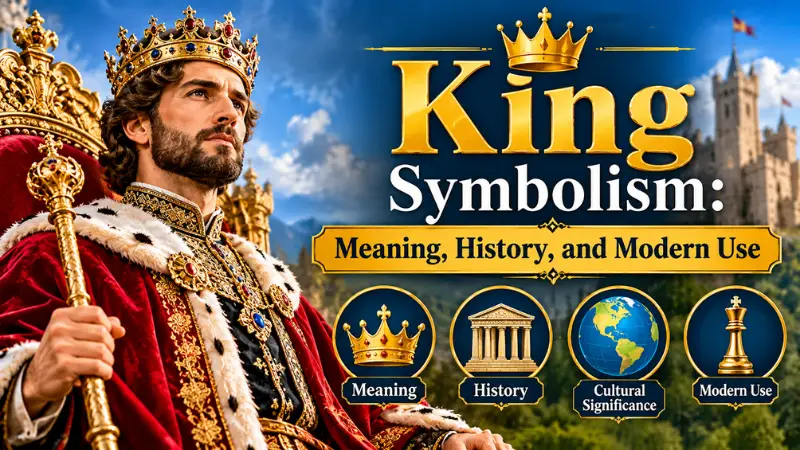
A king is traditionally a male ruler who holds the highest position of authority within a monarchy. Yet the image of a king represents much more than political power. In king symbolism, the crowned ruler often stands for leadership, wisdom, protection, responsibility, personal authority, and the ability to guide others. His image appears in mythology, religious traditions, literature, playing cards, chess, tattoos, and modern popular culture.
For Americans, the king carries an interesting mixture of meanings. The United States was founded in opposition to hereditary monarchy, making royal imagery somewhat different from its meaning in countries with living royal families. Nevertheless, Americans continue to associate kings with confidence, achievement, independence, influence, and the responsibility that comes with leadership.
Understanding this symbol requires looking beyond the crown and throne. A king can represent an admirable leader who protects others, but he can also represent someone who abuses authority or places personal ambition above the needs of the people.
Quick Answer
King symbolism commonly represents leadership, authority, wisdom, protection, responsibility, and personal power in modern American culture. Historically, kings were also associated with divine approval, social order, political legitimacy, and the responsibility to maintain peace and protect their kingdoms.
TL;DR
- Leadership: A king represents the ability to guide and influence others.
- Authority: His crown and throne symbolize recognized power and responsibility.
- Wisdom: An ideal king makes thoughtful decisions and exercises good judgment.
- Protection: Traditional kingship connects leadership with defending a community.
- Spirituality: Religious traditions sometimes associate kings with divine authority.
- Modern culture: King imagery represents confidence, achievement, independence, and self-respect.
What Does a King Symbolize?
The king is one of the most recognizable images of authority in human culture. His traditional appearance usually includes a crown, royal clothing, a throne, and sometimes a scepter or ceremonial sword. These objects distinguish him from ordinary members of society and communicate his position within a political or social hierarchy.
However, the symbolic meaning of a king depends on the qualities associated with his rule.
A good king represents justice, generosity, wisdom, and protection. He uses his position to maintain stability and provide for his people. A cruel or selfish king, on the other hand, represents oppression, arrogance, greed, and uncontrolled ambition.
Several meanings appear repeatedly in modern interpretations:
- Leadership and influence: The ability to guide people toward a shared purpose.
- Personal authority: Confidence in one’s decisions, values, and abilities.
- Wisdom and maturity: The judgment required to make difficult decisions.
- Protection and security: Responsibility for the safety of others.
- Achievement and recognition: Reaching a respected position through effort or accomplishment.
- Responsibility: Understanding that authority comes with obligations.
These meanings explain why the king remains a popular figure in stories, games, art, and personal expressions of identity.
Ancient Roots and Early Symbolism of Kingship
Kingship developed in several ancient civilizations, including Mesopotamia and Egypt. Although their political systems and religious beliefs differed, both societies connected royal authority with maintaining order.
In ancient Mesopotamia, kings were often understood as rulers whose authority received divine approval. The Sumerian concept of kingship was associated with the idea that the institution had descended from heaven. However, Mesopotamian kings were generally regarded as human representatives of divine authority rather than automatically being gods themselves.
Royal objects helped communicate this position. Crowns, thrones, and scepters were recognizable signs of the king’s office.
Ancient Egypt developed a somewhat different understanding. The pharaoh occupied a central religious and political position and was associated with maintaining maat, the principle of truth, justice, balance, and proper order. The living king was associated with Horus, while the deceased king was connected with Osiris.
This did not mean Egyptians believed every individual pharaoh was simply immortal. Rather, the institution of kingship carried sacred significance that extended beyond the lifetime of any particular ruler.
These early traditions established several associations that remain recognizable today: the king as guardian of order, representative of authority, protector of the community, and symbol of political stability.
The Crown, Throne, and Scepter as Symbols of Royal Power
A king’s traditional objects communicate different aspects of his position. They are not merely decorative accessories; each has developed its own symbolic associations.
Thronjubiläum der Queen: Wo sitzt die Königin? – Panorama – SZ.de
8
The crown
The crown is the most recognizable royal symbol. It represents sovereignty, achievement, responsibility, and recognized authority. Because it sits above the head, it can also suggest elevated status, dignity, and the expectations placed upon a ruler.
In modern personal symbolism, a crown may represent self-respect, confidence, or reaching an important milestone.
The throne
The throne represents the king’s official position and the stability of his authority. Unlike a temporary display of wealth, it signifies an established office and the responsibility to govern.
A throne can also suggest permanence, tradition, and the continuity of leadership across generations.
The scepter
The scepter is a ceremonial staff associated with royal command. It represents the right to exercise authority, make decisions, and establish order.
In symbolic artwork, it often communicates leadership through recognized responsibility rather than physical strength.
Together, these three objects create a visual language of sovereignty: the crown identifies status, the throne establishes position, and the scepter communicates authority.
Leadership, Responsibility, and Wisdom
One of the most important meanings of the king is responsible leadership.
In traditional stories, the ideal king is not simply the person who gives orders. He must understand the needs of his community, make difficult decisions, resolve disagreements, and protect people from danger.
This explains why wisdom is frequently associated with royal imagery.
A king who rules successfully must balance competing interests. He may need to choose between personal comfort and public responsibility, immediate rewards and long-term stability, or military strength and peaceful negotiation.
The biblical figure of Solomon is a familiar example of the connection between kingship and wisdom. His reputation for wise judgment has made him a lasting cultural reference for thoughtful leadership.
In modern American life, this interpretation extends beyond government. A business owner, parent, coach, teacher, or community organizer may be described as a leader when that person demonstrates good judgment and accepts responsibility for others.
The king therefore represents an ideal of leadership in which authority is justified by conduct.
King Symbolism in the United States
American interpretations of royal imagery are shaped by the country’s founding history.
Before the American Revolution, the British monarch occupied the highest position in colonial political life. Royal portraits, coats of arms, official initials, and other symbols appeared on everyday objects, including drinking vessels, signs, documents, and military equipment.
King George III represented the authority of the British Crown over the American colonies.
The Revolution changed how many Americans understood this imagery. Independence challenged hereditary rule and the idea that political authority belonged naturally to a monarch.
The American republic instead emphasized elected government, constitutional limits, and the principle that legitimate political authority comes from the people.
This historical change helps explain an important distinction: the United States does not treat the king as its national symbol of political leadership. American national imagery relies more heavily on figures and objects associated with republican government, such as the bald eagle, the American flag, and the Statue of Liberty.
Nevertheless, the king remains popular in American entertainment and everyday language.
Expressions such as “king of the hill,” “king of the court,” and “king of the industry” describe someone who has reached a leading position within a particular field.
In music, sports, business, and fashion, the title often communicates exceptional skill, recognition, or cultural influence.
American uses of royal imagery can therefore celebrate personal achievement without necessarily supporting monarchy as a political system.
Religious and Spiritual Meaning of the King
The king has important associations in several religious traditions. These interpretations vary, so it is important not to treat all religious understandings of kingship as identical.
Christianity
In Christianity, kingship is strongly associated with Jesus Christ, who is frequently described as the King of Kings. This title expresses supreme spiritual authority and sovereignty.
The image of Christ as a king differs from the image of a worldly ruler. Christian teachings emphasize humility, mercy, sacrifice, justice, and service.
The shepherd is another important royal image in biblical tradition. A shepherd protects and guides a flock, making the metaphor a way to describe leadership based on care rather than domination.
The Christian celebration known as the Feast of Christ the King also emphasizes the spiritual meaning of divine kingship.
Judaism
In Jewish tradition, God is frequently described as King, particularly in prayers and religious poetry. This imagery communicates divine sovereignty, justice, judgment, and authority over creation.
The biblical kings of Israel, including David and Solomon, also provide important examples of human kingship, including its responsibilities and limitations.
Hinduism
Hindu traditions include extensive discussions of kingship, duty, and righteous governance. The concept of dharma is particularly important when considering the responsibilities of a ruler.
Lord Rama, a central figure in the Ramayana, is often presented as an example of righteous kingship. His association with Rama Rajya represents an ideal kingdom characterized by justice, moral conduct, and social well-being.
In these traditions, the king is not simply someone who possesses authority. His conduct must reflect moral and spiritual obligations.
King Symbolism Across Different Cultures
Royal imagery developed independently across different parts of the world. Although crowns and royal clothing may look different, many traditions connect kingship with leadership, community identity, and the maintenance of social order.
Akwasidae Celebration In Kumasi And The Returned Looted Artefacts Of The Asante Kingdom
Fine Yoruba Beaded Crown — Art Blackburn
TRANS-SAHARAN GOLD TRADE AND BYZANTINE COINAGE | The Antiquaries Journal | Cambridge Core
6
African traditions
Several African societies have traditions of sacred kingship, in which rulers hold both political and religious responsibilities.
Among the Asante of Ghana, the Golden Stool is a significant symbol of the nation and the spiritual continuity of the Asante people. Its importance extends beyond the individual ruler.
Yoruba royal traditions also use elaborate beaded crowns and other regalia to communicate royal status, authority, and cultural identity.
These examples show that royal symbolism can represent an entire community rather than simply an individual monarch.
European traditions
European royal imagery often emphasizes hereditary succession, territorial sovereignty, noble lineage, and ceremonial authority.
Crowns, coats of arms, royal colors, and family emblems helped distinguish monarchs and communicate their position within political and social structures.
South Asian traditions
In South Asian traditions, kingship has often been connected with religious duty, moral responsibility, and the protection of society.
The ideal ruler is expected to maintain justice and follow established principles of righteous conduct.
These traditions demonstrate that the meaning of a king is influenced by the values of the society in which the symbol develops.
The Psychological and Emotional Meaning of a King
Beyond history and religion, the king can represent qualities people want to develop within themselves.
Psychologically, royal imagery may communicate confidence, independence, ambition, maturity, and a desire for personal control.
For someone who has experienced uncertainty or a loss of confidence, the image of a king may represent becoming more comfortable with making decisions and accepting responsibility.
It can also express the desire to establish personal boundaries.
For example, someone who chooses a crown tattoo after overcoming a difficult period may associate it with self-respect and the decision to take control of their future.
However, the symbol has another side.
A king can also represent an excessive need for recognition, control, or superiority. When authority becomes more important than empathy, the royal figure can symbolize arrogance and entitlement.
This contrast makes the king an interesting psychological image. It represents both the desire to lead and the responsibility to avoid controlling others.
King Symbolism in Chess, Playing Cards, and Tarot
The king appears in several familiar American games and forms of symbolic imagery. Its meaning changes according to the rules and visual traditions of each activity.
Chess photographed on a chessboard
6
Chess
The king is the central piece in chess. Although it can move only one square in any direction, its safety determines the outcome of the game.
This creates an interesting symbolic contrast. The king holds the highest status, but he is not necessarily the most powerful piece in terms of movement.
The chess king can therefore represent the importance of protecting what matters most, strategic thinking, and the vulnerability that accompanies leadership.
Playing cards
A standard deck contains four kings, one for each suit: hearts, diamonds, clubs, and spades.
These figures traditionally represent different royal personalities and historical or courtly associations. Their illustrated designs have changed over time, but they remain recognizable representations of rank and authority.
In everyday American culture, the king card can suggest winning, prestige, confidence, or being at the top.
Tarot
In tarot, the four King cards belong to the court cards of the Minor Arcana. Their interpretations depend on their individual suits.
| Tarot KingCommon Symbolic Meaning | |
|---|---|
| King of Wands | Vision, confidence, creativity, and initiative |
| King of Cups | Emotional maturity, compassion, and diplomacy |
| King of Swords | Logic, judgment, communication, and intellectual authority |
| King of Pentacles | Financial stability, practical success, and responsible management |
In tarot readings, these cards may represent a person’s characteristics, a leadership situation, or qualities that someone needs to develop. Interpretations vary between tarot traditions and individual readers.
King Symbolism in Dreams
Dreaming about a king can reflect how you think about authority, responsibility, recognition, or control.
The details of the dream matter more than the appearance of the king alone.
- Seeing a king: May reflect a desire for leadership, recognition, or greater personal confidence.
- Becoming a king: Can suggest ambition, independence, or readiness to accept new responsibilities.
- Speaking with a king: May reflect a need for guidance or a difficult decision involving authority.
- Seeing an angry king: Could represent fear of criticism, controlling behavior, or conflict with someone in power.
- Losing a crown: May reflect concerns about status, self-confidence, or losing an important position.
- Being protected by a king: May represent a desire for security, guidance, or dependable leadership.
Dream interpretation is subjective. A king in a dream does not predict that someone will become wealthy, famous, or politically influential. Personal experiences and emotions provide a more useful context for understanding the image.
Why People Choose King Tattoos and Jewelry
King imagery is popular in tattoos and jewelry because it communicates identity through a simple, recognizable design.
Pin by Kwestro Inc. on Kwestro Inc. Wanna do | Chess piece tattoo, Chess tattoo, Full sleeve tattoos
10
A crown tattoo is often chosen to represent self-respect, personal achievement, confidence, or the determination to overcome difficult circumstances.
Some people combine a crown with a name, date, or initials to honor a family member or partner. In these designs, the royal image can represent affection, loyalty, or the importance of a relationship.
A king chess-piece tattoo may communicate strategic thinking, patience, and the importance of protecting one’s priorities.
Other popular combinations include:
- King and queen tattoos: Partnership, loyalty, and mutual respect.
- Lion and crown designs: Courage, leadership, and confidence.
- King playing-card tattoos: Competition, ambition, and personal identity.
- Crown jewelry: Self-worth, achievement, and individual style.
- Royal lettering: Confidence, status, and personal recognition.
Not everyone chooses these designs for the same reason. A crown may represent family pride to one person and professional achievement to another.
The personal story behind the design often matters more than its traditional interpretation.
King Symbolism in Modern Fashion, Entertainment, and Social Media
Royal imagery remains common in contemporary American visual culture.
In fashion, crowns and royal motifs appear on clothing, accessories, watches, rings, and decorative designs. They often communicate luxury, confidence, exclusivity, or a bold personal identity.
In entertainment, the title “king” frequently describes an individual who has achieved exceptional recognition within a particular field.
For example, professional athletes may be described as kings of their sport, while influential musicians may receive royal nicknames because of their impact on a genre.
Social media has also expanded the informal use of the term.
People sometimes call themselves kings as a playful expression of confidence. Friends may use the word to encourage someone after an achievement or to acknowledge a positive action.
The phrase “king behavior” can similarly describe conduct considered confident, generous, or admirable.
However, these expressions are usually informal. They do not necessarily communicate political beliefs or a literal desire for royal status.
Positive and Negative Meanings of the King
The king is not exclusively a positive symbol. His meaning depends on how authority is exercised.
| Context | Positive Meaning | Negative Meaning |
|---|---|---|
| Leadership | Wisdom and guidance | Domination and control |
| Authority | Responsibility and stability | Abuse of power |
| Personal identity | Confidence and self-respect | Arrogance and entitlement |
| Wealth | Achievement and security | Greed and extravagance |
| Religion | Justice and divine sovereignty | False claims of divine authority |
| Relationships | Loyalty and protection | Possessiveness and superiority |
This dual meaning appears frequently in mythology, literature, and political history.
A king who protects his people can become a model of responsible leadership. A king who exploits them becomes a warning about what happens when power operates without accountability.
In modern American culture, this distinction is especially relevant because democratic values place importance on equality, individual rights, and limits on authority.
The symbol is therefore most constructive when it represents confidence combined with responsibility rather than superiority over others.
Common Misunderstandings About King Symbolism
Several misconceptions can make the king’s symbolism seem simpler than it actually is.
A king always represents masculinity.
Although traditional kingship is associated with male rulers, the qualities symbolized by a king are not limited to men. Leadership, wisdom, confidence, and responsibility can apply to anyone.
A crown always means wealth.
Crowns can represent sovereignty, dignity, achievement, religious authority, or responsibility. Financial status is only one possible interpretation.
All ancient kings were considered gods.
This is historically inaccurate. Some rulers were regarded as divine, while others were considered human representatives of the gods or leaders whose authority had divine approval.
King symbolism always represents good leadership.
A king can represent tyranny, selfishness, oppression, and unchecked ambition. The symbol can communicate a warning as easily as admiration.
Calling someone a king means supporting monarchy.
In contemporary American speech, the term is often metaphorical. Describing an athlete or musician as a king usually refers to exceptional ability or cultural influence rather than political beliefs.
Recognizing these distinctions helps preserve the historical and cultural meaning of royal imagery.
How the Meaning of the King Has Changed Over Time
The king has moved through several stages of cultural interpretation.
In ancient societies, royal authority was often connected with religion, military protection, and the organization of political life. The king was expected to maintain social order and, in many traditions, fulfill obligations to divine powers.
During the medieval period in Europe, royal imagery became closely associated with hereditary succession, noble identity, territorial rule, and religious legitimacy. Crowns, royal seals, and coats of arms helped establish a ruler’s public identity.
The American Revolution introduced a different interpretation. By rejecting the British monarchy’s political authority, the new republic challenged hereditary rule and promoted government based on popular sovereignty.
In the modern period, the king increasingly became a cultural metaphor. The title could describe a successful performer, an exceptional athlete, a respected leader, or someone with strong personal confidence.
Today, the image can communicate both traditional authority and individual achievement. Its meaning depends on whether it appears in a religious setting, a historical artwork, a game, a tattoo, or everyday conversation.
FAQs
1. What does a king symbolize spiritually?
Spiritually, a king can represent divine authority, moral responsibility, justice, protection, and spiritual leadership. In Christianity, the image is especially associated with Jesus Christ as King of Kings, while other traditions connect kingship with righteous governance and sacred responsibility.
2. Is a king a symbol of good luck?
A king is not universally recognized as a traditional good-luck symbol. However, in playing cards, games, and personal designs, the king can represent success, winning, achievement, and favorable outcomes.
3. What does a king tattoo mean?
A king tattoo commonly represents confidence, self-respect, leadership, independence, or personal achievement. Its meaning can become more specific when combined with crowns, lions, playing cards, or a queen design.
4. What does a crown represent compared with a king?
A king represents the person or role associated with leadership, while a crown represents the authority, dignity, or status attached to that position. A crown can also symbolize personal achievement without referring to an actual monarch.
5. Why is the king important in Christianity?
Christianity uses kingship to describe the sovereignty of God and the authority of Jesus Christ. The title King of Kings communicates that spiritual authority surpasses the power of earthly rulers.
6. What does a king symbolize in a dream?
A king in a dream may represent authority, ambition, confidence, responsibility, or a desire for guidance. The emotional atmosphere of the dream and the king’s behavior can help clarify its personal meaning.
7. Does a king symbolize power or wisdom?
A king can symbolize both, but traditional ideas of good kingship connect power with wisdom and responsibility. Authority without sound judgment is often portrayed negatively in historical stories and literature.
Conclusion
The king is a symbol of leadership, authority, wisdom, protection, and responsibility. From ancient Egyptian pharaohs and Mesopotamian rulers to biblical figures, European monarchs, and modern cultural icons, the image has represented different forms of influence and social position.
In the United States, its meaning has shifted from the political authority once associated with British monarchy toward a broader expression of personal achievement, confidence, and cultural influence. Crowns, chess pieces, tarot cards, tattoos, and popular expressions continue to give the royal figure a place in everyday life.
Ultimately, king symbolism is about more than holding the highest position. It also raises an important question: what does someone do with the authority and influence they possess? A worthy king is remembered not simply for the crown he wears, but for the responsibility he accepts and the way he treats others.