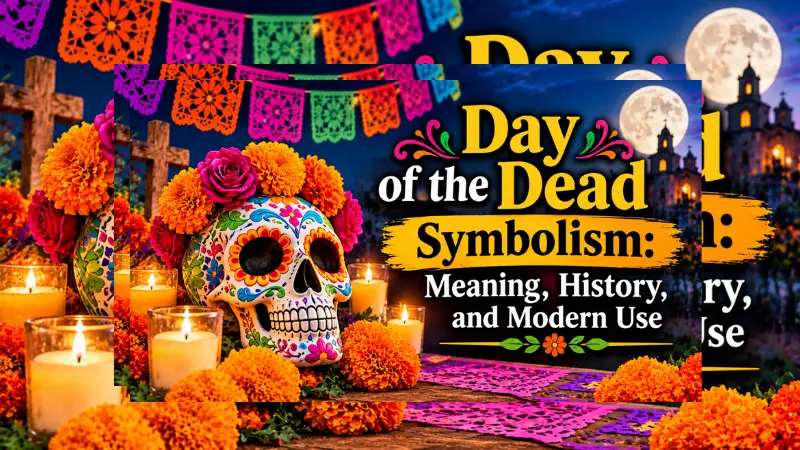
Day of the Dead symbolism centers on remembering deceased loved ones, honoring family connections, and celebrating the belief that death does not erase a person’s place in the lives of those who remain. Known in Spanish as Día de los Muertos, this Mexican tradition is recognized for its colorful altars, marigold flowers, decorated skulls, candles, photographs, and offerings of food.
Although the holiday takes place around November 1 and 2, its meaning extends beyond a date on the calendar. Families use the occasion to remember relatives and friends who have died, share stories about their lives, prepare favorite foods, and maintain connections between generations.
In the United States, the celebration has become increasingly visible through community festivals, museum exhibitions, school activities, public art, and popular culture. Understanding its symbolism helps distinguish the holiday’s traditional Mexican meaning from the simplified images of skulls and skeletons sometimes associated with Halloween.
Quick Answer
Day of the Dead symbolism commonly represents remembrance, family connection, love for deceased relatives, and the celebration of life in Mexican and Mexican American culture. Its historical meaning combines Indigenous traditions of honoring the dead with Catholic observances, expressing the idea that death is part of life’s continuing cycle rather than a reason to forget those who have passed away.
TL;DR
- Remembrance: Honors deceased family members and keeps their memories alive.
- Family: Celebrates connections between living relatives and ancestors.
- Marigolds: Represent remembrance and guide spirits toward family offerings.
- Sugar skulls: Celebrate individual identity and the acceptance of mortality.
- Ofrendas: Welcome and honor deceased loved ones with meaningful offerings.
- Modern America: Connects Mexican heritage, cultural identity, education, and community celebrations.
1. What Day of the Dead Represents in Mexican Culture
In Mexican culture, Día de los Muertos represents the relationship between the living and the dead. Rather than treating death only as an ending, the celebration gives families an opportunity to remember deceased relatives as continuing members of their family history.
Three central ideas shape its symbolism:
- Memory: Remembering someone’s personality, experiences, achievements, and contributions.
- Connection: Maintaining family relationships through photographs, stories, prayers, and shared traditions.
- Celebration of life: Recognizing that a person’s life deserves appreciation even after death.
For many families, remembering someone is an active responsibility. Preparing their favorite meal, displaying their photograph, or telling a familiar story allows their presence to remain part of everyday family identity.
The celebration is not necessarily a rejection of grief. People can miss their relatives, feel sadness about their absence, and still celebrate the happiness those individuals brought into their lives.
2. Historical Origins and the Development of the Tradition
The history of Día de los Muertos involves Indigenous Mesoamerican traditions and Catholic observances introduced by Spanish colonizers.
Before European colonization, Indigenous societies in what is now Mexico had different beliefs and ceremonies concerning death, ancestors, and the afterlife. The Mexica (Aztec), Maya, Mixtec, Zapotec, and other peoples developed their own approaches to honoring the deceased. These practices were not identical, and they should not be treated as one universal ancient holiday.
After the Spanish conquest in the 16th century, Indigenous customs interacted with Catholic religious traditions, particularly All Saints’ Day on November 1 and All Souls’ Day on November 2. Over generations, these influences contributed to the observances now associated with Día de los Muertos.
The resulting celebration developed differently across Mexican regions and communities. Some families emphasize cemetery visits and religious prayers, while others create elaborate home altars, prepare traditional foods, and organize public gatherings.
Its historical development demonstrates cultural continuity and adaptation. The holiday preserves Indigenous relationships with ancestors while also reflecting centuries of religious and social change. Smithsonian Institution+2
3. The Symbolism of the Ofrenda (Memorial Altar)
The ofrenda is one of the most important elements of the celebration. It is a carefully arranged offering space where families display objects that honor deceased relatives and welcome their spirits according to the beliefs of the tradition.
An ofrenda is not simply a decorative altar. Its individual objects often communicate something about the person being remembered.
Common elements include:
- Photographs: Identify the deceased family members being honored.
- Candles: Represent light, remembrance, and spiritual guidance.
- Flowers: Help create a welcoming path for returning spirits.
- Food and drinks: Reflect hospitality and the deceased person’s preferences.
- Personal belongings: Connect the memorial with the individual’s life and personality.
- Religious objects: Express the family’s Catholic or other spiritual beliefs.
Some altars have several levels, while others are small arrangements on a table. Their construction depends on family traditions, available space, and regional customs.
The most meaningful ofrendas are often personal rather than elaborate. A photograph, a favorite cup, and a homemade dish may communicate more about someone’s life than an altar filled with expensive decorations.
4. Marigold Flowers and Their Spiritual Meaning
Marigolds, known in Mexico as cempasúchil or cempazúchitl, are among the most recognizable flowers associated with Día de los Muertos.
Their bright yellow and orange colors symbolize remembrance, warmth, and the continuing connection between families and deceased loved ones.
Traditional beliefs associate the flowers’ strong fragrance and vivid petals with guiding spirits toward their offerings. Families may arrange them around photographs, place them in vases, decorate graves, or scatter their petals to create pathways.
Marigolds also carry a seasonal meaning. Their appearance around the autumn observance connects the celebration with nature’s changing cycles.
In modern American decorations, marigolds frequently communicate Mexican cultural identity, family remembrance, and participation in the holiday. Their meaning is more specific than simply representing autumn or happiness.
5. Sugar Skulls and the Acceptance of Mortality
Sugar skulls, called calaveras de azúcar, represent deceased individuals and the cultural acceptance of human mortality.
These skull-shaped sweets are traditionally made from sugar-based mixtures and decorated with colorful icing, patterns, and sometimes the name of a person. They may be placed on ofrendas or given as seasonal gifts.
Their cheerful appearance is important. Instead of presenting death only through frightening or disturbing imagery, decorated skulls approach mortality through creativity, humor, and affection.
The skull also reminds people that death is a shared human experience. Wealth, social position, and public reputation cannot exempt anyone from mortality.
Sugar skulls can represent:
- Remembrance of deceased relatives.
- Acceptance that life has an ending.
- The relationship between sweetness and mortality.
- Individual identity and personal memory.
- Humor as a way of discussing difficult subjects.
In the United States, sugar skull designs are also popular in jewelry, artwork, clothing, and tattoos. However, their traditional meaning is connected to remembering the dead rather than simply celebrating skull imagery.
6. La Catrina: Elegance, Death, and Social Equality
La Catrina is one of the most recognizable artistic figures associated with Mexican Day of the Dead imagery.
She is usually portrayed as an elegantly dressed female skeleton wearing a fashionable hat, sometimes decorated with flowers or feathers. Her appearance combines beauty, fashion, humor, and mortality.
The figure developed from the work of Mexican illustrator and printmaker José Guadalupe Posada in the late 19th and early 20th centuries. His famous skull illustration, originally associated with the name La Calavera Garbancera, criticized people who rejected their Indigenous heritage while attempting to imitate European upper-class fashion.
The image later became widely known as La Catrina, particularly through the artistic influence of Diego Rivera, who included a prominent version in his 1947 mural Dream of a Sunday Afternoon in Alameda Central.
Her symbolism has several dimensions:
Social equality: Everyone eventually faces death, regardless of wealth or social class.
Vanity: Expensive clothing and fashionable appearances cannot change human mortality.
Cultural identity: The figure became an important visual expression of Mexican artistic identity.
Humor: Her elegant appearance makes mortality approachable without removing its seriousness.
Today, La Catrina appears in public celebrations, paintings, costumes, sculptures, and decorative designs. She is more than a fashionable skeleton; her historical background gives her an important connection to Mexican social criticism. The Mexican Museum+2
7. Papel Picado and the Symbolism of Wind and Life
Papel picado is a traditional Mexican decorative art made by cutting intricate patterns into colorful sheets of tissue paper.
During Día de los Muertos, these banners are commonly displayed above altars, across streets, and around public gathering spaces.
Their delicate construction makes them especially meaningful. Because the paper moves with the slightest breeze, it is often associated with wind and the movement of returning spirits.
Different colors and designs may carry additional meanings depending on the family or community. Skeletons, flowers, hearts, and other patterns frequently appear in the decorations.
Papel picado also represents artistic expression and community participation. Preparing the banners can involve considerable patience and skill, making the decoration itself part of the cultural celebration.
Its bright appearance contributes to the holiday’s distinctive visual identity while reminding participants that life is temporary and constantly changing.
8. Candles, Water, and Incense on Day of the Dead Altars
Candles, water, and incense are common altar elements, each serving a particular symbolic purpose.
Candles and light
Candles represent remembrance, hope, and guidance. In traditional interpretations, their light helps deceased relatives find their way toward the family altar. Some families arrange candles to represent individual people being remembered.
Water and renewal
A glass of water is often placed on the ofrenda as a gesture of hospitality. According to traditional beliefs, it refreshes spirits after their journey. Water also represents life, cleansing, and renewal.
Incense and spiritual preparation
Copal, a natural tree resin, is traditionally burned as incense in some communities. Its fragrance is associated with purification, prayer, and creating a welcoming ceremonial atmosphere.
These elements demonstrate how ordinary materials can become meaningful expressions of respect. Their symbolism depends on the beliefs and practices of the family preparing the altar.
9. Pan de Muerto and the Symbolism of Food Offerings
Food plays an important role in Día de los Muertos because sharing meals is closely connected to hospitality, family, and remembrance.
One of the best-known traditional foods is pan de muerto, a sweet bread prepared especially for the celebration.
Its rounded shape and decorative dough pieces often resemble bones. Depending on the region and recipe, the bread may be flavored with orange, anise, or other ingredients.
Pan de muerto symbolizes generosity, the connection between nourishment and life, and the act of welcoming loved ones.
Families may also place favorite meals, fruits, sweets, and drinks on their ofrendas. These offerings are selected because they remind relatives of the deceased person’s preferences and everyday habits.
For example, placing a grandmother’s favorite fruit or a father’s preferred drink on an altar creates a personal connection that generic decorations cannot provide.
Food therefore serves two purposes: it honors the traditional celebration and preserves memories through familiar family experiences.
10. Monarch Butterflies and the Return of Departed Souls
Monarch butterflies are sometimes associated with Día de los Muertos because their annual migration into central Mexico coincides with the season of the celebration.
Their arrival around late October and early November has encouraged spiritual interpretations connecting them with the return of deceased loved ones.
In some Mexican traditions and popular explanations, monarch butterflies are viewed as symbolic visitors carrying the spirits of ancestors. This association is especially meaningful because the butterflies arrive during the period when families prepare to remember the dead.
Their life cycle also offers another layer of symbolism. Monarch butterflies transform from caterpillars into butterflies, making them natural symbols of change, renewal, and transformation.
However, not every Mexican community or family interprets monarch butterflies in the same way. Their spiritual significance should be understood as a meaningful cultural association rather than a universal belief.
11. What the Colors of Day of the Dead Symbolize
Color is central to the appearance of Día de los Muertos. Unlike some mourning traditions that primarily use black or white, this celebration frequently incorporates bright colors to express memory, personality, and the continuation of life.
| Color | Common symbolic association | Where it appears |
|---|---|---|
| Orange | Marigolds, warmth, and remembrance | Flowers and altar decorations |
| Yellow | Light, hope, and the brightness of life | Marigolds and offerings |
| Purple | Mourning, spirituality, and religious devotion | Candles, fabrics, and decorations |
| White | Purity, hope, and spiritual reflection | Flowers and altar arrangements |
| Pink | Celebration, affection, and artistic expression | Papel picado and decorative objects |
| Red | Love, family bonds, and vitality | Flowers and altar designs |
These associations are useful interpretations, not a fixed universal color code. Their meanings can vary across regions, religious backgrounds, and individual families.
For example, purple may communicate mourning in one setting while serving primarily as a decorative color in another. The overall arrangement and the objects surrounding a color often matter more than the shade alone.
12. Day of the Dead Symbolism in the United States
In the United States, Día de los Muertos has become an important cultural celebration, particularly among Mexican American communities and other Latino populations.
Its public visibility increased significantly during the Chicano movement of the 1970s and 1980s. Mexican American artists and activists used the holiday to strengthen cultural identity, preserve traditions, and create opportunities to educate wider audiences about Mexican heritage.
Today, American celebrations take place in several settings:
- Family gatherings: Relatives prepare ofrendas, share traditional meals, and remember deceased family members.
- Community festivals: Cities organize performances, processions, music, and cultural activities.
- Museums: Exhibitions introduce visitors to Mexican art, traditional crafts, and the history of the holiday.
- Schools: Teachers use the celebration to explain Mexican history, cultural traditions, and remembrance.
- Public art: Murals, sculptures, and decorated installations display the holiday’s recognizable imagery.
Cities such as Los Angeles, Chicago, San Antonio, and San Francisco have particularly visible Día de los Muertos celebrations.
For many Mexican Americans, the holiday is not simply an attractive cultural event. It provides a connection to family heritage, language, community history, and personal identity.
The American interpretation has also expanded through education and intercultural exchange. However, the original emphasis on honoring deceased loved ones remains central. Chicago History Museum+2
13. Emotional and Psychological Meaning of Remembering the Dead
Día de los Muertos also has an emotional significance that extends beyond its religious and cultural traditions.
Remembering someone through photographs, familiar foods, and personal objects can help families maintain a sense of connection after bereavement.
The celebration offers several emotional experiences:
Comfort through remembrance: Looking at photographs and sharing memories can make the absence of a loved one easier to acknowledge.
Connection between generations: Children learn about grandparents, great-grandparents, and other relatives they may never have met personally.
Acceptance of mortality: The imagery of skulls and skeletons encourages people to recognize death as a natural part of human existence.
Gratitude for life: Celebrating a deceased person’s experiences helps families appreciate the time they shared.
Community support: Public celebrations create opportunities for people to remember loved ones together rather than experiencing grief entirely alone.
Importantly, the holiday does not require people to feel happy about death. Its emotional meaning comes from allowing remembrance, sadness, affection, humor, and gratitude to exist together.
14. Cross-Cultural and Religious Interpretations
Although Día de los Muertos is most closely associated with Mexico, other cultures also have traditions that honor deceased family members.
Some of these observances share themes of remembrance, spiritual connection, prayer, and family responsibility.
For example:
- Catholic traditions: All Saints’ Day and All Souls’ Day honor saints and remember the faithful departed through prayers and religious observances.
- Chinese Qingming Festival: Families visit ancestral graves, clean burial sites, and make offerings to honor their ancestors.
- Japanese Obon: Many Buddhist-influenced communities welcome and remember ancestral spirits through family gatherings, lanterns, and ceremonies.
- Guatemalan traditions: Some communities observe the season with cemetery visits, family gatherings, and distinctive practices such as giant kite festivals.
- Filipino Undas: Families visit cemeteries, offer prayers, light candles, and gather with relatives to remember deceased loved ones.
These celebrations should not be treated as interchangeable versions of Día de los Muertos. Each has its own history, religious background, and cultural practices.
Their similarities show that remembering ancestors and maintaining family connections after death are important themes in many societies.
15. Modern Uses, Cultural Misunderstandings, and Symbolic Changes
Día de los Muertos imagery has moved beyond traditional altars and community celebrations. In contemporary American culture, its recognizable designs appear in fashion, tattoos, home decorations, illustrations, jewelry, and digital artwork.
Tattoos and personal expression
Sugar skulls, marigolds, and La Catrina are common tattoo subjects.
A person might choose these designs to honor a deceased parent, remember a grandparent, celebrate Mexican heritage, or express acceptance of mortality.
Adding a name, date, or personal object can make the tattoo more closely connected to an individual memory.
Fashion and jewelry
Skull-shaped earrings, colorful necklaces, embroidered clothing, and floral accessories often incorporate Day of the Dead imagery.
For some wearers, these designs communicate cultural pride. Others appreciate the artistic qualities of the traditional patterns.
Home decorations
Decorative skulls, marigold arrangements, papel picado, and small altar-inspired displays appear in American homes, particularly around late October and early November.
When used thoughtfully, these objects can encourage remembrance and provide opportunities to learn about Mexican cultural traditions.
Social media and popular culture
Social media has helped introduce Día de los Muertos artwork and celebrations to wider audiences. Photographs of ofrendas, traditional food, costumes, and community events are shared across digital platforms.
Films and popular entertainment have also influenced how Americans recognize the holiday. Disney and Pixar’s Coco, for example, introduced many viewers to themes of family memory, ancestors, and the importance of remembering the dead.
Common misunderstandings and cultural appropriation
One of the most common misunderstandings is treating Día de los Muertos as another version of Halloween.
Although both celebrations occur around the same season and may include skeleton imagery, their purposes are different. Halloween generally emphasizes costumes, entertainment, and spooky themes, while Día de los Muertos centers on honoring deceased loved ones.
Another concern involves cultural appropriation.
Using sugar skulls or La Catrina designs without understanding their cultural significance can reduce meaningful traditions to seasonal decorations. Wearing traditional clothing or using ceremonial imagery as a costume without respect for its background can also cause offense.
A respectful approach involves learning the history, recognizing Mexican cultural contributions, and understanding that the holiday is a living tradition rather than a decorative theme.
16. How Day of the Dead Symbolism Has Evolved Over Time
The meaning of Día de los Muertos has changed through centuries of cultural exchange, artistic development, migration, and social transformation.
Its early Indigenous influences included different relationships with ancestors, death, and agricultural cycles. Spanish colonization introduced Catholic religious observances that contributed to the development of the modern calendar and its rituals.
During the 19th and early 20th centuries, Mexican artists helped establish the skull and skeleton imagery now closely associated with the holiday. José Guadalupe Posada’s satirical illustrations and the later popularity of La Catrina gave death a recognizable artistic and social identity.
In the United States, Mexican American communities helped transform the celebration into a visible expression of cultural pride and identity during the Chicano movement.
More recently, international tourism, museums, films, social media, and commercial products have introduced its imagery to audiences unfamiliar with its origins.
Despite these changes, several ideas remain central:
- Remembering deceased relatives.
- Maintaining family connections across generations.
- Recognizing the natural reality of death.
- Celebrating the lives of people who have passed away.
- Preserving cultural identity through shared traditions.
The celebration continues to evolve, but its central purpose remains rooted in remembrance and family connection.
FAQs
1. What is the main symbolic meaning of Day of the Dead?
Day of the Dead primarily symbolizes remembrance, family love, and the continuing connection between living people and deceased relatives. It celebrates the lives of those who have passed away rather than focusing exclusively on the sadness of death.
2. Is Day of the Dead a religious holiday?
It has both religious and cultural dimensions. Its modern traditions combine Indigenous Mexican influences with Catholic observances, although some families celebrate it primarily as a cultural and family tradition rather than a religious event.
3. What does a sugar skull symbolize on Day of the Dead?
A sugar skull represents a deceased person and the acceptance of human mortality. Its colorful decorations express affection, individuality, and a celebratory approach to remembering loved ones.
4. Why are marigolds important on Day of the Dead?
Marigolds are traditionally believed to help guide deceased spirits toward family altars through their bright petals and distinctive fragrance. They also represent remembrance and the seasonal connection between nature and the celebration.
5. What does La Catrina symbolize?
La Catrina symbolizes mortality, social equality, and criticism of vanity and class differences. Her elegant clothing contrasts with her skeletal appearance, reminding people that wealth and fashionable appearances cannot prevent death.
6. Is Day of the Dead the same as Halloween?
No. Halloween is primarily associated with costumes, spooky entertainment, and seasonal celebrations, whereas Día de los Muertos focuses on remembering and honoring deceased relatives. Their dates and some visual elements overlap, but their cultural meanings are different.
7. What does a Day of the Dead tattoo mean?
A Day of the Dead tattoo often represents remembrance of a deceased loved one, Mexican cultural heritage, family identity, or acceptance of mortality. Its personal meaning depends on the selected design and the memories associated with it.
Conclusion
Day of the Dead symbolism represents remembrance, family relationships, cultural identity, and the acceptance of mortality. Its flowers, sugar skulls, candles, photographs, and memorial altars each contribute to a tradition that celebrates the lives of people who have passed away.
In modern American culture, the celebration provides an important connection to Mexican heritage while introducing wider audiences to a different way of remembering the dead. Its popularity in art, festivals, fashion, and entertainment has expanded its visibility, but its cultural foundation remains rooted in family and remembrance.
Ultimately, the meaning of Día de los Muertos is found not simply in its colorful decorations but in the people being remembered and the stories their families continue to share.