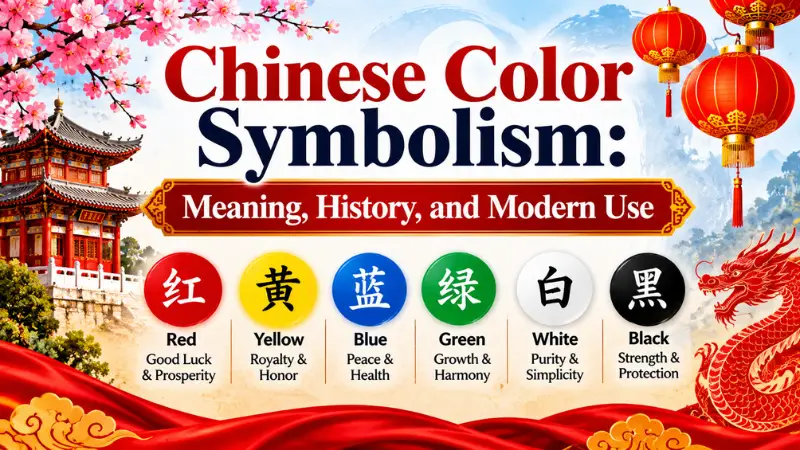
Colors have an important place in Chinese culture, where they communicate ideas about happiness, prosperity, authority, nature, and mourning. Chinese color symbolism comes from centuries of philosophical traditions, religious practices, imperial customs, and everyday celebrations. Unlike many modern Western interpretations, traditional Chinese color meanings are closely connected to the natural world, seasonal changes, and the relationship between different elements of the universe.
From the red decorations used during Lunar New Year to the yellow robes associated with Chinese emperors, colors often communicate messages beyond their appearance. A color can express good fortune, identify social status, mark an important ceremony, or reflect beliefs about life and death.
Understanding these traditions is particularly useful in the United States, where Chinese colors appear in restaurants, cultural festivals, wedding celebrations, fashion, architecture, and decorative art. Their meanings also help explain why certain color combinations are considered appropriate for celebrations while others are associated with mourning.
Quick Answer: What Does Chinese Color Symbolism Mean?
Chinese color symbolism commonly represents good fortune, happiness, prosperity, authority, purity, and the natural balance of life. Traditionally, five major colors—red, yellow, white, black, and blue-green—are connected with the Five Phases, directions, seasons, and elements of Chinese cosmology.
TL;DR: Key Meanings of Traditional Chinese Colors
- Red: Happiness, celebration, prosperity, and good luck.
- Yellow: Imperial authority, dignity, earth, and central power.
- White: Purity, mourning, remembrance, and ceremonial significance.
- Black: Water, wisdom, solemnity, and the northern direction.
- Blue and green: Growth, renewal, nature, and vitality.
- Purple and gold: Nobility, prestige, wealth, and spiritual associations.
1. The Historical Origins of Chinese Color Symbolism
The history of Chinese color symbolism reaches back to ancient Chinese civilization, when colors were used in clothing, religious ceremonies, architecture, artwork, and social customs. Early Chinese communities did not treat color simply as a decorative choice. Particular colors could communicate status, express religious beliefs, or represent relationships between humanity and the natural environment.
During the Shang dynasty (approximately 1600–1046 BCE), inscriptions and ritual practices already reflected the importance of directional and numerical associations. Over subsequent centuries, Chinese thinkers developed more organized systems connecting colors with natural processes, seasons, directions, and elements.
The Five Phases theory, known as Wuxing, became particularly influential. During the Warring States and Han periods, these associations developed into a broader philosophical framework.
Colors also became important in imperial government. Clothing regulations, ceremonial objects, and court decorations helped distinguish rulers and officials from ordinary people. Certain shades became associated with authority and social rank.
Over time, these traditions entered everyday life. Red became familiar at weddings and celebrations, white became important in mourning customs, and yellow developed a strong connection with imperial authority.
2. The Five Traditional Colors and Their Symbolic Connections
One of the most recognizable features of traditional Chinese color culture is the Five Colors system, commonly called Wuse.
It connects five major color categories with the Five Phases:
- Wood
- Fire
- Earth
- Metal
- Water
Each phase also corresponds with a direction and a season. Together, these relationships form a system for understanding the natural world.
| Traditional Color | Five Phase | Direction | Season | Common Symbolism |
|---|---|---|---|---|
| Blue-green (Qing) | Wood | East | Spring | Growth and renewal |
| Red | Fire | South | Summer | Happiness and prosperity |
| Yellow | Earth | Center | Seasonal transition | Authority and stability |
| White | Metal | West | Autumn | Purity and mourning |
| Black | Water | North | Winter | Wisdom and solemnity |
These relationships are not simply decorative associations. They belong to a larger worldview in which natural processes influence one another.
For example, wood supports fire, fire produces earth through ash, earth contains metal, metal is associated with condensation, and water nourishes wood. The system describes cycles of generation and restraint rather than five permanently separate substances.
For American readers, this distinction is important. Chinese color traditions are not merely a collection of individual color meanings. They also describe how different parts of the natural world relate to one another.
3. Red Symbolism: Happiness, Good Fortune, and Celebration
Red is perhaps the most recognizable traditional Chinese color, especially among Americans familiar with Lunar New Year celebrations.
In Chinese culture, red is associated with happiness, good fortune, prosperity, celebration, and positive beginnings. Its connection with fire and the southern direction also places it within the traditional Five Phases system.
Red appears prominently during Lunar New Year, weddings, birthdays, and other important occasions.
One familiar example is the red envelope, known as hongbao. These envelopes contain money and are traditionally given during holidays, weddings, and family celebrations. The red color communicates good wishes for prosperity and good fortune.
Red is also common in traditional Chinese wedding clothing, decorations, lanterns, and festive displays. It helps establish a celebratory atmosphere and expresses hopes for happiness in married life.
In the United States, red Chinese decorations are especially visible during Lunar New Year events in cities such as New York, San Francisco, and Los Angeles.
However, red does not have a positive meaning in every situation. It is generally avoided in traditional Chinese funeral customs because it is strongly associated with celebration rather than mourning. Writing a person’s name in red ink has also carried cultural taboos in some traditional settings.
The meaning depends on the occasion, not simply the color itself.
4. Yellow Symbolism: Imperial Authority, Earth, and Stability
Yellow holds an important position in traditional Chinese culture because of its connection with the earth and the central direction.
In the Five Phases system, yellow represents Earth. It is associated with stability, nourishment, balance, and the center around which other directions are organized.
Yellow also became strongly connected with imperial authority.
During later imperial periods, particularly from the Tang dynasty onward, yellow clothing became increasingly associated with the emperor and the ruling court. Bright yellow robes were especially connected with imperial status, and restrictions governed who could wear particular garments.
This association made yellow a visual expression of political power and royal dignity.
Chinese architecture and decorative art also used yellow in important settings. The Forbidden City in Beijing provides a recognizable example, with its distinctive yellow glazed roof tiles.
For Americans, yellow is sometimes interpreted simply as a cheerful or energetic color. However, in traditional Chinese settings, its historical associations can communicate much more than optimism.
It may suggest authority, cultural heritage, prosperity, or the central role of the earth in traditional cosmology.
5. White Symbolism: Purity, Mourning, and Remembrance
White has a more complicated meaning in Chinese culture than many Americans initially expect.
In the United States, white is commonly associated with weddings, innocence, cleanliness, and new beginnings. Chinese traditions also recognize associations with purity and cleanliness, but white has an especially important connection with funerals and mourning.
Within the Five Phases system, white represents Metal, the western direction, and autumn.
Its connection with autumn reflects themes of decline, transition, and the completion of a natural cycle. These associations help explain its role in traditional mourning customs.
White clothing and white fabrics are used in certain Chinese funeral traditions to express grief and respect for the deceased. Family members may wear white mourning garments as part of ceremonial practices.
White flowers can also appear at memorial services and funerals.
This difference is particularly important in multicultural American settings. A white outfit that might seem appropriate for a joyful wedding in one cultural context may carry a different association in a traditional Chinese mourning ceremony.
Understanding the occasion helps prevent cultural misunderstandings.
6. Black Symbolism: Wisdom, Water, and the Unknown
Black is traditionally associated with Water, the northern direction, and winter.
Its symbolic meanings include wisdom, depth, solemnity, mystery, and the unknown. In certain traditional philosophical interpretations, black also represents the darkness of the heavens and the vastness of the universe.
The color has a long history in Chinese clothing, calligraphy, ink painting, and artistic design.
Black ink, in particular, became central to Chinese calligraphy and traditional landscape painting. Artists used variations in ink density, brush pressure, and water to create landscapes, textures, and expressive details without relying on a wide range of colors.
Black also appears in traditional garments and decorative objects.
Its meaning can vary considerably depending on context. It may communicate sophistication and authority in clothing, concentration in artistic practice, or solemnity in ceremonial settings.
In the United States, black is frequently associated with elegance, formality, and mourning. Those interpretations overlap with some Chinese uses, but the traditional connection with Water and the northern direction adds another cultural dimension.
7. Blue and Green Symbolism: Growth, Nature, and Renewal
Blue and green have a distinctive place in Chinese color traditions because the ancient color category qing does not correspond perfectly to either modern English word.
Depending on the historical context, qing can refer to shades of blue, green, blue-green, or cyan.
In the Five Phases system, this color category represents Wood and the eastern direction. Its seasonal association is spring, when plants begin growing and the natural world becomes active again.
For this reason, blue-green colors are associated with:
- Growth and renewal.
- Natural vitality.
- Springtime and new beginnings.
- Harmony with the environment.
- Development and continuity.
Green is also commonly associated with health and prosperity in contemporary Chinese cultural settings.
Blue has additional artistic importance. Blue-and-white porcelain, for example, became one of the most recognizable forms of Chinese decorative art. Cobalt blue designs against white backgrounds appear on ceramics that have influenced collecting, interior design, and decorative traditions around the world.
In American homes, Chinese-inspired blue and green decorations can communicate calmness, natural beauty, and cultural appreciation.
However, one traditional expression deserves attention: a green hat can carry an association with a man’s partner being unfaithful. This is a specific cultural convention rather than a general meaning of green.
8. Purple Symbolism: Nobility, Prestige, and Spiritual Associations
Purple is not one of the five foundational colors in the traditional Five Phases system, but it has an important place in Chinese art, literature, and cultural symbolism.
Historically, purple could be associated with nobility, prestige, and high status. Its rarity and the expense of producing certain purple dyes contributed to its association with luxury.
Purple also has connections with Taoist traditions and celestial imagery.
One familiar example is the expression Purple Forbidden City, associated with the imperial palace complex in Beijing. The name reflects the historical connection between the emperor’s residence and the Purple Star or celestial symbolism.
In modern settings, purple may communicate elegance, creativity, spirituality, or refinement.
American audiences often associate purple with royalty and luxury, making some of its historical Chinese associations relatively easy to recognize.
Nevertheless, its meaning is not identical in every Chinese historical period or religious tradition.
9. Gold Symbolism: Wealth, Success, and Good Fortune
Gold is closely connected with wealth, prosperity, achievement, and prestige in Chinese culture.
Although it is not one of the five foundational colors, gold frequently appears alongside red in traditional celebrations and decorative objects.
The combination of red and gold is particularly familiar during Lunar New Year. Red communicates happiness and good fortune, while gold reinforces wishes for wealth and financial success.
Gold-colored decorations can include:
- Festival lanterns.
- Decorative Chinese characters.
- Wedding ornaments.
- Jewelry and accessories.
- Gift packaging.
- Temple and architectural details.
Gold also appears in imperial art and ceremonial objects, where it can communicate authority and luxury.
In the United States, gold is often used in Chinese-inspired interior design, restaurant decorations, holiday displays, and cultural celebrations.
Its appeal is partly visual: gold creates a sense of richness and contrast when paired with red, black, or dark wood.
However, its traditional meaning is more specific than simply looking expensive. It frequently expresses hopes for material prosperity and successful beginnings.
10. Chinese Color Symbolism in American Culture
Chinese colors have become familiar parts of American multicultural life, particularly in communities with established Chinese American populations.
They appear in Lunar New Year parades, cultural festivals, restaurants, community centers, museums, and public celebrations.
Red lanterns and gold decorations are among the most recognizable examples. They communicate a festive atmosphere and help connect public spaces with Chinese cultural traditions.
In American Chinatown districts, traditional color combinations also contribute to architectural identity. Storefronts, decorative gates, signs, and festival displays often incorporate red, gold, and other recognizable Chinese colors.
For Chinese American families, these colors may represent cultural continuity and family traditions.
They can also help younger generations maintain connections with ancestral customs, especially during holidays and family celebrations.
However, not every Chinese American interprets colors in exactly the same way. Regional background, family customs, religious beliefs, and personal experiences all influence how traditions are practiced.
The best way to understand these colors in the United States is to recognize their cultural origins while respecting the diversity of Chinese American communities.
11. Chinese Color Symbolism in Weddings and Festivals
Celebrations provide some of the clearest examples of how Chinese colors communicate meaning.
Traditional Chinese weddings frequently feature red clothing, decorations, and ceremonial objects. The color expresses happiness, good fortune, and hopes for a successful marriage.
Gold is often added to emphasize prosperity and family well-being.
During Lunar New Year, red envelopes, lanterns, banners, and decorative ornaments create a similar visual language.
The colors are not chosen randomly. They help establish the occasion as a celebration of renewal, family relationships, and future prosperity.
White, by contrast, has a different role in mourning ceremonies. Its association with funerals demonstrates how cultural context changes the appropriateness of a color.
For Americans attending Chinese weddings or Lunar New Year celebrations, understanding these differences can make participation more respectful.
A red gift envelope, for example, is more than attractive packaging. It carries a traditional message of goodwill.
12. How Chinese Colors Appear in Art, Clothing, and Interior Design
Traditional Chinese colors have influenced artistic practices for centuries.
They appear in silk textiles, embroidery, ceramics, paintings, architecture, theatrical costumes, and decorative objects.
Chinese textiles offer particularly clear examples. Court robes often used colors, patterns, and embroidered symbols to communicate social position and ceremonial importance.
In traditional Chinese painting, color could work alongside brushwork and composition to establish atmosphere and meaning.
Blue-and-white porcelain demonstrates another important artistic tradition. Its distinctive contrast has influenced decorative ceramics and interior design in many countries, including the United States.
Modern designers often incorporate Chinese-inspired colors into:
- Home decorations and furniture.
- Wall art and ceramic collections.
- Clothing and fashion accessories.
- Restaurant interiors.
- Wedding decorations.
- Festival displays.
When used thoughtfully, these colors can introduce cultural history into contemporary design without requiring an entirely traditional setting.
A red accent wall, for instance, may create a celebratory atmosphere, while blue-green decorative pieces can suggest a connection with nature.
The most respectful approach is to understand the cultural associations rather than using traditional colors as unexplained decoration.
13. Emotional and Psychological Meanings of Chinese Colors
Colors influence how people experience spaces, celebrations, clothing, and personal objects.
In Chinese traditions, these emotional associations often overlap with philosophical and ceremonial meanings.
Red can create a feeling of excitement and celebration. Yellow may suggest stability, importance, and dignity. White can communicate cleanliness but also evoke grief in mourning settings.
Black may feel formal or contemplative, while blue and green can suggest natural growth and calmness.
Gold frequently communicates success and achievement.
These interpretations are not universal psychological rules. People respond to colors differently depending on their cultural backgrounds, memories, and personal preferences.
For example, an American who associates white with wedding ceremonies may initially be surprised by its role in Chinese funerals.
Similarly, someone familiar with Western fashion may interpret black mainly as elegance, while a traditional Chinese setting may introduce additional associations with Water and the northern direction.
Cultural knowledge helps explain why the same color can produce different emotional responses.
14. Common Misunderstandings About Chinese Color Symbolism
Chinese color traditions are sometimes simplified when presented outside their cultural context.
One common misunderstanding is that every color has one permanent meaning. In reality, meanings change according to historical period, ceremony, religious practice, and social setting.
Another misconception is that the Five Colors system includes every important traditional Chinese color. Red, yellow, white, black, and qing form the foundational group, but purple, gold, and other colors also have meaningful cultural histories.
Some people also assume that Chinese color symbolism is entirely based on superstition. This overlooks its connections with philosophy, political history, artistic traditions, and social organization.
A further misunderstanding concerns modern Chinese communities. Traditional customs remain influential, but contemporary Chinese people do not necessarily follow every historical convention.
Chinese Americans may also adapt traditions according to their family histories and experiences in the United States.
Understanding these distinctions makes it easier to appreciate the cultural significance of colors without treating Chinese society as a single unchanging tradition.
15. How Chinese Color Meanings Have Evolved in Modern Times
Chinese color symbolism has changed as society, technology, politics, and artistic expression have developed.
Historically, colors were closely connected with imperial clothing regulations, philosophical systems, religious ceremonies, and social customs.
Today, many of these associations remain recognizable, but their applications have expanded.
Red continues to be important during weddings and Lunar New Year celebrations. Yellow remains associated with historical imperial architecture and cultural heritage. White continues to play a role in traditional mourning practices.
At the same time, contemporary designers use these colors in fashion, advertising, digital illustrations, architecture, and entertainment.
Chinese cinema, animation, video games, and graphic design frequently draw on traditional color associations to communicate character, atmosphere, and cultural identity.
Chinese American communities also reinterpret these traditions through local celebrations, family events, and contemporary artistic expression.
This evolution demonstrates that traditional symbolism is not frozen in the past. Its meanings continue to develop while retaining recognizable historical connections.
FAQs
1. What is the most important color in Chinese culture?
Red is one of the most recognizable and widely used colors in Chinese culture. It represents happiness, good fortune, prosperity, and celebration, particularly during Lunar New Year and traditional weddings.
2. Why is red considered lucky in Chinese culture?
Red is traditionally connected with Fire and the southern direction in the Five Phases system. Over time, it became strongly associated with happiness, celebration, prosperity, and protection against misfortune in various folk customs.
3. What does white symbolize in Chinese culture?
White represents Metal in the traditional Five Phases system and has associations with purity and cleanliness. It is also an important mourning color used in certain Chinese funeral ceremonies.
4. What does yellow represent in traditional Chinese culture?
Yellow symbolizes Earth, stability, and the central direction. It also became a major symbol of imperial authority because of its historical association with Chinese emperors and court clothing.
5. What are the five traditional Chinese colors?
The five traditional colors are red, yellow, white, black, and qing, a color category that includes blue-green and cyan shades. Each corresponds with one of the Five Phases: Fire, Earth, Metal, Water, and Wood.
6. What does gold symbolize in Chinese culture?
Gold is commonly associated with wealth, success, prosperity, and prestige. It frequently appears with red in Lunar New Year decorations, wedding ornaments, and traditional celebratory designs.
7. Why is color symbolism important in Chinese weddings?
Colors help communicate wishes and expectations for married life. Red expresses happiness and good fortune, while gold represents prosperity and success, making the combination especially popular in traditional wedding decorations.
Conclusion:
Chinese color symbolism represents much more than personal taste or decorative style. Its meanings developed through ancient philosophy, imperial history, religious practices, artistic traditions, and everyday customs. The Five Phases system connects colors with natural processes, directions, and seasons, while individual colors communicate specific messages in celebrations, clothing, and ceremonial life.
For Americans, understanding these traditions provides a better appreciation of Chinese cultural expressions found in Lunar New Year celebrations, weddings, architecture, fashion, and art. Red may communicate happiness, yellow may recall imperial authority, white may express mourning, and blue-green may represent renewal.
Ultimately, Chinese colors are best understood through their cultural context. Their meanings reflect a long relationship between nature, human experience, and the traditions that continue to shape Chinese cultural identity.