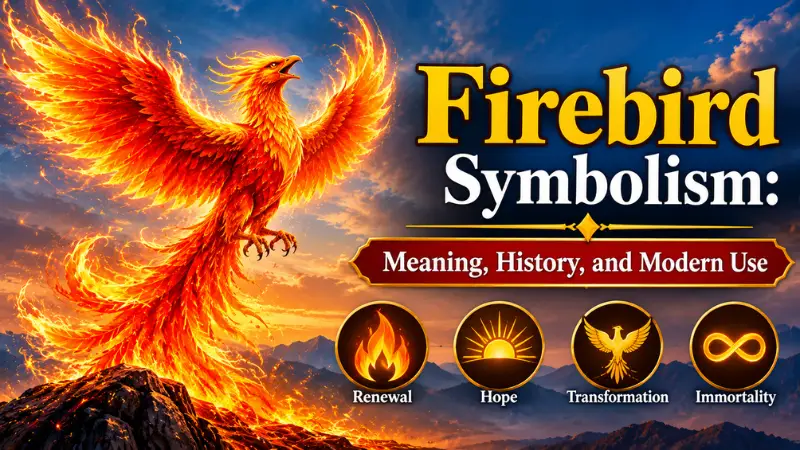
A firebird is a legendary creature often depicted as a magnificent bird with glowing feathers that resemble flames. In firebird symbolism, this unusual creature represents renewal, hope, protection, freedom, and the ability to overcome difficult circumstances. Its brilliant appearance and magical qualities have made it an important figure in folklore, literature, music, and visual art.
The firebird is especially associated with Russian and Eastern European fairy tales, where it often appears as a rare supernatural creature whose feathers bring light, fortune, or unexpected opportunities. Although it shares certain characteristics with the phoenix, the two mythical birds have different origins and traditional stories.
In the United States, the firebird is commonly interpreted through ideas of personal transformation, resilience, creativity, and starting over. Its fiery appearance also makes it a popular image in tattoos, artwork, jewelry, and fantasy-inspired designs.
Quick Answer: What Does Firebird Symbolism Mean?
Firebird symbolism commonly represents renewal, hope, freedom, transformation, and protection in modern American culture. Originating primarily in Slavic folklore, the mythical bird is also associated with magical blessings, good fortune, beauty, and the possibility of overcoming adversity.
TL;DR
- Renewal: Represents fresh beginnings and personal transformation.
- Hope: Suggests light and possibility during difficult circumstances.
- Freedom: Reflects independence and the ability to escape limitations.
- Protection: Its magical feathers can provide help during danger.
- Creativity: Represents imagination, artistic expression, and individuality.
- Cultural heritage: Connects modern interpretations with Slavic folklore.
1. What Is a Firebird in Mythology?
The firebird, known as Zhar-ptitsa in Russian folklore, is a supernatural bird famous for its extraordinary appearance and magical feathers.
It is commonly illustrated with golden, red, orange, and yellow plumage that seems to produce its own light. Some traditional descriptions give it sparkling eyes and feathers that shine brightly enough to illuminate dark surroundings.
Unlike ordinary birds, the firebird is difficult to capture and often appears unexpectedly in enchanted forests, royal gardens, or mysterious kingdoms.
Its physical characteristics contribute to its symbolic associations:
- Flaming feathers: Suggest vitality, beauty, and extraordinary possibilities.
- Golden appearance: Represents rarity, value, and good fortune.
- Bright light: Suggests guidance, hope, and the discovery of something valuable.
- Flight: Represents freedom, independence, and movement beyond limitations.
- Magical abilities: Suggest unexpected assistance and protection.
The firebird is not simply a mythical animal associated with flames. Its stories frequently connect beauty with responsibility, temptation with opportunity, and unexpected encounters with personal change.
2. The Historical Origins of Firebird Symbolism
The firebird’s best-known origins are found in Russian and wider Slavic fairy-tale traditions. It appears in stories involving enchanted gardens, powerful rulers, magical objects, and heroic journeys.
One particularly familiar tale is The Tale of Ivan Tsarevich, the Firebird, and the Gray Wolf. In this story, the Firebird visits a royal garden and eats golden apples. Its presence creates a challenge for the royal family, leading Prince Ivan into an adventure involving the magical bird.
The creature becomes an object of desire because of its extraordinary beauty and valuable feathers. However, obtaining it is not necessarily a straightforward victory.
In these stories, the Firebird can represent several things:
- Something rare that is worth pursuing.
- A difficult opportunity that changes someone’s future.
- The rewards and consequences of ambition.
- The unexpected help that appears during a challenging journey.
The firebird also became internationally recognizable through Igor Stravinsky’s ballet The Firebird, which premiered in Paris on June 25, 1910. Choreographed by Michel Fokine, the production combined elements from several Russian fairy tales.
The ballet helped introduce the mythical creature to wider Western audiences. Its influence continues through classical music, theatrical productions, dance, and contemporary visual culture.
3. The Symbolism of Renewal and New Beginnings
Renewal is one of the most common modern interpretations of the firebird.
Its fiery appearance suggests change, while its ability to move freely through the sky creates an image of leaving old circumstances behind. For many people, this makes the bird an appropriate symbol for beginning another chapter of life.
However, it is important to distinguish the firebird from the phoenix. The phoenix is traditionally associated with death and rebirth through fire, whereas the Russian Firebird does not necessarily die and return to life in its original folklore.
The modern association with renewal is largely an interpretation developed through its resemblance to other legendary birds and its role in stories about overcoming difficulties.
People may connect the firebird with:
- Recovering after a difficult period.
- Beginning a new career or relationship.
- Rebuilding confidence after disappointment.
- Leaving behind unhealthy circumstances.
- Finding a new direction after major life changes.
For example, someone starting over after losing a job might choose a firebird illustration to represent the belief that an unexpected ending can create room for a different future.
The symbolism is not about pretending that difficulties never happened. It is about recognizing that circumstances can change.
4. Firebird Symbolism in American Culture
In the United States, the firebird is generally understood through familiar themes of resilience, independence, creativity, and transformation.
American audiences encounter the creature through fantasy literature, animation, ballet, video games, decorative artwork, and mythology-inspired designs.
Its meaning also fits several recognizable American cultural ideas.
Personal independence: The bird’s ability to fly freely can represent the desire to make independent decisions and live according to personal values.
Resilience: Its fiery appearance suggests determination and the willingness to face difficult circumstances.
Individual expression: Its unusual colors and mythical appearance make it an appealing image for people who want to express an unconventional personality.
Creative ambition: Artists and performers may associate the firebird with originality, imagination, and the courage to develop something distinctive.
The firebird is not an official national symbol of the United States, nor does it have one universally recognized American meaning. Its interpretation depends on the context in which it appears.
For instance, a firebird used in a personal tattoo may communicate recovery, while the same creature in a fantasy illustration may represent magic, adventure, or extraordinary beauty.
5. Firebird Symbolism Across Different Cultures
The firebird belongs most directly to Slavic folklore, but similar supernatural birds appear in different cultural traditions.
These creatures should not be treated as identical. Their stories developed in different historical and religious environments, even when they share visual characteristics.
Slavic traditions
The Russian Firebird is associated with magical beauty, rare treasures, difficult quests, and supernatural assistance. Its feathers are especially valuable, and its appearance can set an entire adventure in motion.
Greek and Egyptian traditions
The phoenix is associated with renewal, longevity, and rebirth. Its legendary cycle of death and regeneration gives it a different symbolic foundation from the Russian Firebird.
Persian literature
The Simurgh is a legendary bird associated with wisdom, healing, and spiritual knowledge. It appears in Persian literary traditions, most notably in Farid ud-Din Attar’s The Conference of the Birds.
Chinese traditions
The Fenghuang is a legendary bird associated with harmony, virtue, prosperity, and favorable circumstances. It is sometimes loosely compared with the phoenix in English, although its traditional identity and symbolism are distinct.
These comparisons show why firebird imagery can have different interpretations depending on the audience. A Russian fairy-tale illustration, a Persian literary reference, and a Chinese decorative motif should not automatically be assigned the same cultural meaning.
6. The Spiritual Meaning of a Firebird
In contemporary spiritual interpretations, the firebird often represents guidance, hope, personal awakening, and the willingness to move toward a new direction.
People who connect with this imagery may view the bird as a reminder to remain open to change rather than allowing fear or disappointment to determine their future.
Its light is sometimes interpreted as a metaphor for discovering clarity during uncertain circumstances.
Common spiritual interpretations include:
- Guidance: Finding direction when facing uncertainty.
- Awakening: Becoming more aware of personal values and priorities.
- Hope: Maintaining optimism when circumstances are difficult.
- Protection: Feeling supported while navigating unfamiliar experiences.
- Transformation: Recognizing the possibility of personal growth.
These meanings are matters of personal belief rather than established religious teachings. There is no single universal spiritual doctrine that assigns the firebird one fixed meaning.
For some people, it is simply an attractive mythical creature. For others, it provides a meaningful image of courage and the possibility of change.
7. The Emotional and Psychological Meaning of the Firebird
The firebird can communicate several emotional experiences, particularly because its appearance combines beauty, movement, brightness, and intensity.
Psychologically, people may associate it with the desire to move beyond limitations and develop a stronger sense of personal identity.
Its symbolism can be understood through several emotional connections.
Confidence: Its striking appearance suggests the willingness to be visible and express individuality.
Hope: Bright feathers provide a natural visual association with light and positive possibilities.
Courage: Its association with dangerous quests can represent facing unfamiliar situations.
Ambition: The bird’s rarity can symbolize the pursuit of meaningful goals.
Independence: Its ability to fly suggests freedom from expectations or restrictive circumstances.
The firebird can also represent the tension between wanting something extraordinary and understanding that pursuing it may involve difficulty.
This interpretation is especially relevant to personal development. Someone who chooses the firebird as a personal emblem may be expressing a commitment to growth without denying the challenges involved.
8. What Do Different Firebird Colors Symbolize?
The colors used to illustrate a firebird can influence how people interpret its meaning.
There is no universal historical color code for the mythical creature. However, modern color symbolism provides several useful interpretations.
| Firebird Color | Common Symbolic Meaning | Associated Qualities |
|---|---|---|
| Red | Courage and vitality | Passion, determination, strength |
| Orange | Creativity and enthusiasm | Confidence, energy, expression |
| Gold | Fortune and achievement | Success, value, prosperity |
| Yellow | Hope and optimism | Clarity, happiness, awareness |
| White | Peace and renewal | Purity, simplicity, fresh beginnings |
| Blue | Wisdom and individuality | Calmness, imagination, insight |
| Purple | Mystery and creativity | Originality, ambition, spirituality |
A red-and-gold firebird, for example, may communicate ambition and achievement, while a blue-and-white version may emphasize imagination, peace, and personal freedom.
Artists, tattoo designers, and jewelry makers often use these color differences to create a particular emotional impression.
9. Firebird Symbolism in Dreams
Seeing a firebird in a dream can be interpreted in different ways depending on the dreamer’s experiences, emotions, and cultural background.
In modern symbolic dream interpretation, the bird may represent an opportunity, a desire for change, or a personal quality that the dreamer wants to develop.
The surrounding details can influence the interpretation.
Dreaming of a flying firebird
A flying firebird may represent independence, ambition, or the desire to move beyond an uncomfortable situation.
Dreaming of a glowing firebird
Its brightness may symbolize hope, inspiration, or a new idea that deserves attention.
Dreaming of catching a firebird
This image may reflect the desire to achieve something rare or difficult. It can also suggest concerns about controlling an opportunity.
Dreaming of a wounded firebird
A wounded bird may symbolize disappointment, reduced confidence, or creative frustration.
Dreaming of a firebird flying away
This may reflect concerns about losing an opportunity or allowing an important possibility to pass.
Dream interpretations are subjective, not reliable predictions of future events. A firebird dream does not automatically indicate good fortune, danger, or a supernatural message.
The most useful approach is to consider what the bird represents personally and how the dream relates to current circumstances.
10. Why the Firebird Appears in Tattoos and Personal Style
Firebird tattoos are appealing because the creature combines an attractive visual design with several recognizable symbolic meanings.
Its feathers offer opportunities for detailed artwork, while its connection with mythology gives the image a story beyond its appearance.
In American tattoo culture, a firebird can communicate personal transformation, independence, resilience, or creative identity.
Popular design choices include:
- Flying firebird: Represents freedom and moving forward.
- Firebird with extended wings: Suggests confidence and independence.
- Firebird surrounded by flames: Emphasizes intensity, courage, and determination.
- Small firebird feather: Represents inspiration, hope, or a personal reminder.
- Gold and red firebird: Communicates ambition, vitality, and achievement.
- Watercolor firebird: Emphasizes artistic expression and individuality.
Some people choose the image after a significant life transition, while others simply appreciate its connection with folklore and fantasy.
The meaning ultimately depends on the person wearing it. A firebird tattoo does not automatically communicate a particular experience or belief.
11. Firebird Symbolism in Jewelry and Home Decor
Beyond tattoos, firebird imagery appears in decorative objects, jewelry, paintings, clothing, and collectible artwork.
Its colorful appearance makes it particularly suitable for designs that combine traditional craftsmanship with fantasy-inspired aesthetics.
Jewelry
Firebird pendants, earrings, and decorative brooches can represent personal identity, creativity, and independence. A feather-shaped pendant may offer a subtler reference to the creature than a complete bird design.
Home decor
Firebird paintings, sculptures, and decorative ornaments can introduce themes of imagination, renewal, and movement into a room.
In a living room or creative workspace, the image may serve as an expression of artistic interests or an appreciation for mythology.
Fashion
Clothing featuring firebird illustrations often communicates individuality and a preference for bold, colorful designs.
Collectibles
Mythology-inspired figurines and artwork appeal to collectors interested in folklore, classical fantasy, and traditional decorative arts.
Unlike religious symbols with established ceremonial functions, firebird decorations generally serve personal, artistic, or cultural purposes.
12. The Firebird in Literature, Music, and Popular Culture
One of the most important reasons the firebird remains recognizable in modern culture is its influence on the performing arts.
Stravinsky’s The Firebird helped establish the creature as an internationally recognized figure in ballet and classical music.
The ballet’s story follows Prince Ivan, who encounters the Firebird in an enchanted garden. After capturing and releasing her, he receives a magical feather that can summon her assistance.
When Ivan later faces the sorcerer Kashchei, the Firebird helps defeat the forces holding the princesses captive.
This story gives the bird several important narrative roles:
- It acts as a supernatural helper.
- It rewards compassion and mercy.
- It helps overcome an apparently stronger enemy.
- It contributes to the liberation of those held captive.
The creature’s influence extends beyond classical ballet. Firebird-inspired imagery appears in fantasy books, animation, gaming, illustration, and contemporary entertainment.
It is also important to distinguish the mythical Firebird from the Pontiac Firebird, an American automobile introduced in 1967. The car’s name and firebird-inspired imagery helped bring the creature into American automotive culture, although the vehicle itself is a product rather than a direct continuation of Slavic folklore.
13. Firebird vs. Phoenix: What Is the Difference?
The firebird and phoenix are frequently confused because both are legendary birds associated with fire, extraordinary beauty, and unusual abilities.
However, their traditional stories are different.
The firebird originates primarily in Slavic fairy tales, while the phoenix belongs to a much older and broader tradition of legendary birds associated with death and renewal.
| Feature | Firebird | Phoenix |
|---|---|---|
| Cultural origin | Primarily Slavic folklore | Ancient Egyptian and Greek traditions |
| Appearance | Glowing golden or fiery feathers | Brilliant plumage, often associated with fire |
| Main traditional role | Magical creature and helper in fairy tales | Legendary bird associated with regeneration |
| Common modern meaning | Freedom, hope, beauty, transformation | Rebirth, renewal, overcoming adversity |
| Famous story | Prince Ivan and the Firebird | Death and regeneration through fire |
The most important distinction is that the phoenix traditionally undergoes a cycle of death and rebirth, while the Firebird is generally a magical creature whose role involves quests, protection, and extraordinary encounters.
Modern artwork sometimes combines the two images, but their original cultural identities remain separate.
14. Common Misunderstandings About Firebird Symbolism
The firebird’s popularity has led to several interpretations that are not always supported by its traditional folklore.
Understanding these differences helps separate historical meaning from modern creative expression.
Misunderstanding 1: The Firebird and phoenix are identical.
They are related through modern visual associations, but they come from different mythological traditions and have different narrative roles.
Misunderstanding 2: The Firebird always represents rebirth after death.
This interpretation is more closely associated with the phoenix. The Firebird’s original stories focus more heavily on magical encounters, rare treasures, and assistance during heroic adventures.
Misunderstanding 3: Seeing a firebird guarantees good luck.
Traditional stories sometimes connect its feathers with extraordinary benefits, but the creature is not a universally recognized guarantee of prosperity.
Misunderstanding 4: The Firebird belongs to one religious tradition.
It is primarily a folkloric and literary figure, not a universal religious emblem.
Misunderstanding 5: Every firebird design has the same meaning.
Modern artists and individuals interpret the creature differently. A tattoo, ballet costume, decorative painting, and fictional character can communicate entirely different ideas.
The firebird should therefore be understood through its cultural origins as well as the context in which someone uses it today.
15. How Firebird Symbolism Has Evolved Over Time
The firebird’s meaning has changed as the creature moved from traditional storytelling into international art and popular culture.
In older Russian fairy tales, it frequently appears as a rare and valuable supernatural creature. Its feathers can become the starting point of a dangerous adventure, encouraging characters to pursue something extraordinary.
During the early twentieth century, Stravinsky’s ballet introduced a more widely accessible artistic interpretation. The creature became recognizable through music, choreography, elaborate costumes, and theatrical storytelling.
In modern American culture, the firebird has developed additional associations with:
- Personal growth and self-expression.
- Recovery after difficult experiences.
- Artistic originality.
- Independence and ambition.
- Fantasy, mythology, and decorative design.
Social media and contemporary tattoo culture have also encouraged more individualized interpretations.
Today, someone might choose a firebird as a personal emblem without knowing its original Russian stories. Another person might appreciate it specifically because of its connection with classical ballet or Slavic folklore.
Neither interpretation is necessarily incorrect. The important distinction is between the creature’s historical origins and the meanings people assign to it in contemporary life.
FAQs
1. Is the firebird a symbol of good luck?
The firebird can represent good fortune because its magical feathers are valuable and sometimes provide supernatural assistance in traditional fairy tales. However, good luck is only one interpretation; its symbolism also includes beauty, hope, freedom, and extraordinary opportunities.
2. What does a firebird tattoo symbolize?
A firebird tattoo commonly represents personal transformation, independence, courage, and creative expression. Some people also choose it as a reminder of overcoming a difficult experience or beginning a new chapter in life.
3. Is the firebird the same as the phoenix?
No. The firebird comes primarily from Slavic folklore and often appears as a magical helper in fairy tales. The phoenix is traditionally associated with death and regeneration through fire, making rebirth its central symbolic theme.
4. What does the firebird symbolize spiritually?
In contemporary spiritual interpretations, the firebird can represent hope, guidance, awakening, protection, and personal change. These associations are based on individual beliefs rather than one universally established religious tradition.
5. What does a golden firebird represent?
A golden firebird commonly represents prosperity, rarity, achievement, and valuable opportunities. Gold is also closely connected with the creature’s traditional appearance in Russian fairy tales, where its feathers are considered extraordinary treasures.
6. Is firebird symbolism positive or negative?
The firebird is generally associated with positive qualities such as hope, freedom, beauty, and transformation. However, traditional stories also connect the pursuit of the bird with temptation, danger, and difficult challenges, giving its symbolism a more complicated dimension.
7. What is the difference between the Russian Firebird and the American Pontiac Firebird?
The Russian Firebird is a mythical creature from Slavic folklore, while the Pontiac Firebird was an American automobile produced from 1967 to 2002. The automobile used firebird-inspired branding, bringing the legendary image into American automotive design and popular culture.
Conclusion
Firebird symbolism brings together ideas of hope, freedom, beauty, protection, and personal transformation. Its origins in Slavic folklore give it a distinctive identity, while its appearance in classical ballet, literature, and modern entertainment has introduced the creature to audiences around the world.
In the United States, the firebird is often appreciated as an image of independence, creativity, and the ability to move forward after difficult experiences. Its association with the phoenix has also strengthened its modern connection with renewal, although the two legendary birds have different historical backgrounds.
Whether it appears in a tattoo, painting, piece of jewelry, or fairy tale, the firebird offers a meaningful reminder that extraordinary opportunities can come from unexpected encounters—and that moving forward sometimes requires courage, patience, and an open mind.