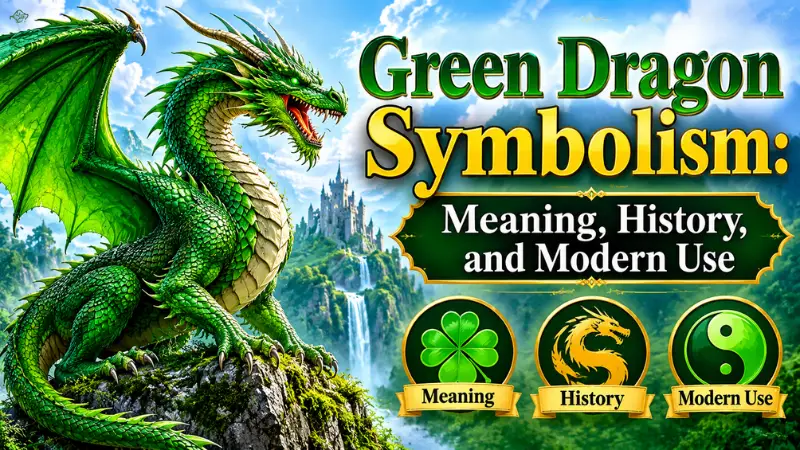
A green dragon is a mythical creature commonly depicted with emerald or forest-green scales, powerful claws, horns, and sometimes large wings. Depending on the artistic tradition, it may appear as a guardian of nature, a ruler of water, a symbol of wisdom, or a dangerous creature with extraordinary abilities. Its meaning comes from the combination of dragon mythology and the cultural associations attached to the color green.
Green dragon symbolism has particularly interesting roots in East Asian traditions, where the Green or Azure Dragon represents the eastern direction, spring, and the element of wood. In contrast, Western fantasy traditions often portray green dragons as creatures associated with forests, magic, poison, or hidden dangers.
In the United States, people encounter green dragons through fantasy literature, video games, tattoos, Asian-inspired artwork, decorative objects, and popular culture. Understanding the symbol requires looking beyond its appearance to the different traditions that have shaped its meaning.
Quick Answer: What Does Green Dragon Symbolism Mean?
Green dragon symbolism commonly represents nature, renewal, wisdom, protection, growth, and vitality in modern American culture. Historically, the Green Dragon of East Asian tradition has been associated with the eastern direction, spring, the wood element, and the natural forces that support life.
TL;DR
- Nature and growth: Green dragons represent vegetation, renewal, and the changing seasons.
- Protection: Dragon mythology connects the creature with guardianship and supernatural authority.
- Ancient origins: The Chinese Azure Dragon represents the east, spring, and the wood element.
- Wisdom and strength: Dragons often communicate intelligence, independence, and personal authority.
- Modern American culture: Green dragons appear in fantasy entertainment, tattoos, artwork, and gaming.
- Transformation: The creature can represent overcoming difficulties and beginning a new chapter.
1. What Is a Green Dragon?
A green dragon is a legendary reptilian creature whose appearance varies across mythology, folklore, literature, and fantasy artwork. Traditional East Asian representations often show dragons with long, serpentine bodies, scales, whiskers, horns, and four limbs. Western fantasy illustrations more frequently depict them with muscular bodies, large wings, sharp teeth, and powerful tails.
The color can range from pale jade and turquoise to deep forest green. Artists sometimes combine green scales with golden horns, yellow eyes, dark claws, or leafy surroundings to emphasize the creature’s connection with nature.
Green dragons commonly appear in several settings:
- Mythological artwork: Representations of legendary dragons in East Asian art and traditional decorative objects.
- Fantasy literature: Creatures that guard forests, ancient treasures, or magical territories.
- Video games: Characters with elemental abilities, intelligence, and supernatural strength.
- Tattoos: Designs representing protection, independence, personal growth, or cultural appreciation.
- Home decoration: Sculptures, paintings, ornaments, and collectible figures.
The meaning depends on the particular dragon tradition. A Chinese Azure Dragon should not automatically be interpreted in the same way as a European fantasy dragon simply because both are green.
2. The Core Symbolic Meanings of a Green Dragon
The green dragon combines two recognizable symbolic elements: the dragon and the color green. Dragons often represent extraordinary strength and authority, while green commonly suggests vegetation, natural growth, and renewal.
Together, these associations produce several interpretations.
Nature and the Natural World
Green is strongly associated with plants, forests, grasslands, and living ecosystems. A green dragon surrounded by trees or mountains can represent the protection of natural environments and the relationship between living creatures and the earth.
Renewal and New Beginnings
Because green plants return during spring, the color frequently suggests fresh starts and seasonal renewal. A green dragon can therefore represent leaving an old situation behind and moving toward a period of development.
Wisdom and Knowledge
Dragons are frequently portrayed as ancient creatures that possess knowledge beyond ordinary human understanding. In fantasy stories, a green dragon may guard forgotten histories, sacred places, or valuable information.
Protection and Guardianship
A dragon protecting a forest, mountain, or hidden treasure communicates the idea of defending something valuable. This interpretation can connect with personal boundaries, loyalty, and responsibility.
Independence and Personal Strength
The dragon’s size, confidence, and ability to survive in dangerous environments make it a recognizable symbol of independence. Its green appearance can soften that impression by connecting strength with nature and personal development.
3. Ancient Origins of the Green Dragon in Chinese Tradition
One of the most historically important examples of a green dragon comes from ancient Chinese cosmology.
The Green Dragon, commonly called the Azure Dragon or Qinglong (青龍), is one of the Four Symbols associated with the four cardinal directions. These supernatural guardians were incorporated into traditional Chinese cosmological thinking, art, and representations of the heavens.
The Azure Dragon represents the east and is associated with spring. Its traditional correspondences include the wood element, which is connected with growth, vegetation, and the developing natural world.
The other three guardians complete the symbolic arrangement:
- Azure Dragon: East, spring, and wood.
- Vermilion Bird: South, summer, and fire.
- White Tiger: West, autumn, and metal.
- Black Tortoise: North, winter, and water.
The arrangement expresses a relationship between direction, seasonal change, and natural processes.
It is important to understand that the traditional Chinese color concept does not always match modern English color categories. The word qing can describe shades that overlap with blue and green. Consequently, the Azure Dragon is also called the Green Dragon or Blue-Green Dragon.
This historical association explains why a green dragon can represent springtime, growth, favorable natural conditions, and the beginning of a new cycle.
4. The Connection Between Green Dragons and the Five Elements
Traditional Chinese philosophy uses the Five Phases, often called the Five Elements in English, to explain relationships between natural processes.
They are wood, fire, earth, metal, and water.
The green or blue-green dragon is associated with wood, which represents the growth of plants, expansion, and the movement of life during spring.
This connection gives the creature a meaning that extends beyond ordinary physical strength.
Wood is associated with development rather than destruction. A green dragon can therefore be interpreted as a guardian of growth, representing the ability to develop while maintaining a connection with the natural environment.
The relationship also explains why green dragons frequently appear in artwork featuring trees, clouds, mountains, and flowing water.
These elements reinforce the association between the dragon and the natural world.
In traditional symbolism, the creature is not simply an animal with unusual abilities. It participates in a larger understanding of how the natural world is organized.
5. What Green Dragon Symbolism Means in the United States
In the United States, green dragons do not have one universally established cultural meaning. Their interpretation depends largely on whether someone encounters them through Asian art, European mythology, fantasy entertainment, or personal design.
Several associations are particularly common.
Fantasy and imagination: Green dragons are familiar creatures in fantasy novels, films, tabletop games, and video games. They can represent a person’s interest in mythology, magical worlds, and imaginative storytelling.
Nature and environmental appreciation: The green color naturally connects the creature with forests, wildlife, vegetation, and environmental protection. Some artists use green dragons as guardians of wilderness areas.
Personal independence: A dragon’s ability to defend itself and command respect makes it an appealing symbol for people who value confidence and self-reliance.
Cultural appreciation: Some Americans encounter green dragon imagery through Chinese and Japanese art, traditional celebrations, museums, and decorative objects. In these settings, understanding the original cultural tradition is important.
Individual identity: A green dragon tattoo, pendant, painting, or collectible can communicate personal interests, creative identity, or an appreciation of mythology.
An interesting historical American connection is Boston’s Green Dragon Tavern. The establishment became associated with colonial political activity and meetings connected with the American revolutionary movement. It was remembered as an important gathering place for revolutionary-era figures.
The tavern’s name demonstrates how green dragon imagery also entered American historical and commercial life, although the tavern’s name should not be confused with the traditional Chinese Azure Dragon.
6. Green Dragon Symbolism Across Different Cultures
Dragon symbolism changes considerably between cultural traditions. The green dragon does not carry an identical meaning everywhere.
| Cultural tradition | Common interpretation | Important association |
|---|---|---|
| Chinese | Growth, favorable natural forces, guardianship | East, spring, and wood |
| Japanese | Protection and natural authority | Water, rain, and spiritual guardianship |
| European folklore | Danger, strength, or supernatural opposition | Legendary creatures and heroic conflicts |
| Modern American fantasy | Nature, magic, intelligence, or danger | Fantasy literature and gaming |
| Contemporary decorative culture | Renewal, individuality, and creativity | Artwork, jewelry, and tattoos |
Chinese Culture
Chinese dragon traditions generally portray dragons as auspicious and extraordinary beings associated with heavenly authority, water, rain, prosperity, and protection.
The Green Dragon of the East adds specific associations with spring and the wood element.
Japanese Culture
Japanese dragon traditions developed through historical interactions with Chinese religious, artistic, and mythological ideas.
Japanese dragons, commonly called ryū, are frequently associated with water, rain, rivers, and protection. Their appearance in temples and traditional artwork can communicate spiritual guardianship.
Green coloration may strengthen associations with nature, although it is not a universal requirement for Japanese dragons.
European Folklore
European dragon stories often present dragons as dangerous creatures that threaten communities, guard treasure, or challenge heroic figures.
Their meanings vary considerably. Some represent destructive forces, while others appear in heraldry and legends as emblems of courage, authority, and protection.
Green coloration does not have one consistent historical meaning across European traditions.
Modern American Interpretations
American audiences combine influences from multiple traditions. A green dragon may be understood as a forest guardian, a fantasy monster, a protective creature, or a reference to Asian mythology.
The surrounding imagery usually provides important clues.
7. The Spiritual Meaning of a Green Dragon
Some people interpret green dragons through personal spirituality, meditation, or contemporary symbolic practices.
In these settings, the creature may represent the relationship between personal development and the natural world.
Its spiritual interpretations commonly include:
- Personal renewal: Moving away from outdated habits and embracing new opportunities.
- Protection: Maintaining emotional boundaries and defending personal values.
- Balance: Finding a healthier relationship between ambition and the natural environment.
- Wisdom: Learning from previous experiences before making important decisions.
- Transformation: Accepting change as part of personal development.
Some contemporary spiritual practitioners also connect green dragons with the heart chakra because green is commonly used to represent compassion, emotional balance, and love in modern chakra-based interpretations.
However, this is a contemporary spiritual association, not a universal historical teaching about the Chinese Azure Dragon.
There is no single religious doctrine that assigns every green dragon the same spiritual meaning. Interpretations should be understood within the particular belief system or personal practice involved.
8. Green Dragon Symbolism in Nature and Environmental Protection
The connection between green dragons and nature is among their most intuitive modern interpretations.
Green is the color of many living plants, while dragons are often imagined as creatures powerful enough to control or protect entire landscapes.
When artists combine these features, the dragon can become a guardian of forests, rivers, mountains, and wildlife.
For example, a green dragon coiled around an ancient tree may represent the importance of preserving natural resources. A dragon flying over a forest can communicate freedom, environmental awareness, and respect for wilderness.
This imagery also works well in environmental storytelling.
A fictional green dragon might defend an endangered forest against destruction or protect a river from pollution. In such a story, its supernatural strength becomes a metaphor for the responsibility to protect ecosystems.
The meaning is particularly relevant in contemporary American environmental art, where animals, trees, and mythical creatures are sometimes used to communicate conservation messages.
9. The Emotional and Psychological Meaning of a Green Dragon
A green dragon can communicate several emotional qualities, depending on its appearance and the situation in which it is presented.
Its symbolic value often comes from the contrast between its intimidating physical strength and the natural associations of its color.
Confidence and Self-Respect
A large dragon with an upright posture and extended wings may communicate confidence and personal authority. Someone who chooses this imagery might associate it with overcoming insecurity or becoming more independent.
Calmness and Stability
Green is often used in visual design to suggest natural surroundings and a sense of balance. When combined with a peaceful dragon, it can produce an impression of stability rather than aggression.
Courage During Change
Dragons frequently appear in stories involving dangerous journeys and difficult challenges. A green dragon can represent the courage needed to enter unfamiliar situations and continue developing.
Connection With Identity
A person may choose dragon imagery because it reflects their interests, personality, artistic preferences, or appreciation of a particular cultural tradition.
These interpretations are symbolic rather than psychological diagnoses. A person’s choice of dragon imagery does not establish their personality or emotional condition.
10. Green Dragon Symbolism in Tattoos and Personal Style
Green dragon tattoos combine traditional mythology with individual artistic expression.
In American tattoo culture, dragon designs are especially adaptable because the creature can be represented in many different styles, from traditional Japanese-inspired artwork to modern fantasy illustrations.
The color green adds another layer of interpretation.
Common designs include:
- Green dragon with a tree: Represents nature, growth, and protection.
- Green dragon with extended wings: Suggests independence, freedom, and ambition.
- Green dragon surrounded by flowers: Connects the creature with renewal and the beauty of the natural world.
- Green dragon with a pearl: Can reference wisdom, enlightenment, and traditional East Asian dragon imagery.
- Green dragon wrapped around a sword: Combines protection, courage, and personal determination.
- Green dragon emerging from water: Suggests natural power, renewal, and the relationship between water and life.
The placement and artistic style also affect the overall impression.
A detailed dragon covering the back or arm may emphasize strength and confidence. A smaller green dragon on the wrist or shoulder may communicate a personal interest in mythology without making the image overly prominent.
People choosing culturally specific designs should also understand their origins. A traditional Chinese Azure Dragon and a European fantasy dragon are not interchangeable symbols.
11. Green Dragons in Fantasy Literature, Gaming, and Popular Culture
Modern fantasy entertainment has helped make green dragons recognizable to American audiences.
In novels, games, and fictional worlds, green dragons can serve as intelligent adversaries, powerful guardians, or supernatural creatures connected with forests.
Their characterization varies by fictional universe.
For example, in Dungeons & Dragons, green dragons are traditionally associated with cunning, manipulation, and poisonous breath. They are often portrayed as calculating creatures that prefer deception over direct confrontation.
This is a specific fantasy convention, not an ancient universal belief about green dragons.
Other fictional works portray green dragons as peaceful protectors, wise companions, or defenders of natural environments.
Their green appearance also helps fantasy creators distinguish them from dragons associated with fire, ice, lightning, or other elements.
In video games, the creature may function as a boss character, an ally, a mount, or a rare magical creature.
For American audiences, these entertainment settings are among the most familiar sources of green dragon imagery.
12. The Meaning of Seeing a Green Dragon in a Dream
Dreaming about a green dragon can be interpreted in different ways depending on the dream’s setting, emotional atmosphere, and the creature’s behavior.
There is no scientifically established universal meaning for a particular dream symbol. Nevertheless, people sometimes use personal symbolism to reflect on their experiences.
Some possible interpretations include:
A friendly green dragon: May represent confidence, reassurance, protection, or a supportive influence.
An aggressive green dragon: Could reflect a personal challenge, conflict, or situation that feels difficult to control.
A flying green dragon: May suggest ambition, independence, or a desire to move beyond current limitations.
A green dragon in a forest: Can reflect a personal connection with nature, renewal, or the need for a fresh start.
A sleeping green dragon: Might represent unused potential, patience, or an ability that has not yet been developed.
The most useful question is how the dream made the person feel. A peaceful encounter may have a different personal significance from a frightening confrontation.
Dream interpretations should be treated as opportunities for reflection, not predictions of future events.
13. Positive and Negative Meanings of the Green Dragon
Green dragons can represent favorable or unfavorable qualities. Their meaning is not automatically positive simply because they are green.
The cultural tradition and visual presentation make a difference.
| Positive symbolism | Negative symbolism |
|---|---|
| Growth and renewal | Jealousy or possessiveness |
| Wisdom and knowledge | Manipulation and deception |
| Protection and guardianship | Aggression and intimidation |
| Independence and confidence | Excessive pride |
| Natural balance | Destructive natural forces |
| Transformation | Fear of change |
In traditional Chinese symbolism, the Azure Dragon is generally an auspicious guardian associated with the east and spring.
In some Western fantasy settings, however, green dragons are depicted as deceptive, dangerous, or poisonous.
The contrast is important because modern entertainment sometimes influences how people interpret symbols that originated in different cultural traditions.
Neither interpretation should be treated as the universal meaning of every green dragon.
14. Common Misunderstandings About Green Dragon Symbolism
Several misconceptions arise when people combine different dragon traditions without considering their historical backgrounds.
Misunderstanding 1: Every green dragon represents the Chinese Azure Dragon.
Not necessarily. The Azure Dragon has a specific historical identity within Chinese cosmology. A green dragon in a modern fantasy game may have no connection with that tradition.
Misunderstanding 2: Green dragons are always peaceful.
Some traditions associate dragons with protection and favorable natural forces, while fictional settings may portray green dragons as aggressive or dangerous.
Misunderstanding 3: Green dragons have one universal spiritual meaning.
Their spiritual interpretations vary across cultures and individual beliefs. No single meaning applies to every religious or spiritual tradition.
Misunderstanding 4: Green dragons are exclusively associated with nature.
Nature is a common modern interpretation, but dragons can also represent authority, wisdom, water, prosperity, danger, and supernatural power.
Misunderstanding 5: A green dragon always represents jealousy.
Green sometimes carries associations with envy in Western expressions and visual conventions. However, this is only one possible association of the color and does not define the historical meaning of the Green Dragon.
Understanding these distinctions prevents modern interpretations from being incorrectly presented as ancient cultural beliefs.
15. How Green Dragon Symbolism Has Evolved Over Time
The meaning of the green dragon has changed as dragon imagery moved between cultures, artistic traditions, and forms of entertainment.
In ancient Chinese cosmology, the Green or Azure Dragon became associated with the east, spring, and wood. Its role reflected a broader understanding of the natural world and the relationship between seasonal change and cosmic order.
In later East Asian artistic traditions, dragon imagery continued to appear in paintings, ceramics, textiles, architecture, and decorative objects. Its associations with authority, rain, protection, and auspicious natural forces remained important.
European traditions developed different interpretations of dragons. They frequently appeared in heroic legends, religious imagery, heraldry, and stories about dangerous supernatural creatures.
In modern America, the dragon became increasingly familiar through translated mythology, fantasy novels, movies, role-playing games, animation, and video games.
The green version gained additional associations with forests, magical environments, environmental protection, and fantasy creatures.
Today, its meaning is more flexible than ever. Someone viewing an Azure Dragon in traditional Asian artwork may recognize its historical cosmological significance, while someone encountering a green dragon in a fantasy game may associate it with poison, magic, or deception.
The symbol has not lost its earlier meanings; rather, new interpretations have developed alongside them.
FAQs
1. Is a green dragon a symbol of good luck?
In the context of the Chinese Azure Dragon, the creature is generally regarded as an auspicious guardian associated with favorable natural forces and spring. However, green dragons in Western fantasy stories do not necessarily represent good fortune.
2. What does a green dragon tattoo symbolize?
A green dragon tattoo can represent nature, protection, wisdom, personal strength, independence, and transformation. Its meaning also depends on the design, cultural inspiration, and personal reasons behind choosing the tattoo.
3. What does the Green Dragon represent in Chinese mythology?
The Green Dragon, or Azure Dragon, represents the eastern direction and the season of spring. It is also associated with the wood element and forms one of the Four Symbols in traditional Chinese cosmology.
4. Is a green dragon a symbol of protection?
Yes, protection is a common interpretation of dragon imagery, particularly in East Asian traditions where dragons can serve as guardians of important natural and spiritual forces. In contemporary artwork, a green dragon protecting a tree or forest often communicates environmental guardianship.
5. What does a green dragon symbolize spiritually?
In contemporary spiritual interpretations, a green dragon may represent personal growth, renewal, protection, wisdom, and balance with nature. Some people also connect its green color with the heart chakra, although this is not a universal historical association.
6. Are green dragons good or evil?
Green dragons can be portrayed as either benevolent or dangerous. Chinese Azure Dragon traditions generally emphasize auspicious guardianship, while certain Western fantasy settings depict green dragons as deceptive and hostile creatures.
7. Why are dragons often depicted in green?
Green helps artists connect dragons with forests, vegetation, springtime, and natural environments. It also provides a recognizable visual identity for fantasy creatures associated with forests, poison, magic, or other fictional abilities.
Conclusion
Green dragon symbolism combines the dragon’s traditional associations with supernatural strength, wisdom, and protection with the color green’s connections to nature, growth, and renewal. Its historical roots are especially significant in Chinese cosmology, where the Azure Dragon represents the east, spring, and the wood element.
In modern American culture, green dragons appear in fantasy entertainment, tattoos, decorative artwork, gaming, and personal expressions of identity. Depending on the context, they can represent environmental appreciation, independence, courage, guardianship, or the challenges of personal transformation.
Ultimately, understanding a green dragon requires looking at its cultural background and visual setting. Whether it appears as an ancient celestial guardian or a fictional forest creature, its symbolism reflects the relationship between natural growth, extraordinary strength, and the stories people create around mythical beings.