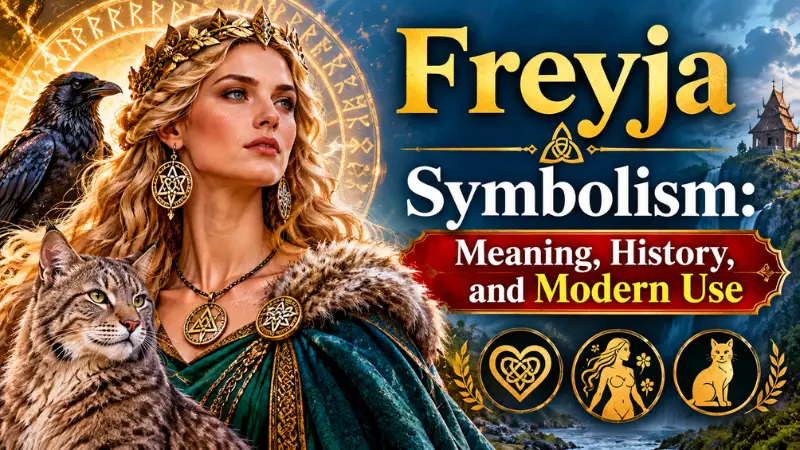
Freyja symbolism comes from Norse mythology, where Freyja represents love, beauty, fertility, magic, independence, and the courage associated with battle. She is one of the most prominent goddesses in the Old Norse tradition, known for combining qualities that are sometimes treated as opposites: sensuality and strength, affection and authority, life and death. Her image continues to attract attention in modern American pagan spirituality, jewelry, tattoos, fantasy art, and discussions of feminine power.
Unlike symbols that communicate one simple idea, Freyja’s identity has several layers. Her necklace represents beauty and desire, her cats suggest independence and mystery, and her association with battle gives her a place in stories about courage and the afterlife. Understanding these connections helps explain why she remains relevant to people interested in mythology, personal identity, and spiritual symbolism.
Quick Answer
Freyja symbolism commonly represents love, feminine independence, beauty, fertility, and personal strength in modern American culture. Historically, the Norse goddess was also associated with seiðr magic, warfare, prosperity, and receiving half of the warriors who died in battle.
TL;DR
- Love and beauty: Freyja represents attraction, affection, sensuality, and romantic desire.
- Fertility: Her mythology connects her with growth, prosperity, and reproductive life.
- Independence: She symbolizes a woman who exercises personal choice and authority.
- Magic: Her association with seiðr represents spiritual knowledge and divination.
- Warrior strength: She shares responsibility for receiving warriors killed in battle.
- Modern identity: Her image appears in pagan spirituality, tattoos, jewelry, and fantasy art.
Who Is Freyja in Norse Mythology?
Freyja is a major goddess in Norse mythology and belongs to the Vanir, a family of deities associated with fertility, prosperity, and aspects of the natural world. She is the daughter of Njörðr and the sister of Freyr. Her name is commonly understood as meaning “Lady,” reflecting her elevated status.
She is sometimes associated with the Æsir, the other major family of Norse gods, because the mythological traditions describe an exchange of hostages following a conflict between the two groups. Freyja eventually becomes an important figure among the gods.
Her character is more complicated than the familiar image of a beautiful goddess of love. She has connections to magic, battle, wealth, and the dead. In the surviving stories, she can express desire, exercise authority, and make decisions that affect other powerful figures.
This combination makes Freyja different from a goddess whose role is limited to romance or motherhood. She represents a broader understanding of feminine authority in the Norse mythological world.
The Core Symbolic Meanings of Freyja
Freyja carries several symbolic meanings because her mythology connects different parts of human experience. Her associations with relationships, fertility, magic, and warfare make her relevant to people exploring both personal and spiritual themes.
1. Love, Attraction, and Romantic Desire
Love is one of Freyja’s most recognizable associations. Norse stories connect her with romantic attraction, desire, beauty, and intimate relationships.
However, her symbolism is not limited to marriage or conventional romance. She represents attraction as an expression of personal choice and emotional freedom. Her character does not simply exist to make other people happy or fulfill their expectations.
In modern American interpretations, Freyja can represent:
- Romantic love and emotional connection.
- Confidence in expressing attraction.
- Sexual autonomy and personal boundaries.
- Appreciation of beauty and physical identity.
- The freedom to choose one’s relationships.
For someone interested in love symbolism, Freyja offers a more independent interpretation than a traditional romantic figure. Her stories suggest that affection and desire can exist alongside personal authority.
2. Feminine Strength and Independence
Freyja is frequently interpreted as a symbol of feminine strength because she occupies a position of authority among the Norse gods.
She is not simply a companion to a male deity. She has her own dwelling, responsibilities, abilities, and influence. Her decisions matter, and even powerful gods recognize her importance.
This makes her especially relevant to contemporary conversations about women’s independence.
In the United States, people may connect Freyja with:
- Women’s empowerment and self-determination.
- Confidence in personal decisions.
- Independence within relationships.
- Leadership and individual authority.
- Strength without sacrificing compassion.
Her symbolism does not suggest that strength requires rejecting affection or beauty. Instead, Freyja represents the possibility of possessing both.
3. Fertility, Growth, and Prosperity
Freyja’s connection to the Vanir places her within a mythological tradition associated with fertility, abundance, and prosperity.
Fertility in this context has broader implications than pregnancy. It can represent the ability of living things to grow, reproduce, and sustain themselves.
Her symbolism can therefore be interpreted through several ideas:
- Physical fertility and reproductive life.
- Agricultural abundance and natural growth.
- Financial prosperity and material well-being.
- Creativity and the development of new ideas.
- Emotional growth and renewed relationships.
Modern spiritual interpretations sometimes use Freyja as a figure associated with abundance and new beginnings.
It is important, however, to distinguish these contemporary interpretations from specific historical religious practices. The surviving Norse sources do not provide a complete modern-style system of fertility rituals dedicated to Freyja.
Ancient Roots and Historical Origins of Freyja’s Symbolism
Most detailed written descriptions of Freyja come from medieval Icelandic texts, particularly the Poetic Edda and Snorri Sturluson’s Prose Edda.
These works preserve older Norse mythological material, although they were written down after Scandinavia’s conversion to Christianity. Consequently, they offer important evidence about earlier beliefs but should not automatically be treated as direct records of every Viking Age religious practice.
Freyja’s identity developed through stories about her family, supernatural abilities, possessions, and relationships with other gods.
One important feature of her mythology is her connection to the Vanir. The conflict between the Vanir and Æsir, followed by their reconciliation, places her within a larger story about divine relationships and the exchange of knowledge.
Her association with fertility and prosperity reflects her Vanir background, while her connections to magic and warfare give her a more complex position.
Archaeological objects from Viking Age Scandinavia also provide useful context. Cat figurines, staffs, jewelry, and female representations have sometimes been connected with Freyja. However, identifying a particular archaeological object as an image of the goddess is not always certain.
Her symbolism therefore comes from a combination of surviving literature, archaeological interpretation, and later cultural understanding.
The Meaning of Freyja’s Most Recognizable Symbols
Freyja is associated with several objects and animals that help communicate different aspects of her character. These images frequently appear in modern artwork and personal designs.
Brísingamen: The Necklace of Beauty and Desire
Brísingamen is Freyja’s famous necklace, described in Norse mythological tradition as an exceptionally beautiful and desirable piece of jewelry.
Its story connects beauty with desire, personal choice, and conflict. In one account, four dwarfs create the necklace, and Freyja obtains it through an arrangement involving each of them.
The necklace later becomes the subject of conflict involving Loki and Odin.
Symbolically, Brísingamen is commonly interpreted as representing:
- Beauty and personal adornment.
- Attraction and romantic desire.
- Wealth and precious possessions.
- Self-expression and feminine identity.
- The complicated relationship between beauty and power.
In modern jewelry, a necklace inspired by Brísingamen can serve as a personal reminder of confidence, beauty, and independence.
Cats: Independence and Mystery
Freyja’s chariot is described in the Prose Edda as being pulled by cats. This unusual detail has become one of the most recognizable visual elements associated with her.
Cats can suggest independence, alertness, grace, and an ability to move between different environments. These qualities fit many modern interpretations of Freyja’s personality.
For contemporary audiences, her cats may symbolize:
- Self-reliance and personal freedom.
- Intuition and awareness.
- Grace and confidence.
- Curiosity and adaptability.
- The balance between affection and independence.
Cat imagery is especially popular in modern illustrations of Freyja because it makes her mythology visually distinctive.
The Falcon Cloak: Transformation and Freedom
Norse mythological stories describe a feather garment associated with Freyja that allows its wearer to travel through the air in falcon form. She lends this garment to Loki in a story involving a journey to the world of giants.
The falcon cloak can represent transformation, movement, and the ability to cross boundaries.
In modern symbolic interpretations, it may communicate:
- Freedom from restrictive circumstances.
- Personal transformation.
- Independence and exploration.
- Adaptability during difficult changes.
- A broader perspective on life’s challenges.
It is also a useful reminder that Freyja’s mythology includes abilities beyond romance and beauty.
The Boar: Courage and Warrior Identity
Freyja is associated with a golden-bristled boar named Hildisvíni, whose name is commonly translated as Battle-Swine.
The boar has strong connections with warfare and martial identity in Germanic traditions. Its appearance in Freyja’s mythology adds another dimension to her character.
It can symbolize courage, determination, protection, and the willingness to confront danger.
For modern audiences, the boar is a fitting image for someone who wants to express resilience rather than romantic or decorative aspects of Freyja.
Freyja, Seiðr Magic, and Spiritual Knowledge
One of the most distinctive aspects of Freyja’s mythology is her association with seiðr, a form of Old Norse magic connected with divination and supernatural knowledge.
In the Ynglinga saga, Freyja is described as teaching seiðr to the Æsir. Odin, who is also strongly associated with magic and knowledge, becomes connected to this practice.
Seiðr is not simply equivalent to modern fortune-telling. Historical interpretations connect it with a range of ritual practices involving prophecy, influence, and interactions with unseen forces.
Freyja’s association with this tradition contributes to her symbolism of:
- Spiritual knowledge and awareness.
- Intuition and foresight.
- Transformation and personal discovery.
- Hidden knowledge and ritual practice.
- The pursuit of wisdom beyond ordinary experience.
In contemporary American pagan communities, Freyja may be honored as a goddess associated with magic, spiritual practice, and personal development.
However, modern interpretations of seiðr vary, and present-day practices should not automatically be assumed to reproduce ancient Scandinavian rituals.
Freyja and the Symbolism of Death and the Afterlife
Freyja has a significant connection to death that is sometimes overlooked in modern depictions of her as a goddess of beauty and love.
According to the Prose Edda, Freyja rules over Fólkvangr, a heavenly field where she receives half of those killed in battle. Odin receives the other half.
Her hall within Fólkvangr is called Sessrúmnir.
This association places Freyja alongside Odin in an important aspect of the Norse understanding of the afterlife. She is not simply a goddess concerned with the beginning of life; her mythology also addresses what happens when life ends.
Her connection to death can symbolize:
- Courage in the face of mortality.
- Honor and recognition after death.
- The continuation of identity beyond physical life.
- Respect for those who have died.
- The relationship between bravery and sacrifice.
This aspect makes Freyja particularly interesting because it connects her associations with love and fertility to the realities of loss and mortality.
It also corrects the common assumption that Valhalla was the only important destination for warriors in Norse mythology.
What Freyja Symbolism Means in the United States
Freyja is not a mainstream American religious symbol in the same way that the cross, dove, or national flag is widely recognized. Her presence is more concentrated in Norse mythology education, modern Heathen and pagan communities, fantasy culture, and personal artistic expression.
Nevertheless, her image has become recognizable to people interested in Scandinavian heritage and mythology.
In the United States, her symbolism commonly appears in several settings.
Modern pagan spirituality: Some practitioners of Heathenry and other Norse-inspired spiritual traditions honor Freyja as a deity. Her associations with love, fertility, magic, and warfare inform different forms of devotion.
Women’s identity and empowerment: Contemporary audiences may interpret her as an independent female figure who combines beauty, confidence, sexuality, and authority.
Jewelry and fashion: Necklaces, pendants, and other decorative objects inspired by Brísingamen allow people to express an interest in Norse mythology.
Fantasy and entertainment: Freyja appears in modern retellings, games, illustrations, and fantasy-inspired artwork. These interpretations sometimes emphasize her magical abilities or warrior identity.
Scandinavian heritage: Some Americans with an interest in Nordic ancestry explore Freyja as part of a broader interest in pre-Christian Scandinavian traditions. However, appreciating her mythology does not require Scandinavian ancestry.
Her American cultural meaning is therefore flexible. Some people approach her as a religious figure, others as a mythological character, and others as a symbol of independence.
Freyja Symbolism Across Different Modern Contexts
The meaning of Freyja changes according to how and where her image appears. A tattoo, a necklace, and a spiritual illustration may communicate different aspects of the same goddess.
| Context | Common Meaning | Main Association | Modern Interpretation |
|---|---|---|---|
| Jewelry | Beauty and desire | Brísingamen | Confidence and self-expression |
| Tattoos | Independence and strength | Goddess imagery | Personal identity |
| Spiritual practice | Magic and devotion | Seiðr | Religious or spiritual connection |
| Cat imagery | Freedom and intuition | Chariot cats | Self-reliance |
| Boar imagery | Courage and determination | Hildisvíni | Warrior identity |
| Fantasy art | Feminine authority | Goddess mythology | Creativity and transformation |
These interpretations are not universal religious rules. They are contemporary ways of expressing ideas associated with Freyja’s mythology.
The Emotional and Psychological Meaning of Freyja
Freyja can represent a combination of emotions that people sometimes struggle to reconcile.
For example, someone may want to be independent while also wanting emotional intimacy. Another person may value physical beauty but reject the idea that appearance should determine personal worth.
Freyja’s mythology offers a figure through which these qualities can be considered together.
Her emotional symbolism may include:
Self-confidence: Her authority and independence can represent trust in personal decisions.
Emotional freedom: Her association with desire can remind people that affection and attraction involve personal choice.
Resilience: Her connection to battle and the afterlife offers an image of courage when facing difficult circumstances.
Curiosity: Her magical associations can represent the desire to explore knowledge and understand unfamiliar experiences.
Personal growth: Her different mythological roles can encourage people to recognize that identity is not limited to one characteristic.
From a psychological perspective, these are modern interpretations rather than scientifically established effects of a mythological symbol.
For some people, Freyja is simply an interesting character. For others, her stories provide a way to think about confidence, relationships, and personal development.
Why People Choose Freyja Tattoos and Jewelry
Freyja-inspired tattoos and jewelry appeal to people who want a design with connections to mythology, feminine identity, and personal independence.
Unlike a simple heart or flower, her imagery offers several possible meanings depending on the design.
Popular tattoo ideas include:
- Freyja’s portrait: Represents feminine authority, beauty, and independence.
- Brísingamen necklace: Communicates self-worth, attraction, and appreciation of beauty.
- Two cats: Represents independence, intuition, and companionship.
- Falcon feathers: Suggest freedom, transformation, and exploration.
- A golden boar: Represents determination, courage, and warrior strength.
- Norse-inspired artwork: Expresses an interest in Scandinavian mythology and cultural history.
Jewelry inspired by her mythology can have a similar purpose. A pendant featuring a necklace design or a cat motif may be worn as an expression of personal identity.
There is no single historically verified Freyja emblem that every tattoo or jewelry design must reproduce. Modern artists often combine details from different stories to create their own interpretations.
Anyone considering a historically inspired design should also distinguish authentic historical motifs from modern fantasy artwork.
Freyja Compared With Other Norse Goddesses
Freyja is sometimes confused with Frigg because both are prominent female figures in Norse mythology and share certain associations.
The relationship between these goddesses has been discussed by scholars, but the surviving sources do not establish that they are simply the same goddess under two names.
Frigg is especially associated with marriage, motherhood, and her position as Odin’s wife. Freyja has more explicit connections to desire, fertility, seiðr magic, and the warriors received in Fólkvangr.
Their characteristics overlap, but their mythological identities are distinct in the surviving accounts.
| Goddess | Major Associations | Distinctive Symbolic Themes |
|---|---|---|
| Freyja | Love, fertility, magic, battle | Independence and desire |
| Frigg | Marriage, motherhood, foresight | Family and domestic authority |
| Sif | Marriage and fertility | Family and agricultural associations |
| Hel | The dead and the underworld | Mortality and the afterlife |
| Skaði | Winter, mountains, hunting | Independence and survival |
Comparing these figures helps explain why Freyja cannot be reduced to a generic goddess of love. Her mythology gives her responsibilities and qualities that distinguish her from other female deities.
Controversies and Common Misunderstandings About Freyja
Modern interpretations of Freyja sometimes simplify her mythology or confuse historical traditions with contemporary spiritual ideas.
Understanding these distinctions makes it easier to appreciate her symbolism without repeating inaccurate claims.
Misunderstanding 1: Freyja was only a goddess of love.
Love and desire are important aspects of her mythology, but she also has connections to magic, fertility, warfare, and the afterlife.
Misunderstanding 2: Freyja and Frigg were definitely the same goddess.
Their identities and possible historical relationship remain subjects of scholarly discussion. The surviving Norse texts frequently present them as distinct figures.
Misunderstanding 3: Freyja’s symbols have one universal meaning.
A cat, necklace, falcon, or boar may communicate different ideas depending on the context. Modern spiritual practitioners and artists do not necessarily interpret them identically.
Misunderstanding 4: Every Norse-inspired symbol represents extremist beliefs.
Some ancient European and Norse symbols have been appropriated by white supremacist movements. However, Norse mythology and its religious traditions are not inherently racist. Context matters, and a person’s use of Norse-inspired imagery should not automatically be treated as evidence of extremist beliefs.
Misunderstanding 5: Modern Freyja worship perfectly reproduces Viking Age religion.
Contemporary Heathen and pagan practices are modern religious expressions informed by historical sources. The available evidence does not provide a complete record of ancient rituals, so claims of exact continuity should be approached cautiously.
Separating documented mythology from modern interpretation allows Freyja’s cultural importance to be understood more accurately.
How Freyja’s Symbolism Has Evolved Over Time
Freyja’s meaning has changed as different generations have encountered Norse mythology.
In pre-Christian Scandinavian religious traditions, she was understood as a goddess with connections to fertility, desire, magic, and the fate of the dead. These associations belonged to a wider religious world in which different deities had overlapping responsibilities.
After Christianity spread through Scandinavia, older pagan religious traditions gradually lost their central public position. Much of what modern readers know about Freyja comes from medieval texts written in a Christianized environment.
During the nineteenth century, growing European interest in folklore, medieval literature, and national history helped bring Norse mythology to wider audiences. Romantic artists and writers frequently reinterpreted ancient gods through the cultural ideas of their own time.
In the twentieth century, Norse mythology became increasingly visible through literature, fantasy, popular entertainment, and renewed interest in pre-Christian spirituality.
Today, Freyja has several overlapping identities:
- A goddess in historical Norse mythology.
- A figure honored in some modern pagan traditions.
- An image of feminine independence and authority.
- A character in contemporary fantasy and entertainment.
- A source of inspiration for tattoos, jewelry, and artwork.
Her modern popularity reflects the fact that her mythology contains more than one recognizable human quality. Different audiences can connect with different parts of her story without necessarily sharing the same religious beliefs.
FAQs
1. What does Freyja symbolize spiritually?
Freyja spiritually symbolizes love, fertility, independence, magic, and feminine authority. In modern Norse-inspired spiritual practices, she may also be associated with intuition, prosperity, personal confidence, and devotion.
2. Is Freyja a goddess of love or war?
Freyja is associated with both love and warfare in Norse mythology. Her role in receiving half of the warriors killed in battle demonstrates that her responsibilities extend beyond romance and fertility.
3. What does a Freyja tattoo mean?
A Freyja tattoo commonly represents feminine strength, independence, confidence, romantic freedom, or an interest in Norse mythology. Its specific meaning depends on the imagery, such as cats, a necklace, a falcon, or a warrior-inspired portrait.
4. What animal represents Freyja?
Cats are among the most recognizable animals associated with Freyja because two cats pull her chariot in the Prose Edda. She is also connected with a boar named Hildisvíni and a falcon-feather garment.
5. Is Freyja associated with witchcraft?
Freyja is associated with seiðr, a form of Old Norse magic connected with divination and supernatural knowledge. This association makes her an important figure in modern discussions of Norse magic, although historical seiðr should not be treated as identical to every modern form of witchcraft.
6. Are Freyja and Frigg the same goddess?
The surviving Norse sources generally distinguish Freyja and Frigg as separate goddesses. Some scholars have explored possible historical connections between them, but their identities should not be treated as unquestionably identical.
7. Is Freyja considered a positive symbol?
Freyja is generally interpreted positively in modern symbolic contexts, particularly as a figure of love, independence, courage, and self-confidence. Her connection to warfare and death adds complexity rather than making her an inherently negative figure.
Conclusion
Freyja represents a combination of love, beauty, fertility, independence, magic, and warrior strength. Her mythology challenges the idea that feminine identity must fit into one narrow role. She can be associated with affection and desire while also exercising authority and participating in the fate of warriors.
Freyja symbolism remains relevant in modern American culture through Norse-inspired spirituality, mythology, tattoos, jewelry, and artistic expression. Some people connect with her as a goddess, while others appreciate her as a representation of confidence, freedom, and personal identity.
Ultimately, her most recognizable lesson is that beauty, compassion, independence, and courage do not have to exist separately. They can all be part of the same identity.