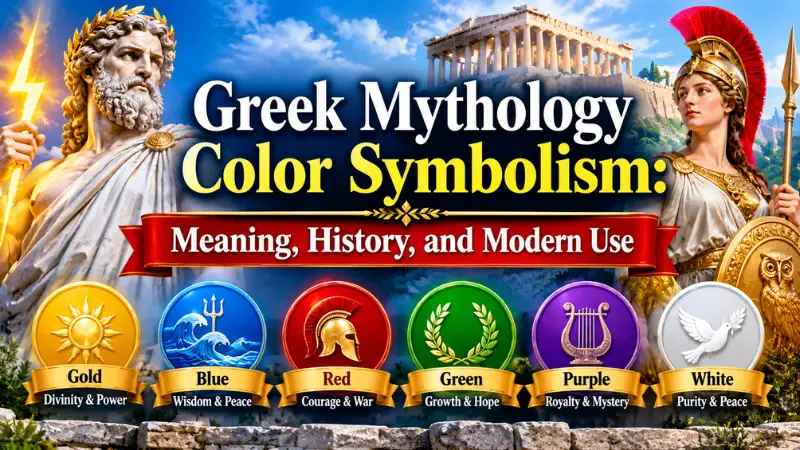
Greek mythology color symbolism explores how colors communicate the identities, powers, emotions, and stories of ancient Greek gods, goddesses, and legendary figures. Colors appear in descriptions of divine clothing, sacred objects, natural elements, weapons, flowers, and artistic representations. Although ancient Greek myths did not follow one universal color code, particular colors became associated with certain gods, religious ideas, and aspects of human life.
For example, gold is frequently connected with divine status and immortality, while white often suggests purity, ritual cleanliness, or divine presence. Red can communicate bloodshed, love, conflict, and sacrifice, depending on the story. Purple, historically associated with expensive dyes and royal clothing, can suggest wealth and authority.
These associations remain interesting to modern American readers because Greek mythology continues to influence literature, films, fashion, tattoos, artwork, architecture, and popular culture. Understanding the historical context behind these colors makes it easier to distinguish ancient Greek beliefs from modern interpretations.
Quick Answer
Greek mythology color symbolism commonly associates gold with divinity and immortality, white with purity and sacredness, red with passion and warfare, blue with the sea and divine protection, and purple with wealth and royalty. In ancient Greek culture, these associations developed through mythology, religious practices, natural materials, artistic traditions, and the social importance of colored clothing.
TL;DR
- Gold represents divine authority, immortality, and exceptional beauty.
- White is associated with purity, sacred rituals, and light.
- Red communicates love, bloodshed, courage, and conflict.
- Blue reflects the sea, the sky, and divine connections.
- Purple traditionally suggests wealth, prestige, and authority.
- Modern interpretations adapt these ancient associations for art, fashion, and tattoos.
1. How Colors Functioned in Ancient Greek Mythology
Color in Greek mythology was more than decoration. It helped artists, poets, and storytellers communicate a character’s identity, social position, emotional condition, and relationship with the divine.
The ancient Greeks encountered color in several forms:
- Mythological descriptions: Poets used color-related descriptions to portray gods, heroes, landscapes, and supernatural events.
- Religious objects: Sacred statues, temple decorations, offerings, and ceremonial clothing incorporated different colors.
- Natural symbolism: The sea, sunlight, flowers, forests, blood, and darkness provided familiar visual associations.
- Artistic representation: Painters and sculptors used pigments to distinguish clothing, weapons, armor, hair, and other identifying features.
One important historical detail changes how modern readers should imagine Greek mythology: ancient Greek sculptures were not generally intended to look like plain white marble. Many were originally painted in multiple colors, sometimes with additional decorative materials.
Archaeological investigations have identified traces of blue, red, yellow, green, and other pigments on surviving sculptures. These discoveries show that color was an important part of ancient Greek visual culture, even though much of it disappeared through weathering, burial, and later cleaning. The Metropolitan Museum of Art+2
This also explains why modern representations of Greek gods sometimes look different from their original ancient counterparts. The familiar white marble appearance reflects centuries of preservation and artistic preference rather than the complete appearance of Greek religious art.
2. Gold Symbolism: Divine Authority, Immortality, and Excellence
Fitzwilliam Museum acquire Apollo Bronze as part of AIL – Art History News – by Bendor Grosvenor
Tours y actividades en Atenas: Descubre su historia y cultura – Civitatis México
Jason and the Argonauts: A Detailed Breakdown of the Greek Myth | TheCollector
9
Gold is one of the most recognizable colors associated with Greek mythology. Its connection with sunlight, precious metals, exceptional beauty, and expensive objects made it a natural visual language for divine distinction.
Gold commonly represents:
- Divine authority and superiority
- Immortality and the supernatural
- Wealth and exceptional status
- Beauty, excellence, and perfection
- Victory and heroic achievement
The association with the divine appears in descriptions of gods and their possessions. Homeric poetry, for example, frequently uses gold to describe divine equipment, elaborate objects, and the splendor of the Olympian world.
Apollo is particularly compatible with modern interpretations of gold because of his associations with sunlight, music, prophecy, and artistic excellence. However, the familiar idea that Apollo must always be represented in gold is a later visual convention, not a universal ancient color rule.
Another important example is the Golden Fleece in the story of Jason and the Argonauts. The fleece represents a royal prize and the extraordinary challenge involved in obtaining it. Its golden appearance communicates rarity, prestige, and exceptional value.
In contemporary American culture, gold-colored Greek mythology artwork often represents ambition, achievement, wisdom, and spiritual distinction. People may choose golden Apollo artwork or mythological jewelry to express confidence, creativity, or a connection with classical ideals.
3. White Symbolism: Purity, Sacredness, and Divine Presence
El nacimiento de Atenea: mito, origen y significado de la diosa de la sabiduría – Juicy Spanish
White frequently appears in modern representations of Greek gods and goddesses. It is commonly associated with purity, light, innocence, sacredness, and ceremonial importance.
In ancient Greek religious life, white clothing and objects could have particular ritual associations. However, the meaning depended on the ceremony, deity, and local tradition rather than following one fixed rule.
White can symbolize:
- Ritual cleanliness and preparation
- Purity and innocence
- Sacredness and divine presence
- Peace and reconciliation
- Light in contrast with darkness
The goddess Artemis, associated with hunting, wilderness, childbirth, and protection, is frequently depicted wearing pale or white garments in later artwork. These depictions emphasize her independence and connection with nature, although white was not an exclusive color of her worship.
White also appears in artistic representations of Athena, whose traditional attributes include a helmet, spear, shield, and owl. Modern artists often use white clothing to communicate her wisdom, dignity, and disciplined character.
For American audiences, white Greek-inspired clothing and decorations can suggest classical beauty, simplicity, spirituality, and elegance. White statues, wedding decorations, and mythological illustrations often draw on these familiar associations.
Nevertheless, ancient Greek ideas about purity should not be confused with modern assumptions that white always means goodness. In mythology, morally complex characters can also appear in white.
4. Red Symbolism: Love, Bloodshed, Courage, and Conflict
Бог війни Арес у давньогрецькій міфології
Red is a particularly flexible color in Greek mythology because it can represent both attraction and destruction.
Its most recognizable associations include:
- Passion and romantic desire
- Blood, sacrifice, and mortality
- Warfare and physical courage
- Anger and aggression
- Vitality and intense emotion
The connection between red and warfare is especially relevant to Ares, the Greek god of war. Ares represents the violent, destructive, and unpredictable aspects of battle. Modern artists frequently use red armor, clothing, or backgrounds to communicate his aggressive character.
Red also fits the mythology of Aphrodite, the goddess of love and desire. Roses, especially red roses in later artistic traditions, became familiar symbols of romantic affection and beauty.
However, Aphrodite’s ancient associations cannot be reduced to red. Her mythology also includes the sea, fertility, beauty, and the complexities of human relationships.
Red therefore has two contrasting interpretations. It can represent the excitement of love and attraction, but it can also suggest jealousy, violence, heartbreak, and loss.
In the United States, red Greek mythology tattoos and artwork often communicate strength, romantic intensity, determination, or a willingness to confront difficult experiences.
5. Blue Symbolism: The Sea, the Sky, and Divine Protection
Blue is naturally connected with the Greek gods because of the importance of the Mediterranean Sea and the open sky in ancient Greek life.
Its common symbolic associations include:
- The ocean and maritime power
- Calmness and emotional balance
- Freedom and exploration
- Protection and authority
- The supernatural world
The clearest mythological connection is Poseidon, the god of the sea, earthquakes, and horses. His trident and association with oceanic power make blue a popular modern color for representing him.
In modern illustrations, Poseidon is often surrounded by turquoise waves, deep-blue water, and stormy skies. These colors communicate both the beauty and unpredictability of the sea.
Blue also appears in modern representations of Athena, particularly when artists want to emphasize her intelligence, strategic thinking, and connection with the city of Athens.
It is important to distinguish these artistic choices from historical evidence. Ancient Greeks did not necessarily assign one exclusive shade of blue to Poseidon or Athena. Their visual traditions used color in different ways depending on the artwork and available materials.
For Americans, blue Greek mythology artwork frequently represents confidence, stability, intelligence, and emotional control. Poseidon-themed decorations, in particular, appeal to people interested in the ocean, maritime history, and adventure.
6. Purple Symbolism: Royalty, Wealth, and Exceptional Status
The Enigmatic Tale of Polycrates’ Ring | History
Purple carries a strong connection with wealth and prestige because producing certain purple dyes in the ancient Mediterranean was expensive and labor-intensive.
Some highly valued purple dyes came from marine mollusks, particularly murex snails. Their production required considerable effort and resources, making purple textiles prestigious possessions.
In Greek mythology and ancient literature, purple-related descriptions could communicate:
- Royal status and authority
- Wealth and luxury
- Honor and distinction
- Dramatic emotion
- The prestige of important individuals
The connection between purple and royalty is particularly important in the story of King Minos and the royal world of Crete, although purple should not be treated as a fixed identifying color for every Greek ruler.
Purple also appears in Homeric descriptions, but an important linguistic complication exists. The ancient Greek term porphyreos did not always refer to a simple modern purple color. Depending on context, it could describe turbulent movement, changing surfaces, or the appearance of blood and other objects.
This makes ancient color interpretation more complicated than matching Greek words with modern color charts. research-bulletin.chs.harvard.edu+1
Today, purple Greek mythology designs are popular in fantasy artwork, jewelry, clothing, and decorative illustrations. They commonly suggest mystery, creativity, prestige, and an association with the supernatural.
7. Black Symbolism: Death, the Underworld, and Transformation
بررسی و تحلیل کهن الگوی هادس؛ خدای عمق و معنا – ستاره
Black is frequently associated with the darker parts of Greek mythology, particularly death, the underworld, mourning, and the unknown.
Its common symbolic meanings include:
- Mortality and death
- Darkness and uncertainty
- Mourning and grief
- Hidden knowledge
- The boundary between life and death
The strongest mythological connection is Hades, the ruler of the underworld. His kingdom is associated with the dead and the separation between the living world and the realm of departed souls.
Black is also appropriate for interpreting Nyx, the primordial goddess of night. In Hesiod’s Theogony, Nyx belongs to the earliest generation of divine beings and represents night as a fundamental force of the universe.
Unlike the familiar modern association between black and evil, Greek mythology often treats darkness as part of the natural structure of existence. Night, death, and the underworld are not simply moral opposites of goodness. They are essential parts of the mythological universe.
For modern American audiences, black Hades artwork and tattoos can represent grief, personal transformation, independence, mystery, or acceptance of mortality.
This interpretation can be especially meaningful to people who view mythology as a way of expressing experiences that are difficult to communicate directly.
8. Green Symbolism: Nature, Fertility, and Renewal
Demeter, Goddess of Harvest in 2025 | Greek gods, Demeter greek goddess, Nature goddess
Green is closely associated with the natural world, making it useful for understanding several Greek mythological figures.
Its common modern symbolic meanings include:
- Fertility and agricultural abundance
- Growth and renewal
- Nature and wilderness
- Springtime and new beginnings
- Restoration and life
Demeter, the goddess of agriculture and the harvest, is an especially relevant figure. Her mythology explains the relationship between agricultural productivity, seasonal change, and human dependence on the natural world.
The story of Demeter and her daughter Persephone is central to understanding this symbolism. Persephone’s time in the underworld and her return to the world above are traditionally connected with the changing seasons and the cycle of agricultural life.
Green is also appropriate for Artemis, whose mythology connects her with wild animals, forests, and untamed landscapes.
It is worth remembering that green was not necessarily a formal sacred color for either goddess. The association is primarily a modern interpretive framework based on their mythological domains.
In American homes and gardens, green Greek mythology decorations can represent environmental awareness, renewal, fertility, and appreciation of nature.
For someone choosing a Demeter tattoo, green may communicate a personal connection with farming, motherhood, natural cycles, or the ability to begin again.
9. Yellow Symbolism: Intelligence, Light, and Knowledge
Novità : Tour di mitologia greca per bambini (2026) – Atene – con recensioni
Yellow is frequently associated with light, knowledge, intellectual achievement, and the brightness of the natural world.
Its modern mythological associations include:
- Intelligence and wisdom
- Mental clarity
- Light and illumination
- Optimism and creativity
- Learning and discovery
Athena provides the clearest example. As the goddess of wisdom, strategic warfare, crafts, and practical intelligence, she is an appropriate subject for yellow and golden artwork.
Her owl, a familiar symbol of wisdom, reinforces the connection between intellectual awareness and careful observation.
Yellow can also be used to represent the light associated with Apollo. However, yellow and gold are not interchangeable in every historical context. Gold suggests the value and prestige of a precious material, while yellow can simply suggest sunlight, brightness, or warmth.
Modern American interpretations often use yellow Greek mythology imagery in educational spaces, creative studios, and personal artwork to communicate curiosity and intellectual confidence.
A yellow Athena design may appeal to someone who values education, thoughtful decision-making, and independence.
10. How Greek Mythology Colors Connect With Individual Gods
Different gods are associated with different natural elements, stories, and visual attributes. Modern artists use these connections to select colors that help viewers recognize a deity’s character.
The following table summarizes common modern interpretations while distinguishing them from historically established exclusive color assignments.
| Greek God or Goddess | Common Color Associations | Symbolic Meaning |
|---|---|---|
| Zeus | Gold, white | Divine authority, leadership, lightning |
| Poseidon | Blue, turquoise | Ocean, strength, unpredictability |
| Athena | Blue, gold, yellow | Wisdom, strategy, intelligence |
| Ares | Red, black | Warfare, aggression, courage |
| Aphrodite | Red, pink, white | Love, beauty, desire |
| Apollo | Gold, yellow | Light, music, prophecy, excellence |
| Artemis | Green, white | Wilderness, independence, protection |
| Demeter | Green, gold | Agriculture, fertility, abundance |
| Hades | Black, dark purple | Underworld, mortality, hidden knowledge |
| Persephone | Green, purple | Spring, transformation, seasonal cycles |
These associations are useful when creating mythology-inspired artwork, but they should not be mistaken for an ancient Greek system that assigned each deity one permanent color.
For example, Athena could appear with different colors depending on whether an artist wanted to emphasize her military role, wisdom, divine status, or connection with Athens.
Similarly, Persephone’s imagery can combine dark colors representing the underworld with brighter colors suggesting spring and renewal.
11. The Historical Origins of Color in Greek Art and Religious Traditions
Color symbolism in Greek mythology developed through a combination of religious beliefs, artistic practices, natural materials, and everyday experiences.
The ancient Greeks used pigments obtained from minerals, plants, and other natural substances. Some colors were relatively accessible, while others required specialized preparation or expensive materials.
Examples include:
- Red: Cinnabar and iron-based earth pigments produced different shades of red.
- Blue: Azurite and Egyptian blue provided blue coloring for artistic objects.
- Yellow: Ochre-based pigments created yellow and golden-earth tones.
- Green: Malachite provided a mineral source of green pigment.
- Black: Burned organic materials and mineral substances produced dark pigments.
These materials appeared in painted sculptures, pottery, architectural decoration, and other artistic objects. Their availability and expense influenced how artists used particular colors.
Gold and other precious materials could also be incorporated into decorative objects and sculpture, giving religious and ceremonial artwork a distinctive appearance.
An important development occurred during the Archaic and Classical periods, when Greek artists increasingly explored how color could communicate realistic appearance, movement, identity, and social position.
By the Hellenistic period, artistic decoration could become especially elaborate, with a wider range of colors and materials used to emphasize clothing, jewelry, backgrounds, and emotional expression. The Metropolitan Museum of Art+2
This history demonstrates that Greek color symbolism was not created entirely through abstract ideas. It also developed from the physical properties, availability, and social value of colored materials.
12. What Greek Color Words Reveal About Ancient Beliefs
Understanding ancient Greek color terminology helps explain why some mythological descriptions cannot be translated directly into modern English.
Modern Americans generally understand colors through familiar categories such as red, blue, green, yellow, and purple. Ancient Greek descriptions sometimes used broader terms that communicated brightness, darkness, texture, movement, and appearance.
One famous example comes from Homer’s description of the sea as oinops pontos, commonly translated as the wine-dark sea.
The expression has attracted attention because the modern image of wine-dark water does not necessarily match how people describe the Mediterranean today. It also demonstrates that ancient poetic descriptions were not always intended to function like modern scientific color labels.
Another example is the description of Athena as glaukopis. The expression is traditionally translated as gray-eyed or bright-eyed Athena, although its precise visual implications have been debated.
These descriptions reveal three important things:
- Ancient Greek poets used color language for artistic and emotional purposes.
- A single ancient term could communicate more than one visual quality.
- Modern translations sometimes simplify meanings that were more flexible in the original language.
Color in Greek mythology therefore needs to be interpreted through its literary context rather than through modern color psychology alone. research-bulletin.chs.harvard.edu+1
13. How Americans Interpret Greek Mythology Colors Today
Greek mythology has a continuing presence in American culture through education, entertainment, visual art, fashion, and personal expression.
Modern Americans often encounter Greek gods through movies, television adaptations, video games, books, and museum exhibitions. These portrayals frequently use recognizable color combinations to make mythological characters easier to identify.
For example:
- Blue and turquoise make Poseidon recognizable as a sea deity.
- Gold and yellow communicate Apollo’s connection with light.
- Red and black create an aggressive visual identity for Ares.
- Green and purple help illustrate Persephone’s relationship with seasonal transformation.
- White and gold make Athena appear dignified and authoritative.
These choices are particularly common in fantasy illustrations and contemporary mythological artwork.
Greek mythology also appears in American educational settings. Teachers use images of gods, goddesses, and legendary creatures to explain ancient literature, classical civilization, and artistic traditions.
In interior design, Greek-inspired colors can create different visual impressions. White and gold suggest classical elegance, blue and white evoke Mediterranean architecture, and dark purple with black can create an atmosphere associated with ancient legends.
However, modern American interpretations should not automatically be attributed to ancient Greek religion. Many popular color combinations developed through later European art, modern fantasy, commercial design, and contemporary storytelling.
14. Emotional and Psychological Meanings of Greek Mythology Colors
Colors influence how people respond to mythological characters and stories. A particular shade can make a god appear welcoming, threatening, powerful, peaceful, or emotionally complicated.
This is one reason color remains important in modern interpretations of Greek mythology.
Consider these examples:
Gold and confidence: Gold can suggest achievement, self-respect, ambition, and a desire to accomplish something exceptional. A person who chooses Apollo-inspired golden artwork might associate it with creativity or personal excellence.
Blue and emotional balance: Blue is commonly used in contemporary design to communicate calmness and stability. Poseidon-inspired blue artwork may appeal to someone who feels connected to water or values emotional resilience.
Red and determination: Red often communicates intensity and action. Ares-inspired red designs can represent courage, assertiveness, and the willingness to face difficult situations.
Black and personal transformation: Dark imagery can represent the acceptance of change, grief, and the unknown. Hades-inspired designs may appeal to people who identify with themes of personal growth and mortality.
Green and renewal: Green can communicate hope, development, and a connection with the natural world. Demeter and Persephone imagery can therefore represent new beginnings.
These interpretations should be understood as modern psychological and artistic associations, not universal emotional responses. Personal experiences, cultural background, and individual preferences influence how people interpret color.
15. Greek Mythology Color Symbolism in Tattoos, Fashion, and Decor
Neo-Traditional Athena with Laurel Leaves – TattooCrafters
8 Amazing Pitchfork Tattoo Ideas With Their Meanings
Persephone Tattoo Meaning – BlackInk AI
12
Greek mythology colors have become useful tools for personal expression. People often choose a particular deity, creature, or mythological story because it represents something meaningful in their lives.
Tattoos
Mythology-inspired tattoos frequently combine colors with recognizable divine attributes.
- Athena tattoos often feature blue, gold, and white to represent wisdom and strategic thinking.
- Poseidon tattoos commonly use blue and turquoise for oceanic strength and independence.
- Aphrodite tattoos may feature pink, red, and white to communicate love and beauty.
- Hades tattoos often incorporate black and purple to suggest mortality and the underworld.
- Persephone tattoos may combine green, purple, and red to represent seasonal change, transformation, and the pomegranate.
The colors help create a visual narrative rather than simply decorating the image.
Jewelry and accessories
Gold-colored jewelry featuring Greek gods, Greek keys, owls, laurel wreaths, or mythological figures often communicates an appreciation for classical art and history.
Blue gemstones may be incorporated into Poseidon-inspired accessories, while purple stones can complement designs associated with royalty or Persephone.
These choices are personal interpretations, not evidence of ancient religious requirements.
Fashion
Greek-inspired clothing often uses white, gold, blue, and earthy shades. Flowing garments, decorative borders, and classical patterns can create a visual connection with ancient Mediterranean art.
Some contemporary fashion designs also use darker shades, metallic accents, and contrasting colors to reinterpret mythological characters in a modern style.
Home decoration
Greek mythology-inspired decor can include painted gods, classical sculptures, decorative pottery, and framed illustrations.
White and gold work well for a traditional classical appearance. Blue and white suggest Mediterranean coastal design, while green and earthy colors create a natural aesthetic.
Social media and digital art
Digital artists frequently use color to communicate a mythological character’s identity immediately. A blue Poseidon illustration or a golden Apollo portrait can communicate the subject before a viewer reads its caption.
This makes color an important part of contemporary mythology-inspired visual storytelling.
16. Common Misunderstandings About Greek Mythology Colors
Greek mythology color symbolism is frequently simplified in modern books, online illustrations, and spiritual content. Some interpretations are useful, but others present modern ideas as though they were established ancient Greek beliefs.
Several misunderstandings deserve attention.
Every Greek god had one official color.
There is no universal ancient Greek color chart assigning each god an exclusive shade. Modern associations are often based on the deity’s natural domain, traditional attributes, literary descriptions, and later artwork.
Ancient Greek statues were naturally white.
Many Greek sculptures originally featured painted surfaces. Their present appearance often reflects the loss of pigments over centuries rather than their original design. The Metropolitan Museum of Art+1
Blue always represented Poseidon.
Blue is an understandable modern association because of Poseidon’s connection with the sea. However, it was not an exclusive religious requirement.
Purple always represented royalty in ancient Greek mythology.
Expensive purple textiles could communicate wealth and social distinction, but purple-related ancient Greek language had additional meanings. It is inaccurate to interpret every purple reference as a symbol of kingship.
Black always represented evil.
Hades, Nyx, and the underworld are associated with darkness, but Greek mythology does not treat every dark force as morally evil. Death and night were also parts of the natural and divine order.
Modern color psychology explains every ancient symbol.
Modern psychological interpretations can help explain how contemporary viewers respond to colors. They cannot independently establish what an ancient Greek poet, worshipper, or artist intended.
The most reliable approach is to consider the individual myth, historical period, religious setting, and artistic context before assigning a color a particular meaning.
FAQs
1. What is the most important color in Greek mythology?
Gold is one of the most recognizable colors because it communicates divine status, exceptional beauty, preciousness, and authority. However, no single color was officially considered the most important across all Greek myths and religious traditions.
2. What color represents Zeus in Greek mythology?
Zeus is commonly represented with gold, white, and shades associated with thunderstorms. Gold communicates his authority as king of the gods, while stormy colors reflect his association with thunder, lightning, and the sky.
3. What does purple symbolize in Greek mythology?
Purple commonly suggests wealth, prestige, luxury, and royal status in modern interpretations of Greek mythology. Its historical importance is connected partly with the expensive production of certain Mediterranean purple dyes.
4. What color represents Persephone?
Persephone is frequently associated with green, purple, and red. Green represents spring and renewal, purple suggests her connection with the underworld and royal identity, and red can refer to the pomegranate in her mythology.
5. What does black represent in Greek mythology?
Black commonly represents death, the underworld, night, mourning, and the unknown. Its associations with Hades and Nyx make it especially relevant to stories about mortality and the supernatural.
6. Why are Greek gods often shown wearing white clothing?
White clothing in modern Greek mythology artwork often communicates purity, dignity, sacredness, and classical beauty. However, ancient Greek clothing and sculptures used many colors, so white should not be treated as the universal appearance of Greek gods.
7. Did ancient Greeks assign specific colors to their gods?
Ancient Greeks used colors in religious art, literature, clothing, and ceremonial objects, but there was no universal system giving every deity one permanent color. Many familiar god-and-color combinations are modern artistic interpretations based on older mythological associations.
Conclusion
Greek mythology color symbolism reveals how ancient people used visual details to communicate divine authority, human emotions, natural forces, and the relationship between life and death. Gold suggests divine distinction, white communicates sacredness, red expresses passion and conflict, blue reflects the sea, and purple represents wealth and prestige. Black and green add further meanings through their connections with mortality, nature, and renewal.
These associations continue to influence American art, tattoos, fashion, entertainment, and interior design. However, modern interpretations should be separated from historical evidence. Ancient Greek artists used a wider range of pigments than surviving white marble sculptures suggest, and their color language was more flexible than today’s familiar categories.
Ultimately, understanding Greek mythology color symbolism means looking beyond individual shades and considering the gods, stories, materials, and cultural traditions that gave those colors meaning.