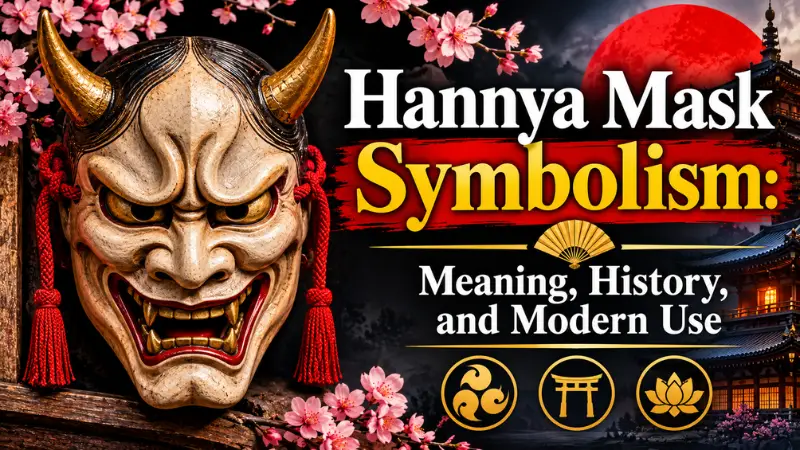
Hannya mask symbolism comes from traditional Japanese theater, where a distinctive horned female face represents jealousy, resentment, heartbreak, and the transformation of human emotions into something frightening. Recognized by its sharp horns, metallic-looking eyes, pointed teeth, and expressive mouth, the Hannya mask is one of the most recognizable images in Japanese visual culture.
Although the mask often looks demonic, its meaning is more complicated than evil or aggression. It represents a woman whose overwhelming jealousy, grief, or emotional suffering has transformed her into a supernatural being. Depending on its expression, lighting, and artistic presentation, the mask can communicate anger, sadness, bitterness, or lingering love.
In the United States, the image appears frequently in Japanese-inspired tattoos, streetwear, contemporary artwork, collectibles, and decorative designs. Understanding its original theatrical and cultural background helps explain why people choose it and why reducing it to a simple demon symbol misses an important part of its meaning.
Quick Answer
Hannya mask symbolism commonly represents jealousy, heartbreak, emotional suffering, and the darker side of human relationships in modern American tattoo and art culture. Historically, the mask comes from Japanese Noh theater, where it depicts a woman transformed into a supernatural, demon-like figure through overwhelming emotions.
TL;DR
- Jealousy: Represents destructive jealousy and resentment.
- Heartbreak: Reflects betrayal, rejection, and emotional suffering.
- Transformation: Shows human emotions becoming supernatural forces.
- Japanese theater: Originates in traditional Noh performances.
- Protection: Sometimes adopted as a personal symbol of strength.
- Modern American culture: Appears in tattoos, fashion, artwork, and collectibles.
What Does a Hannya Mask Look Like?
Hannya Noh Mask by Nomura Ran · Signed with Tomobako & Mask Bag – Japonista
The History and Meaning of the Japanese Hannya Mask – Wabisabi Mart
8
A traditional Hannya mask is a carved wooden theatrical mask depicting a woman who has become a demon or vengeful spirit. Its exaggerated features make it immediately recognizable:
- Two horns: Project from the forehead and represent the character’s transformation into a supernatural being.
- Metallic eyes: Often gold or brass-colored, giving the face an intense, unsettling appearance.
- Sharp teeth: Communicate aggression, rage, and the loss of ordinary human restraint.
- Open mouth: Creates an expression of fury, anguish, or a threatening cry.
- Disheveled hair: Suggests emotional disorder and the character’s separation from her former human identity.
The mask is not designed to communicate only one emotion. Its craftsmanship allows the expression to change according to the angle at which the performer holds their head. Facing forward, it can appear furious; when tilted downward, it may seem sorrowful or defeated.
This shifting expression is essential to understanding the mask. The character is not simply a monster. She is a human figure whose emotional suffering has become visible through a supernatural appearance. Hikone Castle Museum+2
The Main Symbolic Meanings of a Hannya Mask
The Hannya mask carries several connected meanings. Most originate in the traditional theatrical representation of women consumed by jealousy, rejection, and emotional distress.
1. Jealousy and Envy
Jealousy is the mask’s most established symbolic association. In Japanese Noh theater, it represents a woman whose resentment and possessiveness have become so overwhelming that she transforms into a demon-like spirit.
This interpretation is particularly relevant to stories involving romantic betrayal and unreturned affection. The mask illustrates how jealousy can change the way someone thinks, behaves, and sees other people.
In contemporary American art and tattoo culture, the image is sometimes chosen to represent the struggle against envy or the emotional consequences of unhealthy relationships.
2. Heartbreak and Betrayal
The mask also symbolizes the pain of romantic disappointment. Its origins in theatrical stories connect it with women who experience rejection, humiliation, or the loss of someone they love.
For modern audiences, this association makes the Hannya image relevant to experiences such as broken relationships, abandonment, and emotional betrayal.
A person choosing the mask for a tattoo might use it to acknowledge a painful chapter in life rather than celebrate anger itself.
3. Anger and Resentment
The horns, exposed teeth, and aggressive expression make anger one of the most recognizable meanings.
However, the anger represented by the Hannya mask is not necessarily ordinary frustration. It reflects resentment that has developed over time and become difficult to control.
In modern visual art, the image can represent confronting anger, recognizing destructive emotions, or remembering the consequences of allowing resentment to dominate personal decisions.
4. Transformation and Inner Conflict
Another important meaning is transformation. The mask represents the transition from a human woman into a supernatural being.
Symbolically, this can describe how intense emotional experiences change a person’s identity, outlook, or behavior.
In American tattoo culture, transformation is sometimes interpreted positively as surviving difficult experiences and becoming more aware of personal weaknesses. This is a modern personal interpretation, rather than the mask’s original theatrical message.
Ancient Japanese Origins and the History of the Hannya Mask
Experiencing Noh Theater — TOKI
Kịch Noh Nhật Bản: Huyền bí, u linh và tuyệt mỹ trong mỗi cử điệu
11
The Hannya mask originated in Japan’s Noh theater tradition, a classical performance art that developed into its recognizable form during the 14th century. Noh combines music, dance, poetry, stylized movement, and elaborate costumes to communicate stories involving historical figures, spirits, gods, and supernatural beings.
Masks play an important role because performers use them to portray characters whose identities and emotions are not communicated through ordinary facial acting.
The Hannya mask became associated with female characters transformed by jealousy, grief, and resentment. It is particularly connected with theatrical stories in which a woman appears initially human but eventually reveals a demonic or vengeful form.
One important example is Aoi no Ue, a Noh play based on material from The Tale of Genji. It features the spirit of Lady Rokujō, whose jealousy and emotional suffering become central to the supernatural conflict.
Other Noh plays, including Dōjōji and Kurozuka, also use Hannya or related supernatural female masks in dramatic transformations.
Historical masks from the Edo period demonstrate how established this artistic tradition became. The Hikone Castle Museum, for example, holds a 17th-century Hannya mask carved from Japanese cypress.
The mask’s history shows that its original purpose was theatrical storytelling, not simply decoration or the representation of evil. aisf.or.jp+3
Why Is It Called a Hannya Mask?
The word Hannya has an interesting linguistic and historical background.
In Japanese Buddhism, hannya is a term associated with wisdom, particularly the Sanskrit concept of prajñā, or insight into the nature of reality. This Buddhist meaning is different from the mask’s theatrical representation of a female demon.
The precise historical origin of the mask’s name is not completely settled. One widely discussed explanation connects it to Hannyabō, a mask carver believed to have worked during the late 15th or early 16th century.
Another explanation connects the name with Buddhist language and theatrical storytelling.
It is therefore important not to assume that the mask represents Buddhist wisdom simply because it shares the word hannya. Its established theatrical identity is that of a woman transformed by jealousy and emotional suffering.
The distinction between the religious term and the theatrical mask helps prevent a common misunderstanding about its origins. aisf.or.jp+2
What the Different Hannya Mask Colors Symbolize
Masque No | Masque théâtre japonais – Shogun Japon
Noh mask | Japanese theater Mask – KimuraKami
Nô mask, HANNYA negra, el demonio vengador
6
Color is another important part of Hannya mask interpretation. Traditional masks appear in different shades, and their colors can communicate distinctions in character, social status, and emotional intensity.
Three commonly discussed color variations include:
White Hannya: A pale or ivory-colored mask is traditionally associated with an aristocratic woman. Its refined appearance contrasts with the aggressive expression, emphasizing the character’s tragic transformation.
Red Hannya: A red mask is often associated with a more intense or forceful demonic appearance. In traditional classifications, red can also indicate a woman of lower social standing than the aristocratic figure represented by the white mask.
Black Hannya: Darker versions can communicate a more frightening or severe supernatural presence. Their interpretation depends on the specific mask tradition and theatrical role.
These distinctions are not universal rules for every Japanese mask or modern reproduction. Contemporary tattoo artists and designers frequently use colors for visual impact rather than following historical conventions.
For someone interpreting a traditional mask, its original theatrical context matters more than color alone.
What Hannya Mask Symbolism Means in the United States
In the United States, the Hannya mask is most visible in tattoo culture, Japanese-inspired artwork, alternative fashion, and decorative objects.
Many Americans encounter it without having watched a Noh performance or studied Japanese theater. Consequently, its meaning is often interpreted through broader ideas about personal struggle, anger, resilience, and the darker aspects of human experience.
In tattoo culture, it can represent surviving betrayal, recognizing destructive emotions, or remembering a difficult relationship. In visual art, it may communicate the contrast between an attractive human appearance and painful emotions beneath the surface.
The mask also appears in Japanese-inspired designs alongside dragons, koi fish, cherry blossoms, samurai imagery, and traditional waves.
However, its American interpretation should not be confused with its original meaning. The traditional mask portrays a specific kind of supernatural female character, while modern American designs often give it a broader personal meaning.
This difference explains why two people may choose the same image for very different reasons.
Hannya Mask Symbolism in Japanese Culture and Spiritual Traditions
The Hannya mask belongs to a cultural setting where theater, folklore, Buddhist ideas, and supernatural storytelling sometimes overlap.
In Japanese Noh performances, the mask represents a female spirit whose jealousy and resentment have transformed her appearance. This transformation reflects traditional stories about the consequences of uncontrolled emotions.
Japanese folklore also contains accounts of women becoming supernatural beings through jealousy, grief, or revenge. The onryō, for example, is a vengeful spirit associated with unresolved grievances and suffering. Although not every onryō is represented by a Hannya mask, the concepts are related.
Buddhist themes appear in some of the stories involving these characters. In Aoi no Ue, spiritual intervention eventually helps resolve the conflict involving Lady Rokujō’s vengeful spirit.
This connection introduces another dimension to the mask: emotional suffering can be destructive, but it does not have to define a person’s final state.
It is important, however, to distinguish traditional Japanese religious and theatrical ideas from modern spiritual interpretations. The Hannya mask is not a universal Buddhist emblem, nor does wearing one automatically provide spiritual protection.
Hannya Mask Symbolism in Tattoos
19
Tattoos are among the most recognizable ways Americans encounter the Hannya mask. Its dramatic appearance works well in traditional Japanese tattoo compositions, especially when combined with dragons, koi fish, flowers, and ornamental backgrounds.
People choose Hannya tattoos for several reasons.
Remembering heartbreak: The mask can represent a relationship that caused significant emotional pain.
Acknowledging anger: Some people use it as a reminder of the damage resentment can cause.
Personal transformation: Its human-to-demon imagery can represent a major change in someone’s life.
Facing personal struggles: The mask can serve as a reminder that difficult emotions should be understood rather than allowed to control behavior.
Cultural and artistic appreciation: Others choose it because they admire Japanese Noh theater, traditional mask carving, or Japanese tattoo art.
The surrounding design can change the interpretation. A Hannya mask surrounded by cherry blossoms may emphasize the relationship between suffering and the temporary nature of life. A design featuring a dragon may communicate conflict, strength, or supernatural intensity.
A tattoo does not have one fixed meaning. Its significance depends on the person wearing it, the artwork, and the cultural background they associate with it.
Does a Hannya Mask Symbolize Good Luck or Protection?
The Hannya mask is sometimes described in American tattoo and decorative culture as a symbol of protection against negative energy, harmful intentions, or bad influences.
This interpretation is understandable because frightening supernatural images are often used in different cultures as protective decorations. A threatening face can symbolically confront or discourage harmful forces.
However, the traditional Hannya mask is primarily a theatrical representation of jealousy, grief, and a woman’s transformation into a demon. It should not automatically be classified as a Japanese good-luck charm.
Some contemporary owners give it a protective meaning because it reminds them to recognize harmful behavior, maintain emotional boundaries, or confront personal fears.
That interpretation can be meaningful on an individual level, but it is different from the mask’s documented historical purpose.
Emotional and Psychological Meaning of the Hannya Mask
The Hannya mask offers an unusual visual representation of emotional conflict. Rather than presenting a character as entirely evil, it shows how suffering and destructive behavior can exist within the same person.
Its expression communicates several psychological ideas.
- Emotional overwhelm: Feelings become difficult to manage when jealousy and resentment dominate someone’s thinking.
- Inner conflict: A person can experience love and anger toward the same individual.
- Fear of losing control: The transformation suggests what can happen when emotional reactions become destructive.
- Unresolved grief: The mask can represent pain that remains after rejection, humiliation, or loss.
- Self-awareness: Its symbolism can encourage reflection on emotions that need attention rather than denial.
One reason the mask remains visually compelling is that its expression is not emotionally simple. Its frightening appearance does not completely conceal the sadness associated with the character.
For modern viewers, this contrast can represent the difference between how someone appears outwardly and what they may be experiencing internally.
How Hannya Mask Symbolism Changes With Its Context
The same image can communicate different ideas depending on where it appears. A traditional theatrical mask, a tattoo, and a decorative wall piece do not necessarily carry identical meanings.
| Context | Common symbolic meaning | Important distinction |
|---|---|---|
| Traditional Noh theater | Jealousy, sorrow, and transformation | Represents a specific female supernatural character |
| American tattoos | Heartbreak, resilience, and personal struggles | Often reflects the owner’s individual experiences |
| Japanese-inspired artwork | Emotional conflict and supernatural drama | May draw on traditional theatrical imagery |
| Home decoration | Intensity, artistic appreciation, and cultural interest | Not automatically a protective religious object |
| Fashion and accessories | Rebellion, dramatic identity, and alternative style | Often emphasizes visual appeal |
| Social media | Anger, mystery, and personal identity | Meaning depends on the accompanying message |
This comparison helps explain why the mask can be interpreted differently without changing its historical background.
Hannya Mask Symbolism in Modern Fashion, Art, and Pop Culture
This item is unavailable – Etsy
13
The Hannya mask has moved beyond traditional theater and now appears in several forms of contemporary visual culture.
Fashion: Clothing designers use Hannya imagery on graphic T-shirts, jackets, hoodies, and accessories. The mask’s recognizable horns and facial expression make it suitable for bold designs.
Jewelry: Pendants, rings, and bracelets sometimes feature miniature Hannya faces. These pieces may appeal to people interested in Japanese aesthetics or symbolic jewelry.
Home decoration: Wooden reproductions, wall masks, and framed illustrations are used as decorative objects. Some owners appreciate the craftsmanship, while others are drawn to the mask’s dramatic appearance.
Digital illustrations: Artists use the mask in character designs, gaming-inspired artwork, posters, and online graphics.
Pop culture: Japanese-inspired horror, fantasy, animation, and video game aesthetics have helped introduce Hannya imagery to audiences unfamiliar with Noh theater.
Modern popularity has made the mask more accessible, but it has also encouraged simplified interpretations. A design marketed as an evil Japanese demon, for example, may overlook the original character’s emotional suffering and theatrical significance.
Positive and Negative Symbolism of the Hannya Mask
The Hannya mask is generally associated with difficult emotions, but its modern interpretation is not necessarily negative.
Its traditional meaning emphasizes the destructive consequences of jealousy, obsession, and resentment. Nevertheless, contemporary audiences sometimes use the image to communicate personal strength or the decision to confront painful experiences.
Positive interpretations
- Surviving emotional hardship.
- Recognizing destructive relationship patterns.
- Learning from betrayal or disappointment.
- Facing uncomfortable personal emotions.
- Developing greater emotional awareness.
Negative interpretations
- Uncontrolled jealousy.
- Bitterness and revenge.
- Emotional obsession.
- Destructive anger.
- Loss of personal restraint.
These interpretations can coexist. The mask’s meaning is not simply positive or negative because its original character combines human vulnerability with supernatural aggression.
For example, someone might choose a Hannya tattoo to remember a painful relationship and the personal lessons that followed. Another person might use the same image to express anger and rebellion.
The artwork remains recognizable, but the individual’s intention changes its personal significance.
Common Misunderstandings About Hannya Mask Symbolism
Several misconceptions arise because the mask is frequently presented outside its original theatrical setting.
Misunderstanding 1: The Hannya mask represents an ordinary Japanese demon.
It specifically represents a woman transformed into a supernatural, demon-like figure through overwhelming emotions. It is not simply a generic monster mask.
Misunderstanding 2: It always symbolizes evil.
Although its appearance is frightening, the character also expresses sorrow, heartbreak, and emotional vulnerability.
Misunderstanding 3: The mask is originally a protection charm.
Its established historical function is theatrical. Protective meanings are more commonly modern personal interpretations or associations drawn from broader decorative traditions.
Misunderstanding 4: Hannya means demon in Japanese.
The word has a separate Buddhist association with wisdom. The mask’s name has a more complicated history, including a proposed connection to a historical mask carver.
Misunderstanding 5: Every Hannya tattoo has the same meaning.
Tattoo interpretations depend on the wearer. One person may associate the image with betrayal, while another may appreciate its theatrical origins or artistic design.
Understanding these differences makes it easier to appreciate the image without confusing contemporary interpretations with traditional Japanese culture.
How Hannya Mask Symbolism Has Evolved Over Time
The meaning of the Hannya mask has expanded as it has moved between theatrical performance, traditional art, international collections, tattoos, and contemporary entertainment.
In its original Noh setting, the mask helped actors portray women transformed by jealousy and emotional suffering. Its purpose was to communicate a dramatic character through a carefully carved expression.
During later centuries, Hannya masks became established examples of Japanese theatrical craftsmanship. Historical examples were preserved, collected, and appreciated as works of art.
As Japanese visual culture reached wider international audiences, the mask became recognizable beyond theater. Western tattoo culture and contemporary design introduced additional associations with personal struggles, rebellion, heartbreak, and resilience.
Today, the image has two important layers of meaning:
- Traditional meaning: A female character transformed by jealousy, resentment, and grief.
- Modern interpretation: A personal symbol of emotional struggle, survival, strength, or appreciation for Japanese art.
These meanings are connected, but they are not interchangeable. Recognizing the difference allows modern audiences to use and appreciate the image with greater cultural understanding.
FAQs
1. What does a Hannya mask symbolize spiritually?
A Hannya mask is traditionally associated with jealousy, resentment, grief, and the transformation of human emotions into a supernatural form. Some modern spiritual interpretations connect it with confronting negative emotions and protecting personal boundaries, although protection is not its original theatrical purpose.
2. Is a Hannya mask a good or bad symbol?
It can represent both positive and negative ideas. Traditionally, it illustrates destructive jealousy and emotional suffering, while modern interpretations may associate it with resilience, self-awareness, and overcoming difficult experiences.
3. What does a Hannya mask tattoo mean?
A Hannya mask tattoo commonly represents heartbreak, betrayal, anger, emotional struggles, or personal transformation. Its meaning depends on the wearer and the accompanying artwork, such as Japanese flowers, dragons, or waves.
4. Why does the Hannya mask have horns?
The horns represent the woman’s transformation from a human character into a supernatural demon-like figure. Along with its sharp teeth and metallic eyes, they communicate the intensity of her jealousy, anger, and resentment.
5. Is the Hannya mask connected to Buddhism?
The mask appears in Japanese theatrical stories that sometimes incorporate Buddhist themes, but it is not itself a universal Buddhist religious symbol. The Japanese word hannya also refers to Buddhist wisdom, a meaning distinct from the theatrical mask.
6. What is the difference between a red and white Hannya mask?
Traditional white Hannya masks are associated with aristocratic women, while red versions are commonly associated with women of lower social standing and a more forceful appearance. These distinctions belong to traditional mask conventions and should not be treated as universal rules for modern reproductions.
7. Is it disrespectful to wear a Hannya mask tattoo?
Not automatically. People outside Japan can appreciate and wear Japanese-inspired artwork, but understanding its theatrical origins and avoiding inaccurate claims about its religious meaning demonstrates cultural respect.
Conclusion
Hannya mask symbolism represents the complicated relationship between jealousy, heartbreak, anger, and human transformation. Its origins in Japanese Noh theater reveal a character who is frightening not simply because she becomes a demon, but because her supernatural appearance expresses the emotional suffering that led to her transformation.
In modern American culture, the mask has gained additional associations with resilience, personal struggles, tattoos, and artistic identity. These interpretations give people different ways to connect with the image while its traditional meaning remains rooted in Japanese theater.
Ultimately, the Hannya mask is more than a frightening face. It is a reminder that intense emotions can change how people see themselves and others, making emotional understanding an important part of human experience.