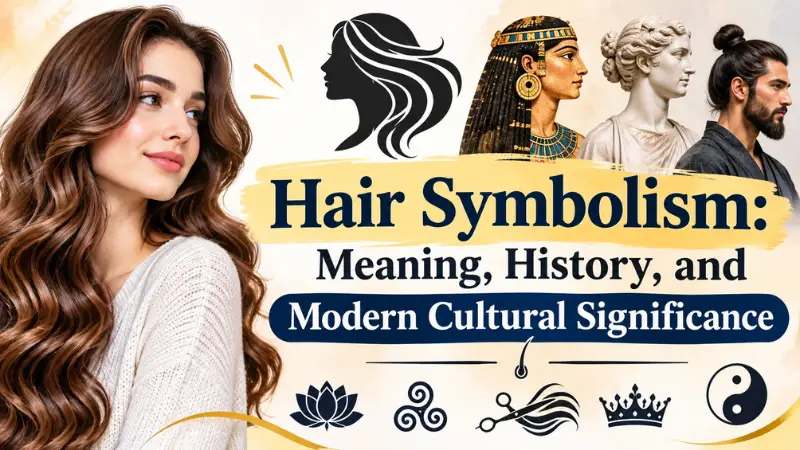
Hair is more than a physical feature. Across cultures and generations, it has represented personal identity, beauty, strength, freedom, spirituality, and social belonging. Hair symbolism helps explain why the way people grow, cut, cover, style, or preserve their hair can carry meanings that extend far beyond appearance.
In everyday American life, hair is closely connected to self-expression. A person might grow their hair long to represent freedom, shave their head after a major life change, wear natural curls as an expression of cultural pride, or preserve a loved one’s hair as a personal keepsake. These choices can communicate emotions and values without requiring words.
Hair also has a complicated history. Religious traditions, ancient stories, beauty standards, racial discrimination, and changing fashion trends have all influenced how people interpret it. Understanding these connections provides a clearer picture of why hair remains such a meaningful part of human identity.
Quick Answer: What Does Hair Symbolize?
Hair commonly symbolizes personal identity, beauty, confidence, freedom, and self-expression in modern American culture. Historically, it has also represented spiritual devotion, social status, strength, cultural belonging, mourning, and the transition between different stages of life.
TL;DR
- Identity: Hair communicates personality, cultural background, and individual style.
- Strength: Long or uncut hair can represent vitality and spiritual commitment.
- Freedom: Changing hairstyles often expresses independence and personal choice.
- Spirituality: Religious traditions connect hair with faith, modesty, and devotion.
- Love and memory: Preserved hair can represent affection and remembrance.
- Social history: Hair has been connected to racial identity, beauty standards, and discrimination.
1. What Makes Hair a Symbol?
Hair is one of the most visible and changeable features of the human body. Unlike many physical characteristics, people can grow it, cut it, color it, cover it, straighten it, braid it, or shave it according to personal preferences and cultural expectations.
This ability to change its appearance makes hair especially meaningful.
A person with long, flowing hair may be perceived as expressing femininity, freedom, or traditional beauty. Someone with a completely shaved head might communicate simplicity, rebellion, discipline, or a desire for a fresh beginning.
Hair also has an unusual connection to memory. A photograph can preserve someone’s appearance, but an actual lock of hair can preserve a physical part of that person long after it has been cut.
Its symbolic meaning therefore comes from three connected qualities:
- Visibility: Hair communicates information about appearance and identity.
- Changeability: Different hairstyles can represent personal decisions and life transitions.
- Personal connection: Hair remains physically associated with an individual even after it is removed.
These qualities help explain why hair appears in religious practices, family traditions, personal rituals, literature, and modern fashion.
2. The Most Common Symbolic Meanings of Hair
Hair does not have one universal meaning. Its interpretation depends on its appearance, the person’s intentions, and the cultural setting.
However, several associations appear repeatedly across different societies.
Identity and individuality
Hair is an important way people communicate who they are. A particular cut, color, texture, or style can reflect personality, cultural background, and personal preferences.
Beauty and attractiveness
Many societies have developed beauty standards involving hair length, thickness, texture, and appearance. In the United States, hairstyles frequently influence how people present themselves in social and professional environments.
Strength and vitality
Thick or healthy-looking hair is often associated with physical vitality. Long hair can also represent endurance, natural growth, and personal strength.
Freedom and independence
Changing one’s hairstyle can represent a decision to move away from expectations imposed by family, society, or previous generations.
Spirituality and devotion
In certain religious traditions, keeping hair uncut, covering it, or removing it has a specific spiritual purpose.
Memory and affection
A lock of hair exchanged between loved ones can become a reminder of a relationship, a family connection, or someone who has died.
These meanings overlap, but they are not interchangeable. A shaved head, for example, may represent religious discipline in one setting and personal rebellion in another.
3. Ancient Origins of Hair Symbolism
Hair has carried social and spiritual meaning since ancient times. Early societies often treated hairstyles as visible signs of age, rank, gender, community membership, and religious identity.
In ancient Egypt, hairstyles and wigs were important parts of personal presentation. Both men and women used carefully arranged hair and elaborate wigs, while shaving or removing natural hair could also serve practical and cultural purposes. Hairpieces, braids, and decorative accessories communicated social position and attention to appearance.
In ancient Greece, hair was associated with youth, beauty, and social presentation. Long hair could be admired as a sign of beauty, while hair offerings sometimes appeared in religious and ceremonial settings.
Ancient Roman society also attached meaning to hairstyles. Women’s hairstyles changed with fashion and social expectations, while men’s facial hair could communicate age, status, and cultural preference.
Hair also appears in ancient religious stories. One of the best-known examples is Samson in the Hebrew Bible. His extraordinary strength is connected to his uncut hair as part of his Nazirite dedication. When his hair is cut, he loses his strength.
This story helped establish an enduring association between hair, physical strength, sacred commitment, and personal vulnerability.
Ancient examples show that hair was never simply a decorative feature. It could communicate a person’s relationship with society, religion, and personal identity.
4. Hair Symbolism in American Culture
In the United States, hair has become an important form of individual expression. Americans frequently use hairstyles to communicate personality, cultural identity, political attitudes, and changing social values.
The meaning of hair has also changed with different generations.
During much of the nineteenth and early twentieth centuries, long hair was widely promoted as an ideal of feminine beauty. Advertisements for hair tonics, dyes, and grooming products encouraged people to associate attractive hair with health, youth, and social respectability.
During the 1920s, shorter hairstyles, particularly the bob, became associated with changing expectations for American women. The style was connected to modern fashion and the growing visibility of women’s independence.
The 1960s and 1970s brought another major transformation. Long hair, natural hairstyles, and unconventional cuts became associated with youth culture, countercultural movements, and challenges to traditional expectations.
Black Americans also used natural hairstyles as expressions of cultural pride and resistance to Eurocentric beauty standards. Afros, braids, twists, and other styles became important forms of identity and self-expression.
Today, American hair culture is highly diverse. People use hairstyles to celebrate heritage, experiment with appearance, express creativity, and challenge outdated ideas about professional or acceptable grooming.
Hair can communicate individuality, but it can also reveal how society treats people differently based on appearance.
5. The Symbolism of Hair in Black American Identity
Hair has a particularly significant place in African American history and culture.
Before and during the transatlantic slave trade, hairstyles in various West and Central African societies communicated information about community, age, marital status, social position, and cultural identity.
Enslavement disrupted these traditions. Enslaved Africans were sometimes forcibly shaved, separating them from familiar hairstyles and forms of personal expression. Hair texture and appearance were also used to create racial hierarchies and discriminatory classifications.
These practices contributed to a long history in which Black hair was judged according to European standards of beauty.
The natural hair movement challenged those expectations. During the 1960s and 1970s, the Afro became an especially recognizable expression of Black pride, cultural confidence, and political resistance.
Other styles carry important cultural histories:
- Cornrows: Traditional protective hairstyles with roots in African cultures.
- Bantu knots: A distinctive hairstyle with African cultural connections.
- Locs: Often associated with cultural identity, spirituality, and personal commitment.
- Afros: Frequently connected to Black pride and the natural hair movement.
- Twists and braids: Styles that combine practical hair protection with artistic expression.
In contemporary America, the CROWN Act movement has brought further attention to discrimination based on natural hair texture and protective hairstyles.
Hair is therefore more than a personal fashion choice for many Black Americans. It can represent heritage, dignity, cultural continuity, and the right to express identity without discrimination.
6. Religious and Spiritual Meanings of Hair
Different religions approach hair in different ways. Some traditions encourage keeping it uncut, others emphasize covering it, and some use shaving as part of spiritual practice.
The meaning depends on the beliefs and customs of each community.
Sikhism: Uncut hair and spiritual commitment
In Sikhism, uncut hair, known as kesh, is one of the Five Ks associated with the Khalsa tradition.
For observant Sikhs, maintaining uncut hair represents acceptance of God’s creation, spiritual discipline, and religious identity. Many Sikhs cover their hair with a turban or another appropriate covering as an expression of respect and commitment.
Christianity: Hair, modesty, and devotion
Christian interpretations of hair vary across denominations and historical periods.
The Bible includes references to hair as a sign of beauty, devotion, and modesty. The story of Samson connects uncut hair with a special religious commitment.
Some Christian communities also practice hair covering for women during worship, while certain religious orders associate covered or closely managed hair with humility and dedication.
Judaism: Hair and religious observance
In some Jewish communities, hair practices communicate religious identity and observance.
For example, some Orthodox Jewish married women cover their hair in public through scarves, hats, or wigs. Some Jewish men maintain peyot, or sidelocks, in accordance with particular interpretations of religious teachings.
These practices differ among Jewish communities.
Islam: Hair and modesty
In Islam, hair covering is an important practice for many Muslim women, although interpretations and levels of observance vary.
The hijab is commonly understood as an expression of modesty and religious commitment. For many Muslim women, covering their hair is a personal decision connected to faith, identity, and devotion.
Hinduism and Buddhism: Hair removal as a spiritual act
In some Hindu traditions, shaving the head is performed during religious ceremonies or important life events.
In Buddhism, shaving the head is associated with monastic life and symbolizes renunciation of vanity and attachment to worldly appearance.
These examples demonstrate that hair can symbolize devotion through both keeping it and removing it.
7. What Long Hair Symbolizes
Long hair commonly represents freedom, beauty, patience, vitality, and individuality.
Because growing long hair takes time, some people associate it with personal dedication and the ability to maintain a long-term commitment.
In American culture, long hair has also been associated with independence and nonconformity. During the countercultural movements of the 1960s, longer hairstyles became visible expressions of resistance to conventional social expectations.
Long hair can also carry different gender-related meanings.
For women, it has traditionally been associated with femininity and beauty, although contemporary attitudes are much more flexible.
For men, long hair may communicate creativity, individuality, cultural identity, or rejection of conventional masculine grooming standards.
In certain spiritual traditions, long hair represents religious observance rather than fashion.
Ultimately, long hair does not have a fixed meaning. Its symbolism comes from the personal and cultural reasons behind wearing it.
8. What Short Hair and Shaved Heads Symbolize
Short hair and shaved heads often represent transformation, simplicity, discipline, courage, or independence.
Cutting hair can feel like an important personal decision because appearance is closely connected to identity.
A person might cut their hair after ending a relationship, changing careers, moving to a new place, or deciding to leave an earlier version of themselves behind.
A shaved head can communicate several different ideas:
- New beginnings: Letting go of an old appearance or personal chapter.
- Simplicity: Reducing attention to grooming and conventional beauty expectations.
- Strength: Showing confidence and willingness to challenge social standards.
- Spiritual discipline: Renouncing vanity or expressing religious commitment.
- Solidarity: Supporting people experiencing medical hair loss.
For people undergoing chemotherapy, shaving the head can also be a way to regain a sense of control over a difficult experience.
However, not everyone chooses hair removal voluntarily. Medical conditions and treatment can cause hair loss, making it important not to assume that a shaved head always represents a particular personal decision.
9. Hair in Love, Weddings, and Mourning Traditions
Hair has a long association with emotional relationships.
Before modern photography became widely available, locks of hair were sometimes exchanged as personal keepsakes between romantic partners, relatives, and close friends.
During the nineteenth century, particularly in Victorian America, hair jewelry and decorative hairwork became popular expressions of affection and remembrance.
People incorporated human hair into bracelets, brooches, rings, and other objects. These items could preserve a physical connection with someone who lived far away or had died.
Hair also appears in wedding and relationship traditions.
A bride may choose a hairstyle that reflects family customs, cultural heritage, or personal ideas about beauty. In some communities, elaborate braids, covered hair, or ceremonial hair arrangements form part of wedding celebrations.
Mourning traditions give hair another meaning. A preserved lock may serve as a reminder of a deceased relative, child, or partner.
Because hair can remain recognizable long after it has been separated from the body, it has historically offered a particularly intimate connection to memory.
10. Hair and Emotional Psychology
Hair is closely connected to self-image because it influences how people see themselves and how they believe others perceive them.
A hairstyle can become part of someone’s personal identity over many years. Changing it may create excitement, uncertainty, confidence, or even grief.
Consider a few common experiences:
Cutting hair after a difficult period: Some people describe a haircut as a way of marking emotional change. The physical transformation gives a visible form to an internal decision.
Growing hair after a major life transition: Allowing hair to grow can become a personal reminder of patience, recovery, or renewed commitment.
Losing hair unexpectedly: Hair loss may affect confidence and body image because it changes a familiar part of someone’s appearance.
Embracing natural texture: Choosing to stop chemically straightening or otherwise altering hair can represent acceptance of one’s natural appearance.
These experiences are personal rather than universal. A haircut does not automatically resolve emotional difficulties, and hair loss does not affect everyone in the same way.
The important point is that hair can become a visible marker of experiences that are otherwise difficult to communicate.
11. Hair Symbolism in Dreams
Dream interpretations involving hair often focus on identity, confidence, control, aging, and personal change.
However, there is no scientifically established universal dictionary that determines what every hair-related dream means.
Common interpretations include:
| Dream Scenario | Common Symbolic Interpretation | Possible Personal Connection |
|---|---|---|
| Long, healthy hair | Confidence and vitality | Feeling comfortable with yourself |
| Cutting your hair | Change and independence | Moving beyond an old identity |
| Losing hair | Vulnerability or insecurity | Worry about aging or losing control |
| Gray hair | Wisdom and maturity | Accepting responsibility or experience |
| Tangled hair | Confusion or frustration | Feeling overwhelmed by a situation |
| Shaving your head | Renewal or simplicity | Wanting a fresh beginning |
The dreamer’s personal circumstances matter more than a fixed interpretation.
For example, someone who recently cut their hair may dream about it simply because the experience remains on their mind. Another person may associate hair loss with a real-life health concern.
Dream symbolism is best treated as a way to explore personal feelings rather than a prediction of future events.
12. Hair in Tattoos, Jewelry, and Modern Design
Hair-related imagery appears in modern art, fashion, tattoos, and decorative objects.
Its meaning depends on the design and the reason someone chooses it.
Hair tattoos
A flowing strand of hair or a portrait featuring distinctive hair can represent personal identity, beauty, family heritage, or remembrance.
Some people choose symbolic hairstyles in tattoo designs to honor a loved one or celebrate a particular stage of life.
Hair jewelry
Hair jewelry connects contemporary interest in personalized accessories with older traditions of preserving sentimental objects.
A locket or pendant containing a loved one’s hair can serve as a private reminder of affection and family connection.
Fashion and personal style
Braids, curls, locs, natural textures, short cuts, and brightly colored hairstyles can communicate creativity and individuality.
Fashion also demonstrates how quickly hair symbolism can change. A style once considered unconventional may become widely accepted or fashionable within a few years.
Home decor and art
Hair-inspired artwork sometimes explores themes of identity, memory, beauty standards, and the relationship between the human body and personal expression.
These modern uses demonstrate that hair remains an accessible visual language for communicating individual experiences.
13. When Hair Symbolism Becomes Misunderstood or Misused
Hair symbolism can create misunderstandings when people assume that every hairstyle communicates the same message.
One common mistake is treating long hair as automatically feminine or short hair as automatically masculine. These associations come from particular cultural expectations rather than universal rules.
Another misunderstanding involves religious hairstyles. For example, a Sikh person’s uncut hair is not simply a fashion preference. It can represent an important commitment to faith and religious identity.
Cultural appropriation is another concern. Hairstyles such as cornrows, locs, and Bantu knots have specific cultural histories. Wearing them without understanding those histories can sometimes overlook the communities that developed and maintained these traditions.
Hair discrimination is also a serious issue. Natural Black hairstyles have historically been described through unfair stereotypes, particularly in schools and workplaces.
The CROWN Act movement emerged in response to these inequalities, advocating protection against discrimination based on hair texture and protective hairstyles.
It is equally important not to romanticize hair loss. A person experiencing baldness because of illness or another medical condition should not be expected to view that experience as a symbol of courage or transformation.
Respectful interpretation begins with understanding that the person wearing the hairstyle has the strongest authority over what it means to them.
14. How Hair Symbolism Has Changed Over Time
The meaning of hair has evolved alongside changes in religion, fashion, politics, and social expectations.
In ancient societies, hairstyles frequently communicated community membership, social position, religious dedication, and age.
During the medieval and early modern periods, religious expectations and gender conventions influenced how hair was worn and covered.
In nineteenth-century America, hair became increasingly associated with beauty standards, social respectability, sentimental relationships, and public identity. Preserved hair was also used in jewelry and mourning objects.
The twentieth century introduced more visible experimentation. Shorter women’s hairstyles, countercultural long hair, natural Black hairstyles, and changing attitudes toward gender expression challenged earlier expectations.
Today, hair is widely understood as a personal choice, although cultural and social pressures remain.
| Historical or Modern Context | Meaning of Hair | Common Associations |
|---|---|---|
| Ancient societies | Social identity and status | Community, age, rank |
| Religious traditions | Faith and devotion | Commitment, modesty, discipline |
| Victorian America | Affection and remembrance | Mourning, family, romance |
| 1960s–1970s America | Independence and resistance | Counterculture, personal freedom |
| Modern Black culture | Heritage and self-expression | Pride, identity, cultural continuity |
| Contemporary fashion | Individual creativity | Confidence, experimentation, style |
The most significant change is the growing recognition that people should have greater freedom to decide how their hair represents them.
15. Positive and Negative Meanings Associated With Hair
Hair can carry positive, negative, or mixed associations depending on the context.
Positive meanings include:
- Confidence: Feeling comfortable with one’s appearance.
- Freedom: Expressing individuality without following conventional expectations.
- Strength: Representing resilience and personal determination.
- Cultural pride: Celebrating family heritage and community identity.
- Love: Preserving a physical reminder of someone important.
- Spiritual devotion: Maintaining religious practices connected to hair.
Negative associations can include:
- Insecurity: Feeling uncomfortable because of appearance-related expectations.
- Social judgment: Experiencing criticism based on hairstyle or texture.
- Conformity: Changing natural hair to satisfy restrictive beauty standards.
- Loss: Experiencing emotional distress after unexpected hair loss.
- Control: Having personal grooming choices restricted by institutions or authorities.
Neither long nor short hair is inherently positive or negative.
The meaning comes from the circumstances surrounding it, including personal choice, cultural tradition, and the way others respond to it.
FAQs
1. What does hair symbolize spiritually?
Hair can symbolize spiritual devotion, purity, humility, religious identity, and commitment. In some traditions, keeping hair uncut represents acceptance of divine creation, while shaving it can represent renunciation of vanity or attachment to worldly life.
2. What does long hair symbolize?
Long hair commonly represents beauty, freedom, vitality, patience, and individuality. In certain religious and cultural communities, it also communicates heritage and spiritual commitment.
3. What does cutting your hair symbolize?
Cutting hair can represent a fresh beginning, personal independence, emotional change, or the desire to leave an earlier stage of life behind. However, a haircut can also be an ordinary grooming decision without a deeper symbolic meaning.
4. What does black hair symbolize in American culture?
Black hair can represent cultural heritage, identity, creativity, and resistance to discriminatory beauty standards. Natural hairstyles such as Afros, braids, twists, and locs have particular historical and cultural importance in African American communities.
5. What does gray hair symbolize?
Gray hair is commonly associated with aging, wisdom, maturity, and life experience. Modern American attitudes have also increasingly embraced natural gray hair as an expression of confidence and personal style.
6. What does hair symbolize in the Bible?
Biblical references to hair connect it with beauty, modesty, religious dedication, and personal strength. The story of Samson is a well-known example in which uncut hair represents his special dedication to God and is connected to his extraordinary strength.
7. Is hair symbolism positive or negative?
Hair symbolism can be positive or negative depending on the situation. It may represent confidence, freedom, and cultural pride, but it can also become associated with discrimination, insecurity, or social pressure.
Conclusion
Hair represents much more than physical appearance. It can communicate identity, beauty, freedom, strength, spirituality, cultural heritage, and emotional connection. Its meaning changes according to personal choices, religious traditions, historical experiences, and social expectations.
Understanding hair symbolism also means recognizing that the same hairstyle can communicate different things to different people. Long hair might represent religious commitment, while a shaved head might mark a personal transformation. Natural curls may express cultural pride, while a preserved lock of hair may keep the memory of a loved one close.
Ultimately, hair is both a personal feature and a cultural form of expression. Its most meaningful symbolism comes not from appearance alone, but from the experiences, beliefs, and choices of the person who wears it.